Research Fellow in AI & Information @risj_oxford | Research Associate & PhD @oiioxford | Societal impacts of AI, news, (mis)info, democracy | My views etc…
How harmful is GenAI around elections? Will it trigger a misinformation apocalypse and upend elections?
I am happy to finally be able to share @Sacha_Altay’s & my answers to these and other questions on which we have been working for a year and which is out via @knightcolumbia.
@danwilliamsphil Yup. Argued some time ago (using his trailer style visual communication as examples) that he aligns himself with those that elites (but he, too) treat with condescension https://t.co/MIlggZ4PeI
Great questions. My two cents:
1) Just bc you can, doesn’t mean everyone will (due to e.g. jaggedness, distrust, digital divides, org/legal constraints or preference)
2) At least for academia it’s currently mostly “faster horses”. Output up, quality so so, free time equal
we can increasingly get arbitrarily large amounts of work done in arbitrarily short periods of time. what happens to competitive dynamics, when everyone can go arbitrarily fast now? what does that do to one’s sanity? and what is worth spending all this gained time on?
You know what other tools know better than most instructors? Coursera and YouTube courses from top faculty, *the internet*, books from the library. How many students used those tools instead of formal ed? Very very few. How many will use Claude independently to learn the material? Probably the same amount.
I know it doesn’t sound glamorous, but the primary role of faculty is to get students in the seats and create incentives to actually absorb the information. This is your job. AI can help as a tool, I’ve seen some great harnesses of AI for education, but it will not do this.
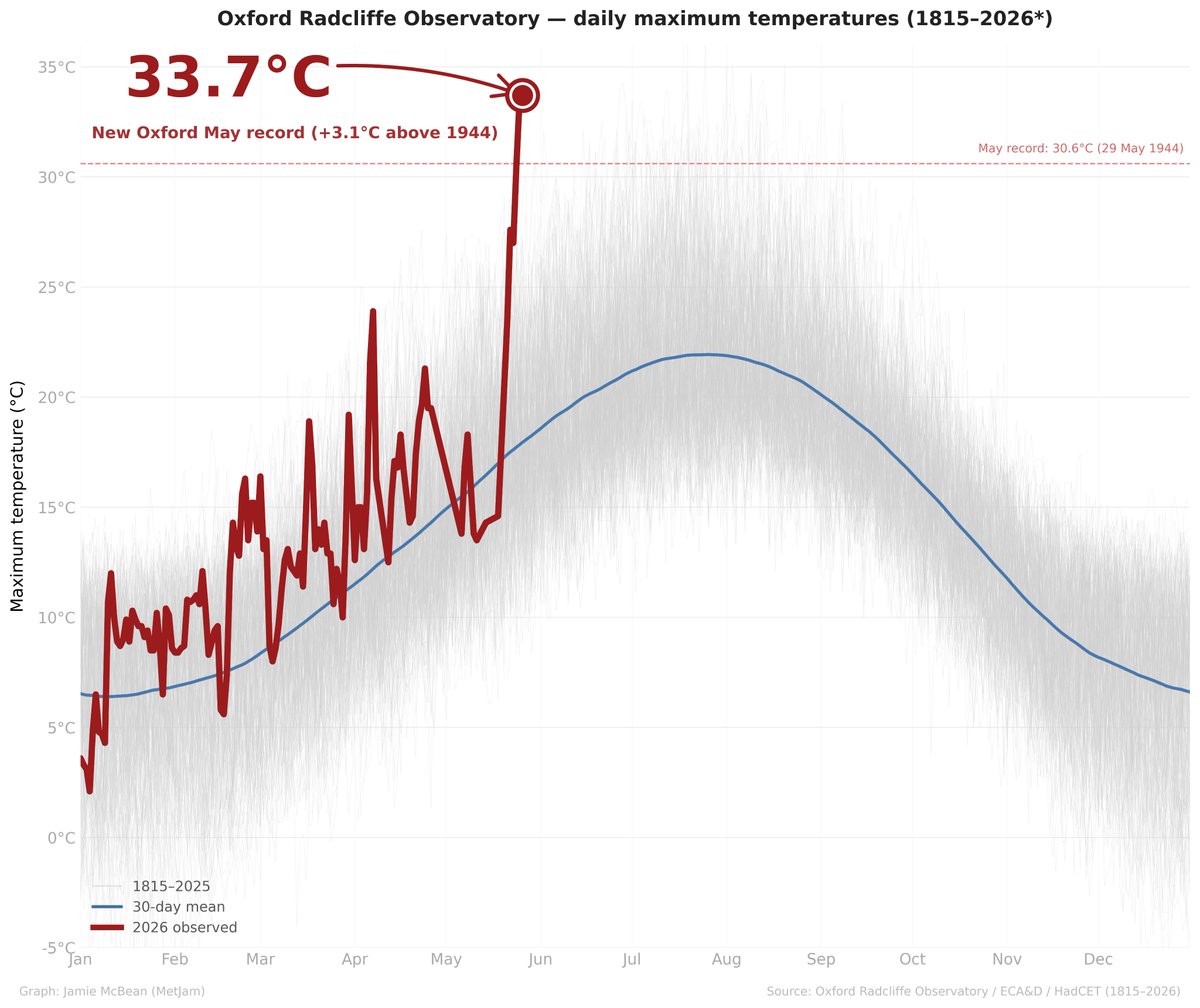
Oxford, the longest running continuous weather station in UK history, with temperature observations stretching back to 1815, has preliminarily broken its maximum temperature record for May yesterday by OVER 3ºC with a temperature of 33.7ºC. Unprecedented in its 211-year history.
Seeing a flurry of evals and startups promising to test the mental health effects of AI. Literally all of them test what the model says in various conditions... none of them measure actual outcomes on actual people. A big gap, fixable with privacy-preserving experiments.
Source: Kommers, C., Duede, E., Gordon, J., Holtzman, A., McNulty, T., Stewart, S., Thomas, L., So, R. J., & Long, H. (2025). Why Slop Matters (arXiv:2601.06060). arXiv. https://t.co/lGwx65gcJo
Not entirely sure I agree with everything argued in this short commentary pre-print on AI slop, but I do think the authors get one thing right: It’s too easy to dismiss AI slop.
Today in something that might not be entirely surprising but is still worth stating clearly: When we ask people to think about the what AI will do to news and their experience of it, their answers do not emerge from a vaccuum of perfectly rational and neutral observation.
On the upside, those trusting the news already also seem to be more positive about what it can do for the news and their own experience of it. The challenge is then on news media to honour that expectation.