Top 5 Holdings now in April 2026:
1) $ACFN
2) $OGD.TO
3) $CCA.AX
4) $MMY.TO
5) $TOT.TO
Haven't sold any $PVE.AX & $VIRI.PA but I did sell out of $VAL in the 90s after the acquisition announcement.
My top 5 Holdings in Jan 2026:
1) $ACFN
2) $MMY.V
3) $OGD.TO
4) $PVE.AX
5) $VIRI.PA (Viridien)
& honorable mention at #6 is $VAL
altogether these 6 make up ~58% of my portfolio
The calls from techbros and $NVDA stockbros to reinstate Jensen Huang illustrate a central theme of our time: the tension between national security and the private sector of an open society, when our principal adversary, CCP-ruled China, is not an open society and nationalizes whomever and whatever it wants within its borders (and sometimes outside too). A few decades ago, the U.S. government controlled dual-use technology superior to anything in the private sector. When commercial markets scaled, R&D spending skewed massively toward companies, and the government lost that dual-use edge.
It’s disingenuous to argue for Jensen’s return while casting his apparent ouster as punishment for banging subordinates. Office romances are the least of the problems here. Yes, America’s bloated legal industry has built a suboptimal liability structure around consensual office relationships, but a board can treat the occasional settlement as a cost of doing business.
If Jensen intervened to ensure the supply of controlled GPUs to Megaspeed, that is far more serious. Yet, it still isn’t the worst issue.
Jensen’s true sin is that he advocated weakening export controls while sleeping with the adversary. Everybody talks their book (short sellers included). That kind of conflict is out in the open: you make more money if your view prevails. It is a far graver matter when a man with Jensen’s influence, over both whether controlled technology reached China and what the rules should be, has an undisclosed relationship that exposes him to romantic manipulation or blackmail. History is full of wreckage left by powerful men thinking with the other head.
Some argue that removing export controls on China makes us safer by keeping China dependent on us. That notion has been resoundingly disproven by decades of China stealing IP, forcing tech transfers, and then burying Western incumbents. When a smart, well-informed person argues for loose or no controls, it is almost always deliberate naiveté. If we value U.S. national security above shareholders' interest in seeing NVDA stock rebound, then Jensen must be held accountable by not regaining control of NVDA.
@dejgarate@Monolith_Cap demand for compute is dependent on the price of compute. If Jensen was having no issues selling his GPUs at current prices, he would not have had to finance his customers' purchases.
"Jensen was laying the groundwork to pull back on backstopping. Companies would need to secure upfront payments from customers, that would make their projects easier to finance and ensure that $NVDA wasn’t alone in being a source of support." -WSJ
https://t.co/9vv8FBNFo1
High demand for semiconductor production consumables can coexist with lower chip prices and margins. Look at FUSO’s ($4368.T) numbers in 2013-2018, when wafer output was particularly strong, while memory prices round-tripped. Chipmakers now have a lot more cash to burn.
Interim CEO Colette Kress is expected to rein in deals after a stretch in which Nvidia aggressively financed computing deals and startup investments. https://t.co/7jCjC3hN3q
The press is now, finally, doing its job decently well. Sad that it took a lurid affair to snap everyone out of it.
How Jensen Huang built the backdoor route that keeps Beijing in the AI race. https://t.co/FQlOcte4Wd via @WSJ
💻머스크 "엔비디아 공급망 계약 상당수는 젠슨 황과의 악수였다… 그가 없으면 일부 핵심 계약 잃을 것"
📌일론 머스크
젠슨 황이 엔비디아 공급망을 탁월하게 이끌었지만, 그 계약 상당수는 서면 계약이 아니라 젠슨 개인과의 악수였다고 지적
젠슨이 없으면 핵심 계약 중 적어도 일부는 잃게 될 것이라고 전망
📌딜런 파텔(세미애널리시스)
젠슨 황은 수요를 내다보고 소규모 공급업체 경영진까지 직접 찾아가 엔비디아가 물량을 확보하도록 설득했다고 설명
황이 떠나자 구글이 이미 해당 업체들에 생산능력을 달라고 요청하는 중이라고 언급
💻반도체 소부장💻[그로쓰리서치]
https://t.co/zqUKwUXFK4
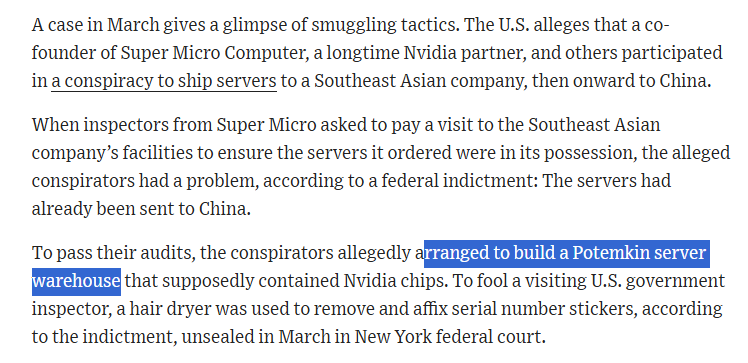
One very simple takeaway: If global chip demand is as strong as many in the market seems to think, Nvidia should have no reason to go anywhere near a deal that even *looks* it *might* be a backdoor into China.
Approximately 27.4% of Worldex's outstanding shares are held by identifiable institutional investors, incorporating AVI's latest 5.31% disclosure.
Activists now make up ~20.95% vs the family's 35.1%.
Minority shareholders already sided with activists in Gumi.
With a couple more activists, they could start wrestling for control!
Data Centers, Permitting Reform Regaining Momentum After Midterm Jolt: The impact of the midterms on data center growth remains to be seen, though optimism already is building around a path forward for the controversial computing infrastructure. dlvr.it/TWJMZw