The Militia Long/Short Equity ETF has launched! The ticker symbol is $ORR and it just began trading.
The strategy is similar to my hedge fund, investing in global stocks up to 150% long and 100% short. This strategy will typically have lower correlation and beta to the market than most public investments. This means that during a strong bull run $ORR will have a tough time keeping up. But in a weak market $ORR is expected to outperform.
My reasons for launching $ORR rather than growing my hedge fund:
Many of the investments in my hedge fund are illiquid and I won���t be able to trade them if my hedge fund grows too big. This is why I’ve been turning away new investors. However, well over half of my bets scale well and $ORR will invest in that portion.
The $ORR ETF will have a lower edge due to its larger scale, and thus it has a much lower fee to match. I have a strong opinion that hedge fund fees are incompatible with large AUM generally, not just for my fund. Most people don’t know it but Buffett pointed out that even Berkshire’s track record would have been mediocre with hedge fund type fees. This is by far the biggest reason I want to launch an ETF. I want to do right for the people investing with me, who are trusting me with their money, rather than sell out like most other hedge fund managers do.
The $ORR ETF has less risk than my hedge fund because it uses less leverage and isn’t short many microcap stocks, which can have extreme volatility. This is a more appealing product to risk averse investors.
The ETF vehicle has many benefits: Simplified, favorable taxes for the ETF holder. Can be owned on margin and in retirement accounts. Daily liquidity. Due diligence on ETFs is simpler than hedge funds, convenient for institutional investors. Compliance isn’t an issue for institutional investors. Allows me to rebalance longs without a tax hit. Both very small and very large investors can join, neither of which could invest in my hedge fund.
Expenses stated in the prospectus:
The 1.3% management fee is accurate, which is around .65%/year fee per 100% gross leverage managed.
The 18.84% gross expense ratio is very misleading. These items cause the stated expenses to be very high but are not real economic costs:
1. When a stock or ETF that I’m short pays a dividend it gets counted as an expense. In reality, whenever dividends are paid the underlying stock or ETF drops by roughly the same amount. Thus, the real economics are neutral. The ETF will be heavily short high dividend investments at the start.
2. When I short a stock or an ETF, I am paying to borrow the shares. On average, my larger scale shorts cost 1%/year to borrow. This is considered an expense. However, when I short sell I am simultaneously borrowing shares from one guy and selling them to someone else. That someone else pays cash for these shares, which the ETF holder earns interest on. Thus, I will be earning a positive carry on that short. But the way the “expense” gets calculated, the interest earned from being short does not offset the cost of borrowing.
3. The margin interest paid for being over 100% gross long. Unlike the first two items, this is a real expense but the expected return of the stocks we own is higher than the interest cost.
Frankly, the way the expense ratio gets calculated in the ETF prospectus is nonsensical. Regulators should update this number to better reflect reality. But since they don’t, and since most people do not understand this, ETF managers are reluctant to do anything in their portfolio that causes this official number to go up. Well, I say to hell with that. I’m just going to do whatever I think has the maximum expected value even if this hurts marketing to many potential investors.
Points about the $ORR ETF at launch:
* Until the ETF reaches ~$50-$150 million AUM, I will not be able to short more than 10 individual stocks or ETFs. This is due to the unusual mechanics of short selling in an ETF vehicle and associated implied cost. Thus, $ORR will be shorting mostly bad ETFs in its early days. This isn’t so bad. There’s a big edge in shorting some of these bad ETFs and I even make these same big bets in my hedge fund. But I want to be transparent: the ETF won’t have its full edge until we hit a bit larger scale.
* While the ETF has low AUM you should be careful with trade execution. Do not use market orders. You will get the best fills if you use limit orders and buy between 10 AM and 3:30 PM ET. If you're buying in large size, contact your broker and do a Request for Quote (RFQ) to get best execution. Also, if you want to invest >$10 million and want more liquidity, you can reach out to me and I can help coordinate with a market maker.
Regulation on public posts, or why I haven’t posted about the ETF until now:
Every post I make about the ETF needs to get approval, including replies to questions in this thread. The turnaround time for approval is 5 days and costs money. Thus, I won’t be able to reply to your questions here. Instead, I will gather a list of questions and write up a FAQ.
Oddly, I am allowed to reply to questions on podcasts. If you run a podcast and want to discuss the ETF, I’d like to go on.
-
Thanks to Sam Lee @svrnco for partnering with me on this. Besides financially backing it, there was an awful lot of overhead work and other hurdles when launching an ETF. He did a great job handling most of that work so that I could focus on investing.
For more information about ORR ETF, a prospectus, fees and risks https://t.co/4PSxwqroLL
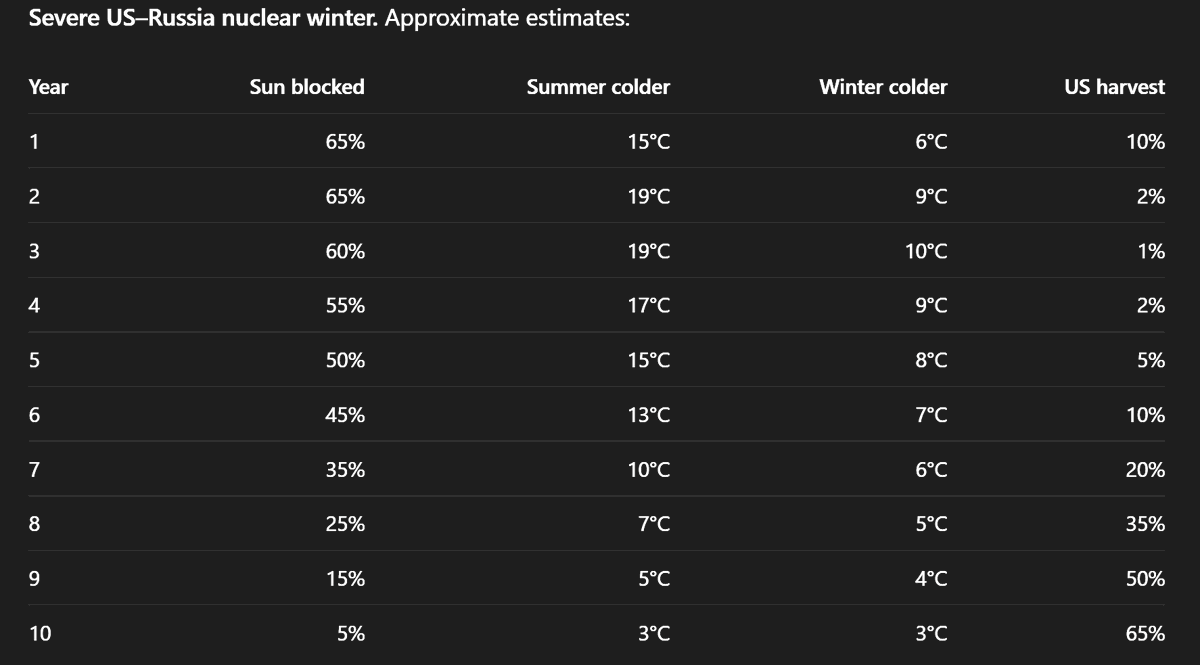
The more I read about nuclear winter, the more I realize the USA would pretty easily survive (even with lots of death).
I'd say it is the best positioned country to survive almost, besides a New Zealand. Rural sunbelt or whatever is a great place to be, just top notch.
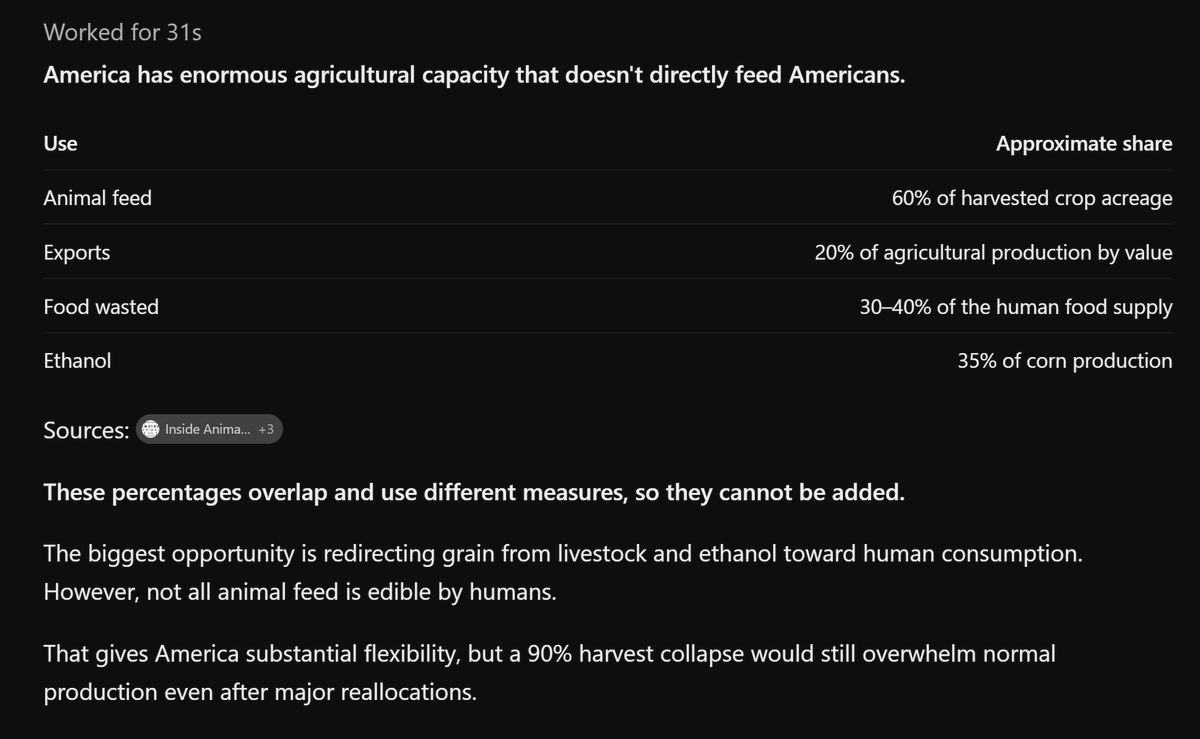
@Biohazard3737 That table assumes no greenhouses get built, but it's likely some would get assembled fast in the first couple of years... while stockpiles of food get worn down fast.
And the numbers seem more dire than actual because of this:
@GlobalStockPick I've finally decided on a permanent dining table. Once that arrives, I'll decide on that piece next. I'm leaning towards no rug because it fits awkward with the walkways.
Here's a weak tell for compute demand (I use ChatGPT):
It used to be the case that I wanted to use pro chat for nearly everything.
Now I get just as good of answers on extra-high for many things.
In another year what does that imply about the cost of doing most tasks?
I just stayed at Aman Tokyo finally. The room was one of the most beautiful I'd been in before. They achieved this by being extremely disciplined and minimalist. The entire room was made up of 3 materials/colors:
1. Black, matte stone slabs. The fabric on the couch and seat cushions and the blackout shades matched this color exactly.
2. A light colored, simple/low grain wood. The walls and furniture were all the same thing.
3. Paper mixed with that same wood as one of the walls/doors on one side of the room.
That was it. The crazy thing here, too, is that the materials were not even expensive.
@variance_swap Nothing compared at all to that mode back then. The downside is it would take 15+ minutes every time.
I was able to switch away earlier this year from deep research completely.
Jevons Paradox is directionally true, of course, but its effect is *wildly* overstated most of the time.
In the car example, you don't drive 5 times as much just because gasoline is 20% of the price. You just drive a fair bit more.
@variance_swap I'm doing the exact same work today as I was 18 months ago using deep research. And I'm getting very similar quality answers now.
For my own process, nothing changed.