ARABIC WRITING AND THE QUESTION OF SANCTITY IN ISLAMIC LAW: A Comprehensive Historical, Linguistic, Theological, and Jurisprudential Examination of Arabic Inscriptions on Footwear and the Athari Trademark
Summary of study:
The proposition that the Arabic language, every Arabic letter, or every word associated with Islamic scholarship possesses an intrinsic sanctity that prohibits its appearance on footwear is not established as a general rule of Islamic law.
The available evidence supports several important distinctions:
- Arabic is honored as the language of the Qur'an, but this does not automatically make every ordinary Arabic word a sacred inscription.
- The word أَثَرِيّ (Atharī) was later recognized as a theological designation, but it originally possesses ordinary linguistic uses.
- Classical Islamic literature records the practice of writing Arabic expressions directly on sandals, shoes, and leather boots.
- Classical Arabic literature records poetry inscribed on sandals, leather footwear, and sandal straps as expressions of fashion, refinement, affection, and esteem. These include a sandal sent by Saʿīd ibn Humayd to a friend with verses honouring the recipient. Such accounts show that inscriptions on footwear were not invariably intended as degradation.
- Early transmitted reports describe scholars writing notes or knowledge on their sandals.
- An inscription's wording, intended meaning, placement, customary treatment, and potential for actual desecration are relevant to its legal assessment.
- A classical discussion directly addresses stepping on carpets marked وقف (waqf). Ibn Hajar al-Haytamī describes the prohibition in that example as “weak, indeed anomalous”—ضعيف بل شاذ. Modern rulings also distinguish ordinary ground inscriptions and commercial labels from sacred writing.
- Reports concerning a riding saddle and inscriptions on animal thighs provide further comparisons.
Al-Bayhaqī records horses bearing an inscription containing Allah’s name during the time of ʿUmar ibn ʿAbd al-ʿAzīz, may Allah be pleased with him. Classical jurists also discuss inscriptions identifying zakāt livestock. These are distinct contexts whose relevance lies in the purpose and treatment of an inscription.
- The majority position identified in comparative jurisprudence distinguishes Arabic letters from the content they convey: letters do not possess intrinsic sanctity merely because they are Arabic, whereas sacred wording requires protection.
- The Shāfiʿī and Hanbalī positions summarized in the cited comparative fatwa permit cleansing with written material lacking protected content or beneficial knowledge. This provides direct evidence against treating every Arabic letter as intrinsically sacred, while preserving the minor disagreement of other jurists.
- The supplied visual examples show Arabic trademarks and ordinary inscriptions on footwear and other commercial objects. They illustrate possible uses of writing, although individual image origins and claims about prevalence require documentation.
- The supplied doormat examples include أهلاً وسهلاً and مرحباً (“Welcome”) and البيت بيتك (“Make yourself at home”). They illustrate ordinary Arabic greetings on surfaces intended for foot contact; the photographs alone do not establish a universal practice or scholarly consensus.
- Further practical comparisons include Arabic parking instructions, floor directions, and restroom notices such as اغسل يديك (“Wash your hands”) and يرجى تشغيل السيفون بعد الاستعمال (“Please flush after use”).
- The cited scholarly discussion identifies no authentic Qur’anic or Prophetic evidence establishing Arabic as the language of Paradise.
The combined evidence supports the distinction between ordinary Arabic letters and content entitled to religious respect.
On that basis, this study argues for the permissibility of using Arabic words, and using the word ATHARI as an ordinary commercial trademark on the visible upper surfaces of sneakers, subject to the actual wording and treatment of the design.
One particularly significant historical source is Abū al-Tayyib al-Washshāʾ (d. 325 AH), who devoted an entire section of his book al-Muwashshā to Arabic writing on sandals and leather footwear, including inscriptions executed in gold and silver.
The central question is not whether Arabic possesses religious importance. It does.
Rather, the question is whether that importance makes Arabic inscriptions or the ordinary word ATHARI, when used as a commercial trademark on footwear, inherently sacred or prohibited from appearing on such an object.
This study arose from the controversy generated by a non-Arabic-speaking Iranian critic from a Shīʿite Rafidī background that resides in the United States of America, over the use of Arabic on footwear, including his inflammatory attacks on @MutahNapoleon, also known as Napoleon, a former member of Tupac Shakur’s Outlawz.
The criticism targeted Beale’s collaboration with a brand called "Athari Wear" on the limited-edition Napoleon 33 sneakers, which bear the word “Athari” as a trademark on the side of the shoe, and what appears to be an abstract Arabic calligraphy mark on the back of the shoe, as documented in the study.
Having examined the relevant evidence, this study finds no basis for the categorical claim that the mere presence of ordinary Arabic writing on footwear makes it prohibited.
- Abu Islām al-Salafī al-Misrī
I’m often asked where I find many of the benefits, quotations and reflections that I share. My answer is quite simple: books of literature (adab).
During my studies in Saudi Arabia many years ago, I came across the words of Imām Ibn ʿAbd al-Barr concerning his reason for compiling Bahjat al-Majālis wa Uns al-Majālis. He sought to bring together a broad range of subjects, including sayings, poetry, anecdotes, stories and valuable insights. The idea was to give the reader familiarity with many different topics, so that when sitting in various gatherings and conversations, he would have something beneficial to contribute.
Since then, I have had a particular appreciation for this genre of Islamic literature. Books of adab introduce the reader to the words of scholars, poets, eloquent Arabs and people of wisdom. They cover an incredibly wide range of subjects and often preserve insights and observations that are difficult to find elsewhere.
Here are some works I would recommend:
• ʿUyūn al-Akhbār, Ibn Qutaybah
• Bahjat al-Majālis wa Uns al-Majālis, Ibn ʿAbd al-Barr
• Rawḍat al-ʿUqalāʾ wa Nuzhat al-Fuḍalāʾ, Ibn Ḥibbān
• al-Funūn, Ibn ʿAqīl al-Ḥanbalī
• Jamharat Maqālāt Maḥmūd Muḥammad Shākir, Maḥmūd Muḥammad Shākir
• Abāṭīl wa Asmār, Maḥmūd Muḥammad Shākir
• Namaṭ Ṣaʿb wa Namaṭ Mukhīf, Maḥmūd Muḥammad Shākir
• al-Mutanabbī, Maḥmūd Muḥammad Shākir
• Risālah fī al-Ṭarīq ilā Thaqāfatinā, Maḥmūd Muḥammad Shākir
These are the kinds of books in which you stumble across gems you may never encounter elsewhere.
🩸 La saignée (Al Hijama) sur le dessus du pied pour les personnes possédées, victimes du mauvais œil ou ensorcelées
🎙️ Cheikh Mohamed Hichâm Tâhiry Al-Afghâny
https://t.co/ZzfDgs0ENA
🔹Earning & Building Wealth🔹
From Hakeem ibn Qays ibn Aasim, that his father, a noble Companion of the Prophet ﷺ, may Allah be pleased with him, gave this advice to his sons as he was dying.
He said:
“It’s upon you to earn wealth and to build it up, for it raises the standing of the noble generous person, and through it one has no need of the blameworthy.
And beware of begging from people, for that is the last means of earning for a man.”
=====
Authenticated by Shaykh AlAlbaani in AlAdabul-Mufrad
Shaykh ʿAbd Al-ʿAzīz Ar-Rayyis حفظه الله is coming to the UK. I advise all the brothers here in the UK to come and benefit from him even if only for 1 hour.
Masjid Daar Al-Hadeeth
150 Homerton High Street, London E9 6JA
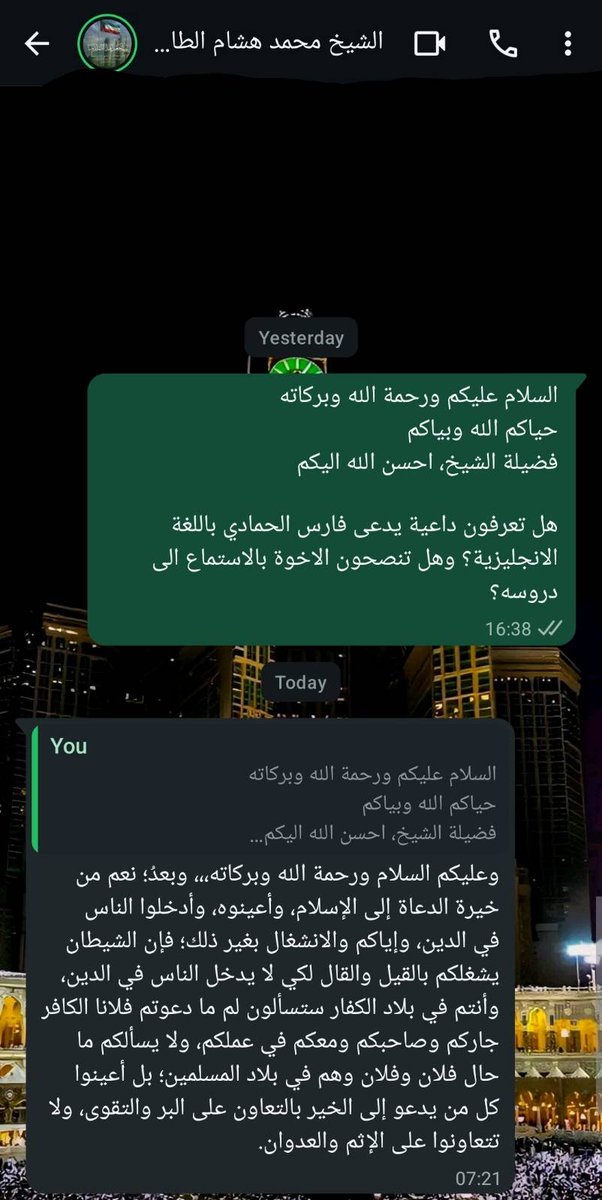
Alhamdulilah, a brother asked sheikh Muhammad Hisham about Sheikh @FarisHammadi and his response is a beautiful tazkiyyah saying that he is from the best duat to Islam, so aid him. This is a prominent scholar saying this, and we have people, I ask Allah to guide them, indulging in sheikh Faris's honor and belittling him. I ask Allah to aid, reward, and give you success @FarisHammadi, ameen.
Testing by Individuals - Whether Scholars of the Sunnah or Heads of the Innovators
By the ʿAllāmah Zayd ibn Muḥammad ibn Hādī al-Madkhalī, may Allāh have mercy upon him
The ʿAllāmah Shaykh Zayd ibn Hādī al-Madkhalī, may Allāh the Most High preserve him, was asked:
What is the ruling on testing people by means of individuals, whether scholars of the Sunnah or heads of the innovators? And does this apply to contemporaries? Please enlighten us, may Allāh reward you with good.
Answer:
“There is no doubt, my brother, that the righteous Salaf used to test people by means of those scholars who were known for their firmness upon the Sunnah, soundness of creed and methodology, and their severity towards the people of desires and innovation. I have come across more than ten texts from the Salaf, each containing an example illustrating the testing of people by means of the people of the Sunnah: whoever recognised their virtue, loved them, and spoke well of them was a person of the Sunnah; and whoever disparaged them and attacked their reputations was a person of evil and innovation. Here is a brief selection from the many Salafī texts on this matter:
1. Imām al-Barbahārī, may Allāh have mercy upon him, said: “When you see a man who loves Abū Hurayrah, Anas ibn Mālik, and Usayd ibn Ḥuḍayr, know that he is a person of the Sunnah, in shāʾ Allāh.”
2. He also said: “When you see a man who loves Ayyūb, Ibn ʿAwn, Ibn Idrīs al-Awdī, and al-Shaʿbī” and he mentioned a group of virtuous scholars “know that he is a person of the Sunnah.”
3. He likewise said: “When you see a man who loves Aḥmad ibn Ḥanbal, al-Ḥajjāj ibn al-Minhāl, and Aḥmad ibn Naṣr, speaks well of them, and holds their view, know that he is a person of the Sunnah.” Sharḥ al-Sunnah: pp. 117–118.
You asked in your question: does this apply to contemporaries in our time?
The answer is: yes. People are tested in every time and place by means of the people of the Sunnah in creed and law, that is, those who have dedicated themselves to preserving the Sunnah, understanding the meanings of its texts, acting upon it, and defending it.
Testing people by means of the people of the Sunnah is not confined to a particular individual or individuals; rather, people are tested by every person of the Sunnah in every time and place according to the description mentioned. Likewise, people are tested by means of the people of innovation who call others to it.
ʿUqbah ibn ʿAlqamah reported: I was in the presence of Arṭāʾah ibn al-Mundhir when one of those present said: “What do you say about a man who sits with the people of the Sunnah and mixes with them, yet when the people of innovation are mentioned he says: ‘Leave off mentioning them, do not speak of them’?”
Arṭāʾah said: “He is one of them, do not let his affair be obscured before you.” ʿUqbah said: “I found this statement of Arṭāʾah objectionable.” He then said: “So I went to al-Awzāʿī, who was perceptive in such matters whenever they reached him, and he said:
‘Arṭāʾah spoke the truth, and the correct view is what he said. This man forbids their mention, but when will people be warned against them if their mention is not kept alive?!’” Tārīkh Dimashq: 8/15.
Al-Awzāʿī, may Allāh have mercy upon him, also said: “Whoever conceals his innovation from us, his companionship with its people will not be concealed from us.” Al-Ibānah of Ibn Baṭṭah: 2/479.
Al-ʿUkbarī, that is Ibn Baṭṭah, said: When Sufyān al-Thawrī came to Basra, he began examining the affair of al-Rabīʿ, meaning Ibn Ṣubayr, and his standing among the people. He asked: “What is his way?” They said: “His way is nothing but the Sunnah.” He asked: “Who are his close companions?” They said: “The people of Qadar.” He said: “Then he is a Qadarī.”
Zayd ibn Muḥammad ibn Hādī al-Madkhalī, al-Ajwibah al-Athariyyah ʿan al-Masāʾil al-Manhajiyyah pp. 27–29.
Forgiveness for those who have even a bit of faith
Ibn ʿUmar said: “When the Day of ʿArafah comes, there remains not a single person with so much as the weight of an atom of faith in his heart except that he is forgiven.”
It was said to him: “Is this particular to those at ʿArafah, or does it extend to people in general?”
He replied: “Rather, to people in general.”
- Ibn Rajab al-Ḥanbalī, ʿAbd al-Raḥmān ibn Aḥmad (d. 795 AH / 1393 CE), Laṭāʾif al-Maʿārif fīmā li-Mawāsim al-ʿĀm min al-Waẓāʾif, Dār Ibn Ḥazm, Beirut, p. 286.
___
📍 New Masjid Appeal: https://t.co/tThASHicGC
Current Masjid Maintenance: https://t.co/vXuQt6FVyI
Photography by Shaykh Ḥammād al-Anṣārī
10. My father - Shaykh Ḥammād al-Anṣārī said:
“In my view, photography is permissible but I do not issue a fatwā on this out of respect for the scholars of fatwā in this land, as they hold it to be prohibited.”
I say: On one occasion my father was browsing through the newspaper al-Muslimīn when he came across a large headline to the effect that Shaykh Ibn ʿUthaymīn had declared photography permissible. My father remarked: “This is what I said before.”
- Al-Majmūʿ fī Tarjamat al-ʿAllāmah al-Muḥaddith al-Shaykh Ḥammād ibn Muḥammad al-Anṣārī 2/760
[ʿAbd al-Awwal ibn Ḥammād al-Anṣārī]