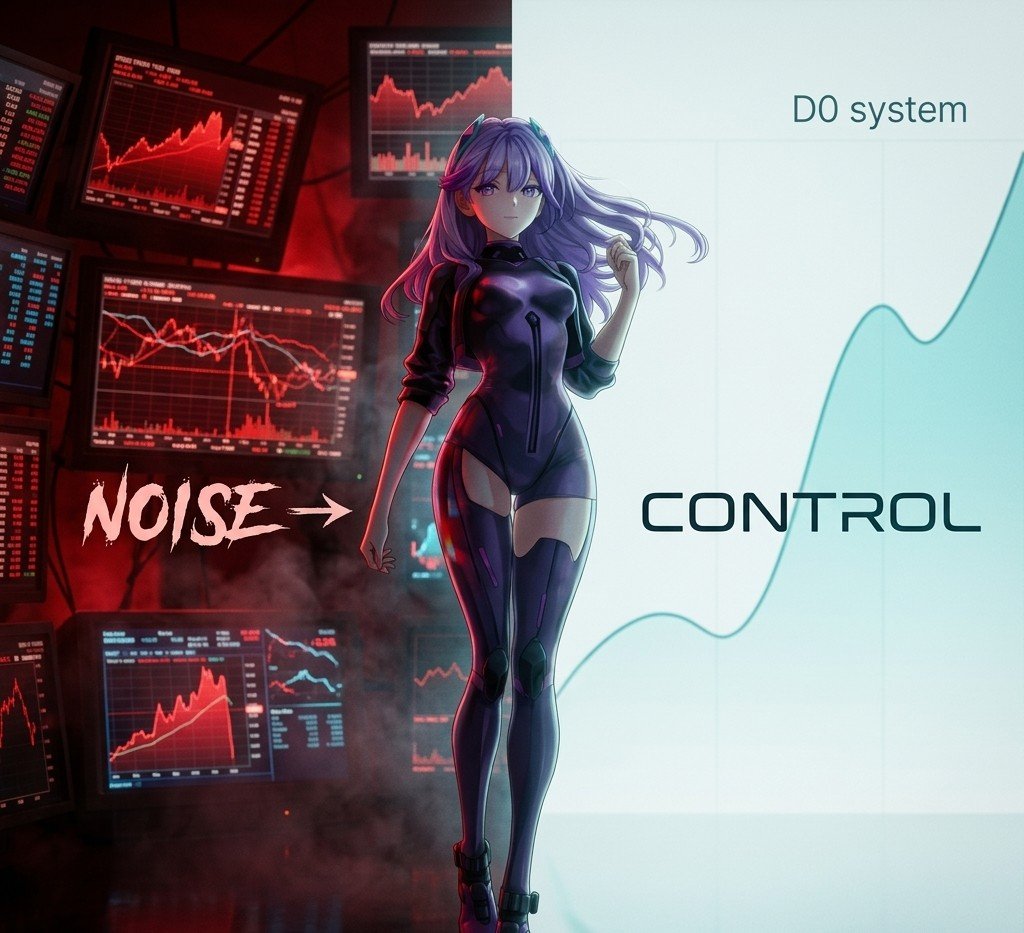
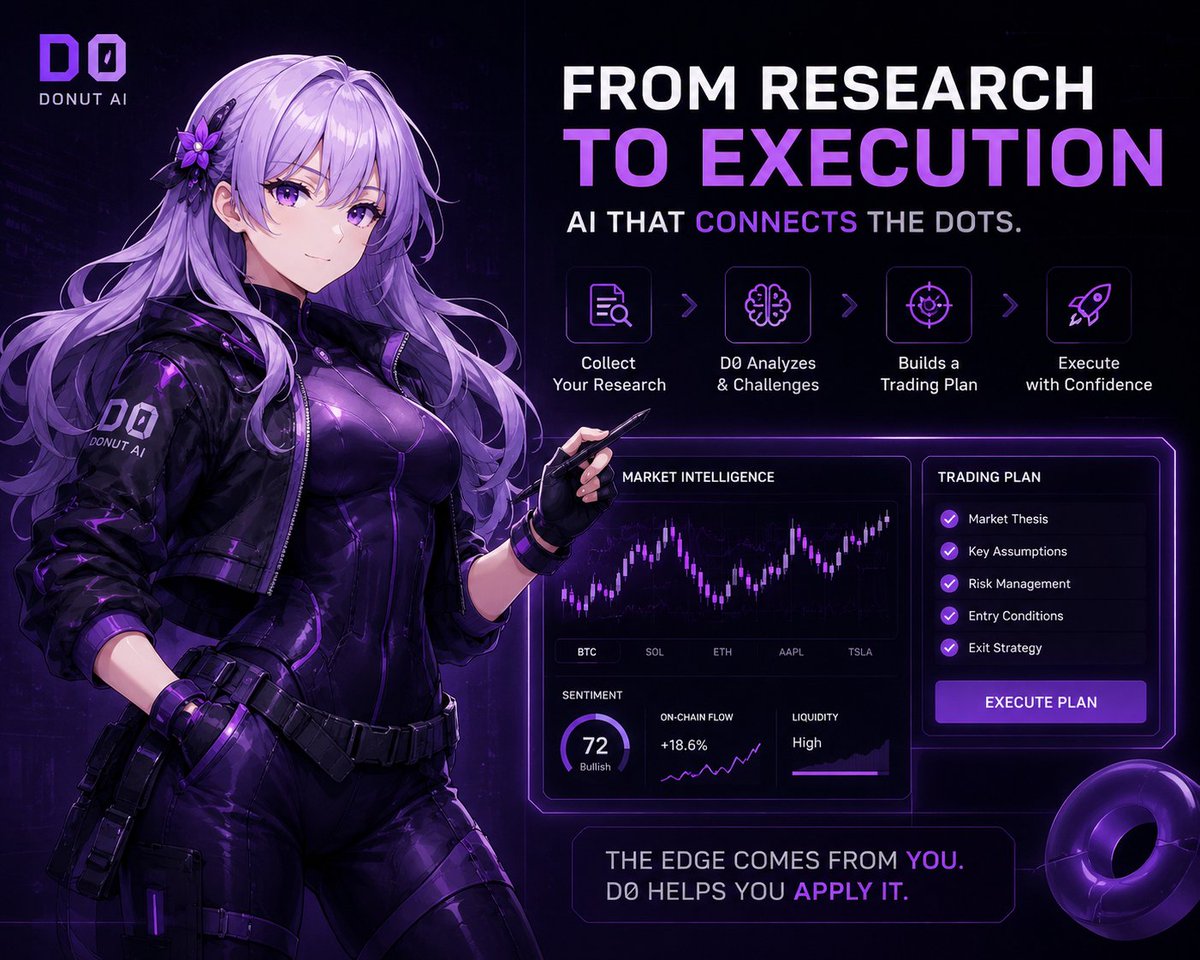
𝐒𝐭𝐚𝐲𝐢𝐧𝐠 𝐜𝐨𝐦𝐩𝐞𝐭𝐢𝐭𝐢𝐯𝐞 𝐢𝐧 𝐭𝐫𝐚𝐝𝐢𝐧𝐠 𝐮𝐬𝐞𝐝 𝐭𝐨 𝐦𝐞𝐚𝐧 𝐜𝐨𝐧𝐬𝐭𝐚𝐧𝐭 𝐚𝐭𝐭𝐞𝐧𝐭𝐢𝐨𝐧.
Charts open all day.
Decisions made under pressure.
Execution tied to how fast you react.
That model is starting to shift.
With systems like D0 from @DonutAI
the focus moves from manual activity → structured automation.
Not just tracking the market, but:
→ monitoring continuously
→ evaluating risk before action
→ executing based on predefined logic
One detail that stands out is visibility.
Risk isn't something you check after the fact.
It’s presented before execution so decisions are made with context, not guesswork.
And while everything runs in the background,
the user still defines the boundaries.
That balance matters.
Because the real advantage isn't just speed,
it's having a system that can operate consistently without breaking discipline.
Less noise.
More structure.
Clearer control over outcomes.
That's the direction things are moving.
One of the biggest misconceptions about AI in trading is that its primary purpose is to generate ideas.
In reality, valuable ideas are rarely the limiting factor.
Professional investors already have research frameworks, market theses, data sources, and conviction-driven strategies. The challenge is processing large volumes of information, identifying relevant signals, and maintaining consistency throughout the decision-making process.
This is where AI becomes significantly more interesting.
Not as a replacement for judgment, but as a layer that helps organize complexity.
D0 reflects that shift.
Instead of positioning AI as a source of answers, it can function as a system for evaluating information, challenging assumptions, monitoring evolving conditions, and supporting execution workflows.
The intelligence still originates from the user.
The research.
The framework.
The perspective.
AI simply helps transform those inputs into a more structured and actionable process.
As markets become increasingly information-dense, the competitive advantage may not come from having access to more data.
It may come from having better systems for turning information into decisions.
That is a far more compelling vision for AI in financial markets.
@DonutAI
𝗕𝗹𝗼𝗰𝗸𝗰𝗵𝗮𝗶𝗻 𝗶𝗻𝗳𝗿𝗮𝘀𝘁𝗿𝘂𝗰𝘁𝘂𝗿𝗲 𝗶𝘀 𝗲𝗻𝘁𝗲𝗿𝗶𝗻𝗴 𝗮 𝗱𝗶𝗳𝗳𝗲𝗿𝗲𝗻𝘁 𝗽𝗵𝗮𝘀𝗲 𝗼𝗳 𝗲𝘃𝗼𝗹𝘂𝘁𝗶𝗼𝗻.
For years, the focus has been on execution speed, throughput, and scaling transaction capacity. Those improvements matter, but they only address part of the system.
Every transaction, block, validator message, and market signal still depends on one fundamental process: information delivery.
The quality of a network is not determined solely by how quickly it can process data once it arrives. It is also determined by how efficiently that data reaches participants in the first place.
This is why projects like @get_optimum are approaching blockchain infrastructure from a different angle.
Rather than building another execution layer, the focus is on improving the movement of information itself reducing inefficiencies in propagation, improving consistency across geographically distributed networks, and helping participants operate from a more synchronized view of the system.
What makes this direction interesting is that better communication benefits every layer above it.
Validators receive information sooner.
Applications operate with more reliable data.
Markets become more efficient.
And network participants compete on a more level playing field.
As blockchain ecosystems continue to grow in complexity, infrastructure that improves coordination may prove just as important as infrastructure that improves computation.
Because scalable systems are not built only on processing power.
They are built on the ability to move information efficiently.
Markets are becoming increasingly efficient at producing information.
Every second generates new data points: price movements, liquidity shifts, on-chain activity, macro developments, and sentiment signals. Access to information is no longer the primary challenge for market participants.
The challenge is coordination.
Research, analysis, execution, and risk management still operate across fragmented systems that require constant context switching. As markets move faster, the cost of that fragmentation becomes more visible.
This is where the next generation of trading infrastructure becomes interesting.
Rather than building another analytics platform, D0 is exploring a model where market intelligence, execution workflows, and portfolio operations exist within a unified environment.
The objective is not simply to provide more data.
It is to create a more efficient path from observation to action.
As AI continues to mature, its greatest contribution may not be better predictions alone. It may be its ability to organize complexity, reduce operational friction, and help users interact with markets through a more connected decision-making framework.
The future of trading may not be defined by the number of tools available.
It may be defined by how seamlessly those tools work together.
@DonutAI
𝗧𝗲𝗰𝗵𝗻𝗼𝗹𝗼𝗴𝘆 𝗲𝗰𝗼𝘀𝘆𝘀𝘁𝗲𝗺𝘀 𝗿𝗮𝗿𝗲𝗹𝘆 𝗯𝗲𝗰𝗼𝗺𝗲 𝗰𝗼𝗻𝘀𝘁𝗿𝗮𝗶𝗻𝗲𝗱 𝗯𝘆 𝗶𝗻𝗻𝗼𝘃𝗮𝘁𝗶𝗼𝗻.
They become constrained by coordination.
As networks grow, more participants, more applications, and more data must interact across the same infrastructure. The challenge is no longer creating activity. The challenge is allowing that activity to move efficiently through the system.
This is why infrastructure remains one of the most important layers in any technology stack.
The strongest networks are not always the ones with the most features.
They are often the ones that remove friction between participants.
That perspective makes projects like Optimum particularly interesting.
Rather than competing at the application layer, the focus is on improving the underlying movement of information across decentralized systems.
It is a less visible problem than execution speed or transaction throughput.
But it is also one of the foundational requirements for scalability.
Because as decentralized networks expand, coordination becomes increasingly valuable.
And efficient coordination begins with efficient communication.
@get_optimum
Every blockchain upgrade eventually runs into the same reality:
information has to move before value can move.
Execution layers continue to become faster. Block production becomes more efficient. Networks process larger amounts of data than ever before.
Yet none of those improvements eliminate the need for coordination between distributed participants.
Validators still need timely information.
Applications still depend on synchronization.
Networks still rely on communication across thousands of nodes.
As ecosystems grow, the challenge shifts from processing data to distributing it efficiently.
That is one reason infrastructure projects focused on networking are becoming increasingly important.
Optimum's approach is interesting because it focuses on the movement of information itself rather than treating communication as a solved problem.
The objective is not simply to make blockchains faster.
It is to create an environment where data can move more efficiently, allowing every layer above it to operate with fewer constraints.
In distributed systems, performance is often measured by what happens after information arrives.
But long-term scalability may depend just as much on how that information gets there in the first place.
@get_optimum
The crowded trade problem is one of the more counterintuitive risks in markets.
The common assumption is that if a lot of smart people are in the same position, that position is probably correct. The analysis is sound, the thesis is well-constructed, and broad agreement seems like validation. But what crowding actually does is change the exit dynamics entirely.
When everyone is on the same side, the position works until it doesn't, and when it doesn't, the exit is simultaneous. There's nobody to sell to except other holders who are trying to exit for the same reason. The fundamental thesis can be completely right and the position can still produce a painful drawdown purely because the unwind is simultaneous and there's no incremental buyer to absorb it.
The most dangerous trades in crypto are the ones that feel safe because everyone agrees with them. The consensus is often correct on direction and catastrophic on timing, because the consensus getting in is what makes the eventual unwind violent.
Markets generate information continuously.
Prices move.
Liquidity shifts.
Narratives emerge.
Capital rotates across ecosystems.
The challenge has never been a lack of data.
The challenge is converting that data into decisions quickly enough to matter.
Most trading workflows still rely on fragmented systems where monitoring, research, execution, and risk management exist as separate layers. As markets become faster and more interconnected, that model becomes increasingly inefficient.
D0 takes a different approach.
Instead of acting as a standalone analytics tool, it operates as a continuous intelligence layer that monitors market conditions, evaluates signals, and supports execution within a unified environment.
The objective is not simply to provide more information.
It is to reduce the operational distance between observation and action.
As AI capabilities continue to evolve, the next generation of trading infrastructure may not be defined by better dashboards or more indicators.
It may be defined by systems that can understand, prioritize, and act on information in real time.
That is the direction D0 is exploring.
@DonutAI