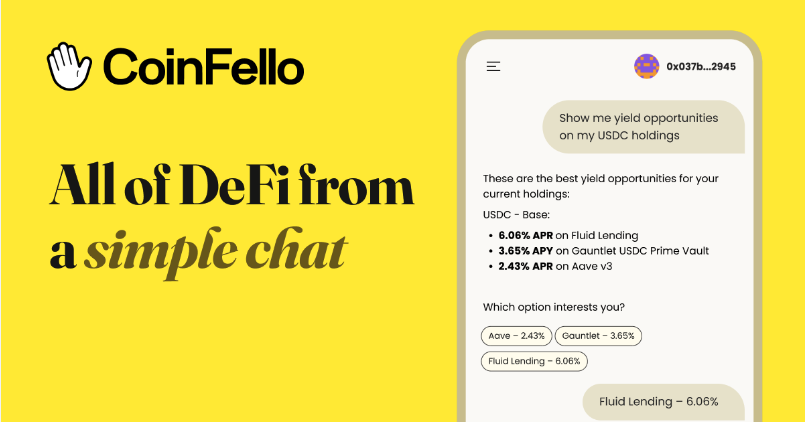
Today we are announcing three major updates for CoinFello 🎉:
1. Fello 2: Your DeFi strategy is now fully automated.
2. Rewards: receive rewards in MON when swapping with Fello.
3. Referrals: refer users and receive rewards for their swaps with Fello too.
How it all works, detailed in the thread 👇
CoinFello is live for everyone!
CoinFello is an AI agent that helps you research, execute, and automate any onchain action across all EVM chains using plain language. Your keys stay yours the entire time.
No waitlist. No invite code. Open to everyone, from today.
Here is what that means 👇
1/8 We've been quietly solving the hardest problem in AI x Web3: how do you give your agent spending power without giving it your wallet?
Today we're shipping the answer with our OpenClaw skill 🧵👇
We showcased a demo of our OpenClaw x CoinFello skill @EthereumDenver ⤵️
Your AI agent handles the smart contract transactions. You keep your keys private.
Launching next week!
Given some rumors, wanted to post a few clarifications:
Farcaster is not shutting down. The protocol works and will continue to work. There were 250,000 MAU in December and over 100,000 funded wallets. The acquirer, Neynar, is a venture-backed startup and plans to shift Farcaster in a more developer-focused direction.
As for Merkle, we’re planning to return the full $180M raised back to investors. Over the last 5 years, we tried to be a good steward of investor capital.
Finally, I bought my house with Coinbase IPO proceeds.
We need better decentralized stablecoins. IMO three problems:
1. Ideally figure out an index to track that's better than USD price
2. Oracle design that's decentralized and is not capturable with a large pool of money
3. Solve the problem that staking yield is competition
Tracking USD is fine short term, but imo part of the vision of nation state resilience should be independence even from that price ticker. On a 20 year timeline, well, what if it hyperinflates, even moderately?
If you don't have (2), then you have to ensure cost of capture > protocol token market cap, which in turn implies protocol value extraction > discount rate, which is quite bad for users. This is a big part of why I constantly rail against financialized governance btw: it inherently has no defense/offense asymmetry, and so high levels of extraction are the only way to be stable. And, of course, it's a big part of why I refuse to give up on DAOs entirely.
If you don't have (3), then again you have a few percent APY suboptimal return rates, which is quite bad. The possible paths to solving (3) [treat this as enumeration of the solution space, not endorsement] are basically:
(i) reduce staking yield to like 0.2%, basically hobbyist level
(ii) create a new category of staking which has yield almost as high as regular staking, but which does not have the same slashing risk
(iii) figure out how to make slashable staking compatible with usability as collateral (does it mean that slashing risk somehow passes on to stablecoin and CDP holders, so both of those need to stake and trust the same delegate?)
If you're going to try to reason through this in detail, remember that the "slashing risk" to guard against is *both* self-contradiction, *and* being on the wrong side of an inactivity leak, ie. engaging in a 51% censorship attack. In general, we think too much about the former and not enough about the latter. Also remember that a stablecoin cannot be secured with a fixed amount of ETH collateral; in the event of large drops you need to be able to handle rebalancing (though of course you could choose to partially drop this goal in a clever way, eg. if ETH price moves too much you stop earning staking yield until you take some other action)
https://t.co/J0k3GrTlwJ
"The layoffs equate to just three people but nevertheless amounting to 75 percent of the software engineers on the team, since Tailwind Labs is a small company."