Taught by the descendants of great teachers. Trained in physiology, biochemistry before the algorithmic age, and in mourning with what got lost in translation.
The geneticist's in truth sent science back close on fifty years. It was the greatest example of "reductionist" thinking I have ever witnessed. Cancer research is perhaps the most glaring casualty of this genocentric dogma.
And it was the usual shenanigans we see in science, like new discoveries, therefore new research, which costs a lot, and new ways of thinking how to justify that cost by introducing dogma.
And as always, they thought they were right, because they were new and costly. The arrogance of novelty. It is a recurring theme in the history of science, the mistaken belief that because a hypothesis is fresh, shiny and equipped with a shiny new set of techniques, it must automatically render a century of foundational, hard won physiology obsolete.
Breaking biological systems into smaller components has been extraordinarily productive. But the problem arises when the properties of those components are treated as sufficient explanations of the behaviour of the intact organism.
The good old boys in the good old school's, and I went to a school that was forty Nobel Laureate's good, will tell you very bluntly...
"Energy flow 'shapes' genetic information"
First principles thermodynamics will always stand supreme.
It's not so much "keto kills thyroid" as it is mostly slightly "downregulates thyroid".
High fat diets, even calorie replete high fat diets can mimic the "fasted state", as opposed to the "fed state". We call this "adaptive hypothyroidism". It is mostly a good thing, not a bad thing that HFDs will lower thyroid activity.
Again, the assay values don't mean much, and with thyroid, we try to mostly rely on symptoms. I've seen literally hundreds of patients with outstanding thyroid panels, but with obvious and debilitating thyroid symptoms.
We mostly do not recommend people with thyroid issues to go low carb, unless we believe a carbohydrate is the cause of the issue. Removing a specific dietary antigen like gluten to damp down autoimmunity in Hashimoto's as an example.
What I do before I put someone on a therapeutic ketogenic diet is find baseline. Two weeks before that introduction, sometimes longer, I will run two or three comprehensive blood, urine and other lab work, and one week apart to understand baseline. Taking these multiple comprehensive biological snapshots one week apart establishes better individual variance before I perturb the system. I am trying to eliminate the baseline noise that trips up less methodical practitioners. Or even you, as we only have one snapshot here. As in, show us your lab work before the diet and the three panels before?
This also includes giving my client wearable technology to understand respiration and heart rate, HRV etc. If you see a drop in cardiac output after the introduction of the diet (which is mostly the case), then I know I have lost a little metabolism. Resting heart rate is a proxy, and it can move with autonomic tone so I have to take other things into consideration. Weight loss being the biggest. This is very often what you mean when you see folks saying "keto kills thyroid". No, weight loss kills thyroid.
Most of the dysfunctional thyroids I see are from folks that have a lifetime history of dieting, very often extreme calorie restriction.
Low carb and particularly carnivore diets are often the preferred means of losing weight. I have seen as much as a 30% drop in metabolism on a low carb diet. And this is why you have to be very careful with the diets. You may think you are calorie replete because you are no longer losing weight. But to preserve that nitrogen, you simply downregulate your metabolism. You may confuse satiety with anorexigenia (appetite suppression).
And this is when you see the numbers go the wrong way. An example, you went low carb and dropped your A1c. But then after six months or a few years, you start to see that A1c creeping back to where it was before the diet intervention. This is a clue that you are losing your metabolism. Thyroid status can move A1c independently of glucose.
I am less interested what the hormone levels are after two weeks, but I want to know after two months, and thereafter. I will give my client the same wearable technology also to check respiration and heart rates months after.
We accept the lowering of thyroid in the diet as it is often preserving nitrogen, preserving the very important NAD+/NADH redox ratio, and possible excessive ROS. In your case, it could be that you have a robust antioxidant system, and you are far from "reductive" stress?
We don't accept it when the patient develops symptoms or I start seeing the numbers go the wrong way. An example, if start seeing lipoproteins creep up from what was a keto baseline lipoprotein score at two and six months. Symptoms mostly rule with thyroid.
You are lucky, Henry. You are fat adapted and you seem to be thriving. The "stress" of carbohydrate restriction is what we called "resolved" stress in your case. You have physiological reserve. But many don't thrive. And that is because the stress becomes "unresolved". It's not because they are doing something wrong. It's because it's a stress too far. In the wisest of words by the Godfather of stress research, endocrinologist Hans Selye once said... "it's not the stress that kills you, it's your reaction to it."
And this is precisely why prescribing broad stroke dietary dogmas like keto and carnivore diets without auditing the individual's baseline resilience is so profoundly dangerous. You aren't treating a disease, but you could be testing an organism's breaking point.
I have made a promise I was going to stay out of this but really it is hard. For me, the thing that is most disturbing (among an avalanche of disturbing things) is how you go from this reaction of joy and triumph in April of 2025
Discordance as in slightly different from the usual low carbohydrate thyroid pattern (as mentioned). I've been prescribing therapeutic low carb diets for over forty years now.
And discordance with the relatively low total T3, high to normal free T3, and borderline low free T4. Your screenshot is missing the reference ranges for Chinese the chemiluminescence assays. That actually would be of interest to me.
TSH is important here, and you have added that result which helps. Thank you.
It is the tissue activity (receptor) that is the instigator of the feedback loop, not the hormone levels. That would be seen in a low TSH if that receptor activity is high. You have moderate TSH level, which seems in accordance to your diet.
There is a caveat here as low carb diets rely on lipolysis, and lipolysis requires an uptick in stress hormones cortisol and the catecholamines. Both cortisol and the catecholamines artificially lower TSH, so you can be fooled. Many doctors are actually fooled by their patients "in range" TSH but typical thyroid symptoms. They may only perform a TSH test?
Summary, so this looks like a euthyroid panel with some assay level untidiness rather than a thyroid problem. We call this "ordinary individual variation".
One thing to remember, and this actually applies to all biomarkers, but particularly to thyroid markers. Your individual variation by only be "one third" of the thyroid reference range for the general population.
Reference ranges are incredibly wide as they have to
reflect a population that has wildly different health contexts and circumstances. That width has to reflect many mixed health contexts. It is the skill of the practitioner or you guys to try and understand the individual variation.
And this is why you never rely on one biomarker in isolation. In the case of understanding thyroid metabolism and bioenergetics for example, I may look at twenty other different biomarkers which might seem unrelated to thyroid to understand what I am trying to understand with regards to thyroid.
We get this a lot on social media. The showing of one panel or one marker. It tells us nothing in all truth. Even I cannot understand this and I've been looking at thyroid panels for over four decades. I can make a guess at best. So we try to find concordance across these seemingly disparate systems is this is how we bypass the broad, population wide reference interval noise.
Hope this helps.
This is brilliant and my favourite post of the week.
And you might not see the chronological anatomy of a sinking narrative with such surgical precision as this. It's just perfect.
- "We retracted our paper. All good".
I laughed so hard I have developed a six pack.
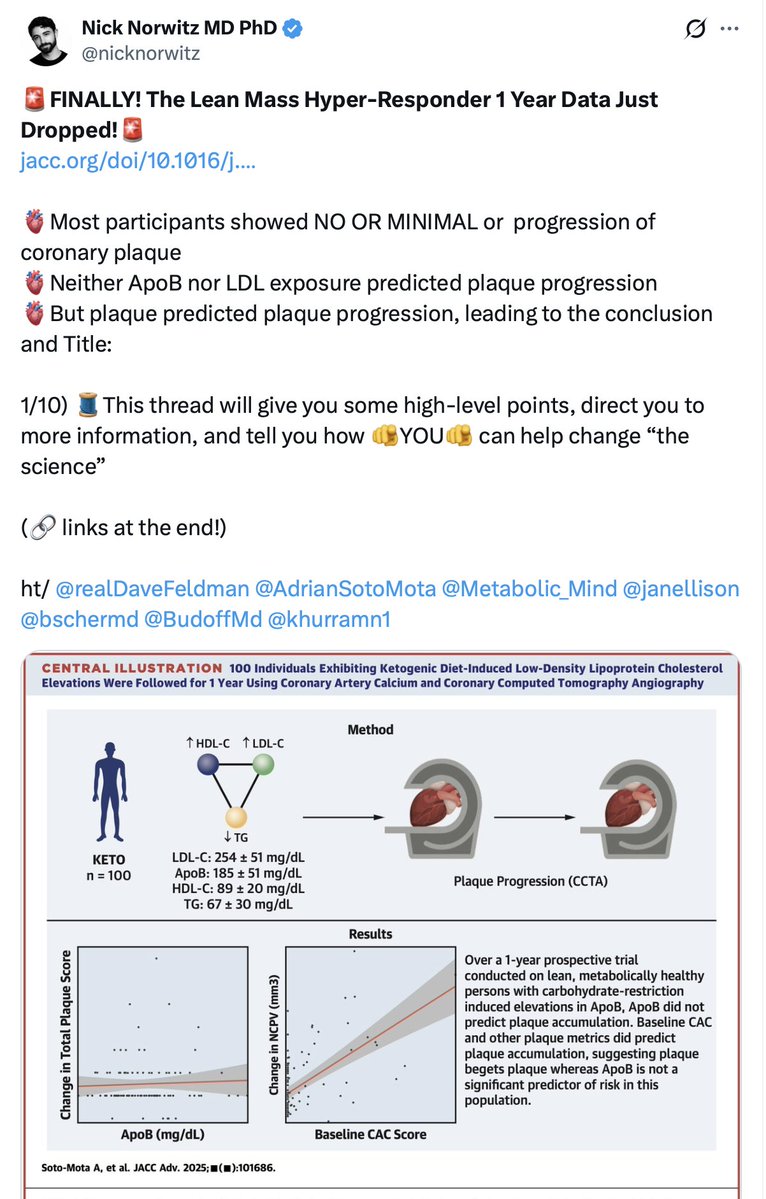
Them: ApoB didn't correlate with plaque progression.
Us: Wait...that wasn't your preregistered primary outcome.
Them: Plaque begets plaque
Us: Wait...your study shows LMHRs have historically high plaque progression.
Them: The data is wrong because our vendor sucks.
Us: Why did you go on a historic marketing campaign and produce a documentary?
Them: We retracted our paper. All good.
Us : That's not how this works.
I think the story is... that the story kept changing. Thankfully, @drgarymcgowan took some screenshots.
And I personally think that when a research group prioritises the release of a slick documentary and the establishment of a lucrative brand over basic quality control, the integrity of the data will always become a secondary concern.
I don’t think they were ever interested in quality control @StevenQuartz. They didn’t even bother with a preprint. The decision to bypass a preprint, especially when launching a massive public relations and documentary campaign to me is telling.
In modern clinical research, preprints should serve as a crucial public sandbox for early peer scrutiny. If an anomaly exists in a dataset, posting a preprint allows the community to inspect the preliminary data, catch the oddities, and raise red flags before a paper receives formal journal publication. Wouldn't you want that before releasing a slick and expensive documentary about this study?
By skipping the preprint stage and rushing straight to publication to align with a film premiere schedule, a safety net might have been deliberately removed. The timeline prioritised maximum media impact on "launch day" over scientific vetting.
And the media vehicle was already rolling, the documentary had even been premiered before the publishing of the study. Maybe, when a film, a brand and a narrative are locked to a public release schedule, the scientific timeline gets crushed by commercial deadlines? Feldman has acknowledged surprise at the NCPV numbers prior to publication. And then simultaneously attempted to downplay the discrepancy post publication. This is fundamentally backwards. The excellent post by @ChrisVMDHealth with regards to publishing day peacocking is worth a read.
We witnessed a masterclass in conflict of interest and performative science. The NCPV figures returned by Cleerly were biologically startling. Anybody in the know, knew that. Seeing an average NCPV progression rate almost four times higher than expected in normal cohorts should have triggered an immediate pause by the authors. It didn’t. They went full steam ahead, hoping nobody would notice the anomalies. And now hoping you only notice the Cleerly anomalies… to deflect you from noticing the manuscript anomalies in both the retracted manuscript and it’s equally anomalous and mischievous preprint. If any of the authors mention “Cleerly”, this is simply “deflection” tactics.
And now we do have a preprint. Because in all truth, that’s all it can ever be. And nine months later that preprint still hasn’t been amended, peer reviewed and published. And if I was a top journal, I’d be inclined to avoid it, knowing that peer review is not what it should be. And @JACCJournals is a good example as peer review obviously failed massively here.
That the documentary's scientific backbone is based on a mischievous stranded preprint is startling to me. If you haven’t watched the @JohnSloughII and @TheCalvinWest YouTubes, I recommend you do. They are fascinating and damning of both manuscripts.
And it could even be that John Slough's "letter of concerns" to the editor is the real reason for the retraction. Only that @JACCJournals could never admit to that. Formal journals rarely send out press releases or emails thanking independent sleuths for doing the editorial board's job for them. Institutional pride dictates a cleaner, more bureaucratic exit strategy, like framing the retraction around the "author requests" or "post publication re evaluations" to preserve whatever dignity the peer review apparatus has left. We'll probably never know the truth.
And, I think that post retraction preprint functions as an exercise in damage control rather than transparent science. It created an illusion of scientific legitimacy for lay audiences for the documentary who do not or cannot distinguish between an unvetted preprint and a peer reviewed journal publication.
Even worse, Feldman is now trying to outsource accountability for that retracted paper.
Well, you can’t. You cannot outsource accountability for your work, your study.
You can outsource the work, but you cannot outsource “accountability”. Most good journals require authors to sign a statement declaring they had full access to all study data and take full responsibility for its integrity. This is in line with the ICMJE accountability. And the university where I reside, we teach students that as authors, they are fully accountable for all aspects of the work. Including the third party data transfers, work and tasks. And that is because a lot of today's science requires third parties. Science has grown far too complex for any single research group to build every tool from scratch.
Attempting to outsource scientific accountability to a third party vendor is not merely a weak defence, it is a fundamental violation of the core tenets of academic authorship. I find that shameful from Feldman, and this is how I know he is not a bonafide investigator. Attempting to claim all the glory of a "groundbreaking" public relations blitz on launch day, only to turn around and blame the software vendor when independent analysts dismantle the paper, is the ultimate display of intellectual dishonesty.
And let's not forget that peacocking by Feldman and the authors on launch day. And never forget the final frames of the video by Feldman on that day in his favourite blue shirt as it funnels traffic directly to a proprietary film website.
The documentary should be titled "The Cholesterol Code Con".
https://t.co/NaHwPBSuEr
Agreed, and @JACCJournals bears substantial responsibility as much as the authors for the conversation we are having now. And I sense this is why the preprint is in limbo? They are starting to realise that traditional academic journals are increasingly too under resourced or rushed to perform a proper scientific audit.
This is the absorbable pad sitting at the bottom of pre-packaged meat trays. We often tongue in cheek call it a "meat diaper" or "soaker pad" as it's a purpose built absorbent pad designed to trap what we call "purge". This is primarily water, but can also be blood and other liquids. It actually is very similar to a baby diaper as it is the same materials used. These materials like superabsorbent polymers are what we call "water locking" materials.
And these materials are not particularly healthy either as they can shed their chemical & nanoplastic components. Even though it looks like harmless paper pulp, it has perforated synthetic resin to stop the meat sticking to the diaper. After slaughter, the tissue can no longer use oxygen, you get a "post mortem" drop in pH as the tissue switches exclusively to anaerobic glycolysis, converting glycogen into lactic acid. This acidic exudate degrades food contact polymers from the diaper or even a vacuum sealed meat product. You also have surfactants issue as the meat proteins help plastics dissolve even quicker.
Ideally, if you eat a lot of meat, you should find and use a reputable butcher, who buys carcass' and who will cut to order. And that butcher will wrap directly in plain unbleached traditional butcher's paper or wax paper. Whole carcass butchers typically source better raised animals.
Another masterclass in reductionist, low carb tinted biochemistry. It’s the classic online nutrition trope we expect to see from such luminaries as Bikman, Baker and many others. That is take a kernel of technical truth, strip away all physiological context, and package it up neatly to sell a book. They may not be essential, but they most certainly are optimal. Saturated fatty acids by the way are also not essential, but Bikman forgot to conveniently mention that.
The vilification of carbohydrates is of course to sell the low carb brand and protocol. But what is really sad is that they monetise the solution via the vilification. They have manufactured a universal metabolic villain, striped away the systems level nuance, sold the fear, and then handily monetise the salvation. Which is ironic, because in my line of work, it is in fact lipids and fatty acids that are often the true villains. Most aberrations of glucose metabolism I see in practice are actually aberrations of lipid and fatty acid kinetics and metabolism beforehand.
I have been prescribing therapeutic ketogenic diets now for over forty years, and I find it profoundly disheartening to see worthy tool, used by such online predators. These people are often not on the front line where it matters. Their credentials are used to inform sometimes gullible people. And that is even sadder, exploiting the vulnerable. And they can operate with complete immunity.
There are essential fatty acids and essential amino acids. There is no essential carbohydrate.
The body does need some glucose, mainly for red blood cells, which have no mitochondria. But the liver and kidneys can make all of it through gluconeogenesis, typically around 100 to 150 grams a day in adults, using lactate, glycerol from fat, and a small amount of amino acids.
Carb tolerance still varies a lot from person to person, and my new book, The Carb Crisis, explains why. The evidence is clear: carbs are optional, not required. Preorder link in the first reply.
You have a cognitive tendency to search for, interpret, and recall information in a way that confirms your pre-existing beliefs while ignoring contrary evidence, like a brutal race environment. You have started off with the desired conclusion (high carbohydrate fueling is bad) and worked your way backwards to assemble a pseudo-scientific justification, selectively weaponising real physiological mechanisms (like osmotic drag) while ignoring basic systems like a brutal race environment.
You have participated in the greatest sunk cost fallacy of your life. Too invested to admit the error. We're watching elite endurance athletes breaking records on 120g+/hr of carbs so when the times drop, you use the same 120g+/hr of carbs to make up a silly story. It is ideological preservation at its finest, and to protect against the existential threat. The big boys in the room all see the silly games you play, hence they call you out.
I spoke to two athletes who competed the race this year. Both said they nearly quit. Both were much slower than previous years. Nothing to do with carbs, these two athletes are actually only around 100g/hr. And have been for many years.
With regards to fluid balance. The Tour de France was the hottest and the fastest race ever this year. They all seem to do fine with 120g+/hr of carbs.
There are many benefits to low carbohydrate or ketogenic diets. I know this because I have been prescribing them for over four decades. Elite level exercise and especially elite level endurance exercise is not one of them. Sorry to bust your bubble.
It's very simple! At that level, fat oxidation simply cannot generate ATP at the rate required to sustain that output.
Your entire paradigm is built on ideology rather than first principles biochemistry.
@ziggibson@ProfTimNoakes Also extremely windy bike leg with head winds in the last third of that leg. Overnight rain made for high humidity. But yeah, let’s blame the carbs 🤪
Constructing an absurd strawman to mock sports science only highlights a fundamental lack of understanding. Conflating intra workout substrate oxidation in high output athletes with sitting on a bench eating a fried pastry is precisely why educated folks find it impossible to take @BiggestComeback commentary and many of the low carb community seriously. This bad faith caricature is exactly why serious professionals tune them out.
And why is it that when these guys mention "high carb" they compulsively resort to a donut? Which can be as much as forty-five percent of the calories from fat? And this is precisely why the image is such a blatantly absurd strawman, because no runner or cyclist finishes a session and reaches for an iced, sprinkled pastry to hit their refueling targets. High fat actively delays gastric emptying, ruining the very rate of glucose absorption an athlete requires.
And the great thing about exercise, you begin to view nutrition through the lens of recovery, performance, and cellular efficiency rather than mindless gratification. That intrinsic discipline is precisely why caricatures like Chris' donut post are so fundamentally disconnected from reality.
The truth is, by substituting proper fueling options with a deep fried pastry, Chris isn't engaging with actual sports nutrition or real world athlete behaviour. It is pure theatrical caricature designed to score quick points with an already dumb audience that already wants to believe high carbohydrate diets are inherently foolish.
The real fool here is Chris S. Cornell.
From the manuscript.
- “the mechanistic link between insulin resistance and cancer remained elusive.”
And exactly my point. They have an epidemiological association, but they haven't established the mechanism. You need to show me a mechanism not an association. This study shows IR proxies track cancer risk, not cause cancer. I know this paper very well. The causal language runs considerably ahead of what the experiment actually establishes. Read the manuscript, it does not demonstrate that insulin resistance is the upstream cause. What that paper is really saying is... A metabolic phenotype associated with predicted insulin resistance is associated with increased incidence of several cancers.
The cell cannot maintain normal oxidative metabolism, redox balance and substrate handling. Insulin resistance is being mistaken for the initiating pathology when it may itself be a consequence of a more fundamental cellular problem. Often this is a protective adaptation to a cell's inability to safely process the available fuel.
You need villains and heroes to sell your type of therapy. It's obvious who those villains and heroes are. So you are putting the cart before the horse here and hoping your audience buys it. Which they will because they live in an echo chamber. You're taking a downstream metabolic phenotype and promoting it to the status of the primary disease mechanism. That is incorrect.
And in forty years of working in clinical nutrition, it is mostly the case that I have reversed insulin resistance with very high carbohydrate diets if I believe it is caused by lipotoxicity. It is mostly the case the aberrations of glucose metabolism are caused by aberrations of fatty acid and lipid metabolism beforehand.
Carbohydrates and glucose "reveal" insulin resistance, they mostly do not cause it. That's why we use a OGTT. We don't use a OGTT to give someone cancer. Only in the case of overnutrition and excess substrate energy would carbohydrates cause insulin resistance. And that's not what we see. In practice what we see is high fat, high carbohydrate overnutrition. You guys like to blame refined carbohydrates in a product, but conveniently forget to mention the product also has a high fat content.
And again, in forty years I have seen literally many different ways how insulin resistance can develop. One fifth of the worlds diabetes burden for example is caused by pollution. Much of the insulin resistance I see is stress, where cortisol and catecholamines inhibit the ability for the cell to respire. Even a simple B1 deficiency will look like insulin resistance. Undiagnosed hypothyroidism is another which is very common. Anything that perturbs the cell will look like insulin resistance. Not much to do with carbohydrates, sorry.
And you can still have lipid induced lipotoxicity, neuroendocrine overdrive, micronutrient bottlenecks, endocrine & environmental perturbations with a low carb diet. It's just that you have eliminated the substrate that "reveals" those things. So stop blaming the whistleblower.
Insulin resistance was not the original lesion.
You're welcome.
@BrianLenzkes@BenBikmanPhD@LifesBestMed It's not a textbook and there is no carb crisis. There is an overeating or overnutrition crisis. And as @AbsurdlyWise mentions also a grifter crisis. Congrats, Brian, you have contributed to the later.
The narrative collapsed, and it was quite obvious what the narrative was. In fact, you'd have to be an idiot to not know what the narrative was in all truth. To suggest that the highest profile carnivore advocate shared a beef vs. longevity chart out of dispassionate, neutral statistical interest requires a very special level of wilful blindness. But you guys do have a particular talent for selective blindness.
But worse. You then try and rescue it with the greatest example pedantic deniability we will see today on X.
I really do not know who is more stupid here, you or Baker? Actually, I think it's you. Baker made a careless, embarrassing blunder. But when it was exposed, you then doubled down with bad faith pedantry. You should have just shut up.
But I guess that's the issue with tribal loyalty. You fell obliged to defend the indefensible? When in all truth the absolute best strategic move was silence.