I keep telling PMs the new interview is a screen share. A CPO just confirmed it on the record.
JZ runs product at Laurel with 5 PMs and 4 designers. She used to manage hundreds of people. The team didn't shrink because times got hard. It shrank because one PM can now ship a full front-end and back-end feature to production with an agent, and adding bodies just adds coordination cost.
So when she hires, she doesn't ask if you're "AI-native." She asks you to share your screen and show her.
Then she grades you on 4 levels:
Level 1: You talk to ChatGPT or Claude in a chat window. Ask a question, get an answer. Basically search.
Level 2: You've automated a workflow. The same email, the same triage, the same call prep now runs without you.
Level 3: You build apps. Something is tedious, so you build the tool that kills it.
Level 4: You ship shared apps other people use, or you ship straight to customers.
Her finding after running this for every role: most people who call themselves AI-native are level 1. They've read the threads. They've never built the workflow.
That gap is the whole interview now.
You can write "AI-native" on a resume. You can quote the last post you saw. But the second your screen is up, there's nowhere to hide. Either there's an automation, an agent, an app you actually made, or there isn't.
The PMs who clear levels 2 and 3 are doing the work of a team of ten. That's why her org is nine people and still shipping.
JZ walked through the whole system on the podcast, including the company OS her team runs out of Claude Code. The screen-share interview is the part that's going to age the best.
Let me trace the timeline here because nobody's connecting it.
Step 1: Scrape the entire internet. Every book, every article, every conversation, every piece of art, every forum post. Do it without asking. Do it without paying.
Step 2: Train a model on all of it. Call it "artificial intelligence."
Step 3: Go to BlackRock's Infrastructure Summit and announce: "We see a future where intelligence is a utility, like electricity or water, and people buy it from us on a meter."
Step 3 is where you sell people's own knowledge back to them. On a meter.
They took the collective output of human thought, compressed it into a model, and now they want to charge you by the token to access a version of what you and everyone you know already created.
One Reddit user put it perfectly: "They stole all this data from us, the people, our life's work, creativity, art, by devouring the internet and blowing through all copyright laws. Now they want to sell it back to us in the form of a utility."
Imagine if someone photocopied every book in the public library, burned the library down, and then opened a subscription service for the copies.
That's the metered intelligence business model.
And they're pitching it to infrastructure investors as though they invented water.
Despite a very full plate, I have been needled by a Ghanaian business journo friend of mine based in NYC to have a go at the debate that has taken Ghana's tech community by storm: the draft NITA bill.
My short essay effectively aligns with what everyone else is saying: shred the bill and come back with something more aligned with modern tech reality!
But in the tradition of the Scarab, I try to go into a bit more detail than most mainstream pieces.
I also point out something that seems missing in the debate. With the rapid surge of technologies like AI, everyone is or will soon be doing stuff previously considered "ICT professional stuff."
Licensing ICT professionals is akin to licensing bloggers in today's rowdy information environment: trying to stop a hurricane by blowing fumes from one's mouth.
https://t.co/hrmLM6SKtE
Recently Honorable @samgeorgegh publicly unveiled AKU - a digital assistant. While the accent of the speech appeared great, the sequence seemed scripted
Anyway, compare & contrast w/ this quick @KhayaAI demo - an actual conversational AI . Available to try RIGHT NOW
⛓️💥 👇
Shopify CEO Tobi Lutke: It’s impossible to make great products if you don’t give a sh*t
“Every product in the world, at the end of the day, is simply a reflection of how much the people who created it gave a sht… It is not possible to make great products if the people who work on it do not give a sht about the product.”
Tobi continues:
“I actually think this is a very important role for product leaders: To make sure that the team gives a shit… The product leader has to give a sht. Do not engage in work on a product that you don’t care about.”
Tobi believes anyone who wants to build great products has two roles:
1. “You have to understand the thing that’s being done better than everyone else.”
2. “You’ve got to be exothermically infectious with actually caring about this thing because just that one thing alone will make a 10x better product. It’s crazy how much of a change this makes.”
Source: @lennysan (Feb 2025)
Jeff Bezos: "If I do my job right, the value to society and civilization from my for-profit companies will be much, much larger than the good that I do with my charitable giving."
We are delighted to introduce Prince Dagadu, ACI for the 64th ACI World Congress in Accra!
Prince serves as the Team Lead for Market Risk at UBA Ghana, bringing an exceptional depth of financial expertise and industry risk knowledge to the stage.
Aliko Dangote’s business playbook is simple: find where billions of dollars leave the African continent every year, then build the capacity to keep that money at home.
When asked how he decides which businesses to be in, Africa’s richest man answers:
"I first of all look at what we need as people: What is it that we're supposed to be producing, but we're importing?”
In other words, find what Africa imports then produce it domestically.
It’s usually termed import substitution, but he calls it backward integration — understandably because in practice he often does both simultaneously.
Every business in the Dangote Group — cement, sugar, salt, petroleum refining, fertilizer, petrochemicals — exists because Africa was spending billions importing something from abroad.
If you want to follow Dangote’s blueprint today, here are five sectors to explore:
1) Refined petroleum. Dangote addressed Nigeria's import dependency, but most of Africa still imports refined fuel; the continent’s annual import bill on refined petroleum products is estimated at $120B. After its West African success, the Dangote Group is already planning a $15–17B replica refinery in East Africa.
2) Machinery & industrial equipment. Africa builds almost none of its own industrial equipment. Instead it spends an estimated $100B annually importing it. This is perhaps a higher risk, longer-horizon play; but it's also where the highest value-add sits.
3) Food processing & agribusiness. Africa spends over $60B on food imports annually — mostly on raw staple grains like wheat, rice, and maize. Opportunities include domestic production of what's imported, production of indigenous crops as substitutes, agro-processing, and coordination infrastructure like commodity exchanges.
4) Building materials beyond cement. Africa spends ~$35B annually on building materials imports, excluding cement. Dangote conquered cement; the next layer is steel, glass, ceramics/tiles, roofing materials, and finished wood products. Urbanization-led investment is a primary driver, and local manufacturing is generally nascent.
5) Pharmaceuticals. Africa spends over $20B on annual pharmaceutical imports. Half the continent's countries have zero local pharmaceutical manufacturing. A Dangote-scale bet here would mean an internationally certified pan-African supply platform.
Of course, the easy part is what I’m doing right now — ideating.
The hard part is pouring capital into opportunities that take decades to incubate, in environments where the currency can lose 90% of its value while you're still laying groundwork.
That's why most people talk about import substitution or backward integration, while others build refineries.
—
Afridigest Intelligence — intelligence & advisory to win in Africa's growth markets: https://t.co/pTeD1UjMLQ | Follow Afridigest on LinkedIn & Instagram
Shopify CEO Tobi Lutke explains Goodhart’s law and why he doesn’t like KPIs or OKRs
“Goodhart’s law is real. The moment a metric becomes a goal, it’s no longer a useful metric… No metric by itself is a complete heuristic for a complex business. There’s a million different tensions in a company, and you can’t keep all of them in harmony by optimizing for one thing.”
For this reason, Shopify doesn’t use KPIs or OKRs. But as Tobi explains, this doesn’t mean they don’t value data and metrics.
“We are extremely data informed. We have invested enormous amounts of money and time into systems that give us basically everything at our fingertips… But what Shopify attempts to do is just not over-fit for what’s quantifiable.”
People love optimizing for highly-quantifiable things because there’s immediate gratification that comes from seeing a number go up. But Tobi thinks that the most important aspects of a product are rarely quantifiable:
“The overlap of the most valuable things you can do with a product and the things that happen to be fully quantifiable are like maybe 20%. Which leaves 80% of a value space unaddressable by the people who only look at quantifiable things.”
He continues:
“Shopify is comfortable with unquantifiable things like taste, quality, passion, love, hate… The sort of deep satisfaction that a craftsperson feels when they’ve done a job well is actually a better proxy if you allow it to be.”
They then have robust analytics systems that tell the company if something’s wrong or a new rollout breaks something.
“We think about it as a cockpit for a pilot. The decisions are still made by pilots, and we think this leads to better results… I think there needs to be more acceptance in business of unquantifiable things… And then metrics take a support function.”
Source: @lennysan (Feb 2025)
Spotted in the NYC subway. “Zero screen time.” An iPod Shuffle ad in 2026.
When we built the iPod, the goal was the technology disappeared and you could have your music wherever you were. 1,000 songs in your pocket.
Now we’re living through a moment where people are actively looking for ways to disconnect from the infinite feed, algos, and constant notifications. That doesn’t mean technology is bad. It means the best technology understands when to step back.
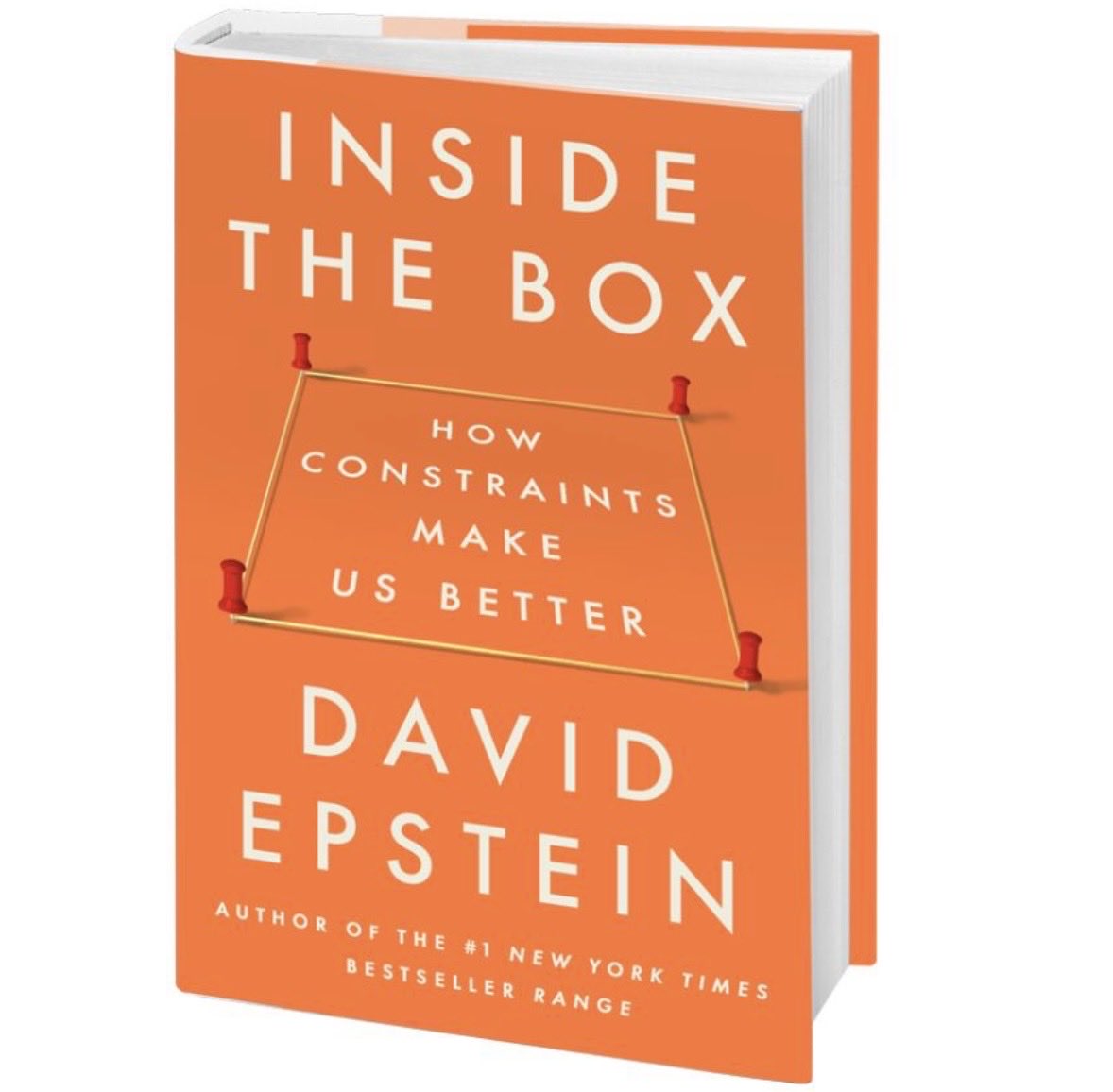
Not every problem needs another screen, another menu, or another layer of complexity. Constraints create freedom (read: @DavidEpstein new book Inside the Box). And often removing features creates a better product than adding them.
The future of technology shouldn’t just be more engagement. It should help us be more human.
If you don’t have constraints, then make up constraints.
After @generalmagicmov many of us walked away realizing the same thing: Big visions fail when the problem space is too big.
My friend @DavidEpstein captures this beautifully in his new book, Inside the Box: How Constraints Make Us Better.
At General Magic, we were trying to build the future all at once. The vision was extraordinary. Too extraordinary. The technology, infrastructure, interfaces, networks, batteries, displays, and user behavior all needed to evolve simultaneously. We were building everything, but for who?
When we built the iPod, we didn’t try to reinvent everything. We focused on one clear problem: people wanted their music collections with them everywhere they went. That focus forced hard decisions: no endless feature list, no bloated interface, and no trying to please everyone. We constrained the team size. We constrained the timeline. We constrained what version one needed to be. The famous scroll wheel itself came from working within constraints. We needed a fast, intuitive way to navigate thousands of songs on a tiny screen with limited hardware resources. Constraint drove simplicity.
The same thing happened on the iPhone. We used internal “heartbeats” aka aggressive prototype deadlines to force learning cycles. The first versions were wrong. Then the second versions were wrong in different ways. But the deadlines forced us to stop, regroup, simplify, and learn before complexity spiraled out of control.
At Nest, we took it even further. Before the product was done, we built the prototype of the packaging first. Literally the box. Why? Because the box forced clarity. If someone saw this thing sitting on a shelf for five seconds, would they immediately understand: what problem it solved, why they needed it, and why it was different? The constraint of the box forced the team to prioritize what actually mattered.
That’s what David gets exactly right in this book! Constraints are not creativity killers. They are creativity filters. The best teams shrink the problem space. They create boundaries that force learning, prioritization, iteration, and clarity.
That’s the pattern. You shrink the problem until it becomes solvable. Then you move.
Great book, David. Everyone building products, companies, or creative work should read this one.
It’s been 19 years since a 19-year-old Lionel Messi dribbled past Getafe’s entire team to score one of football’s most iconic goals 💫
(via @FCBarcelona)
Builders build. Then they ship. Then they solve what breaks.
Launch isn’t the finish line. It’s where reality starts. Great products aren’t defined at launch...they’re defined by how they perform in the real world.
With the #iPod it took us a few generations to truly get it right. We built and shipped the first version of the iPod in 9 months- greenlit in March 2001, announced that October and began shipping in November. Then we fixed, iterated, and produced a product that lasted many years, and ultimately paved the way for the #iPhone. Many of us still love our iPods!
That’s what happens when you stay with the product.
Trust comes from what happens after release and from doing the hard parts: scaling, supporting, improving.
Focus on what’s real: working product, real customers, real outcomes.
That’s the difference between hype and something that lasts.