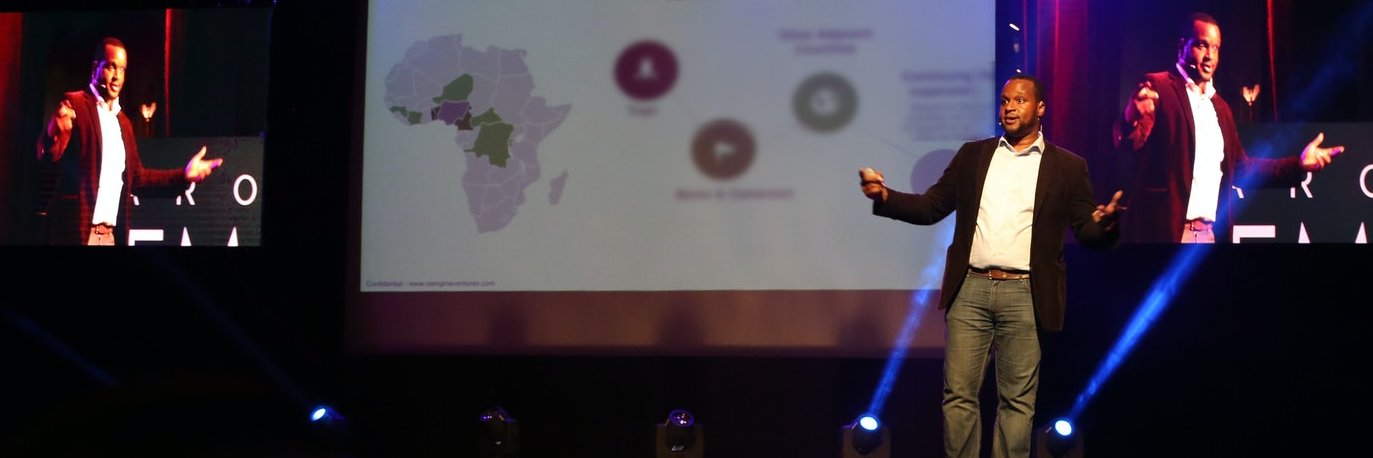
In 2018, I moved to Togo & spent the next four years building Africa's super app, starting w/ Francophone Africa
Today, Gozem operates across multiple verticals in 🇹🇬, 🇧🇯, 🇬🇦, and 🇨🇲
I recently transitioned away & had some time to reflect
Here are 10 lessons I learned...
Africa's wealthiest have a civic duty — and most of them aren't living up to it.
That's the argument @AlikoDangote, Africa's richest man and chairman of the Dangote Group, made to the media last December directly following a meeting with Nigeria’s President Bola Tinubu.
His target: a culture of conspicuous consumption among African elites — the Rolls-Royces, the private jets clogging local airports, the gratuitous mansions in urban and rural areas — capital that he argues should be flowing into industry, jobs, and infrastructure instead.
"If you have money for a Rolls-Royce, you should go and put up an industry in your locality."
The stakes, he emphasizes, are continent-sized.
Nigeria, for example, grows its population by an estimated 7-9M people every year. That means relentless demand for electricity, basic infrastructure, healthcare, & employment — demand that neither government nor foreign investors will meet alone.
In Dangote's view, the civic duty of African wealth is clear:
"When governments give us the environment to make money, we should be conscious of doing our civic duty — paying tax."
He sees a collaborative partnership between business & the state that's currently failing across Africa:
• Government's role: create the enabling environment
• Business's role: invest, employ, & pay taxes
• The result: functional public services — roads, schools, hospitals — that end the cycle of Nigerians traveling to Cairo, London, or the US for medical care and other Africans leaving home for basic services.
"In Nigeria,” Dangote says, “anytime you have a company, the number one shareholder is the government. So it's a partnership — and I cannot be cheating my partner."
His closing argument is one he has made for decades:
"We should stop calling for foreign investors. There's no foreign investor that will come here. The invitation of a foreign investor is a domestic investor."
In other words, foreign capital follows domestic conviction. And the most important variable in Africa's economic development is whether domestic capital decides to bet on the continent.
The wealth is here.
The question is whether the continent's wealthy will follow Dangote’s lead.
His $20B investment in the world's largest single-train oil refinery in Nigeria is now targeting a $40-$50B valuation in what's set to be the largest public offering in African capital market history — with subscriptions expected to open by August.
It's solid proof of one thing:
When Africans bet on Africa, Africa wins.
—
What's your take?
✦ Has conspicuous consumption among Africa's wealthy been a significant drag on development?
✦ Is the mentality of Africa's business elites genuinely shifting toward domestic investment and civic responsibility — or is Dangote an exception that proves the rule?
✦ What would it take to make his ethos of local capital deployment the norm rather than the outlier?
P.S. Follow Afridigest on Instagram ➜ https://t.co/Ge82iGg0uy
In 1950, just 2 of the world's 25 most populous countries were African.
Today, 6 are.
By 2100, 12 are projected to be — just under 50%.
Nigeria is projected to be the 4th most populous country on earth in the lifetimes of some people reading this. DRC, 5th. Ethiopia, 7th.
Population isn't destiny, but it is the economic engine for production and consumption.
And over the next quarter century, the continent will add a billion people, growing from ~1.5B today to ~2.5B by 2050. By 2100, ~4B — close to 40% of all humanity.
More immediately: within the next decade, Africa will have the world's largest workforce — surpassing both China and India as their populations age and contract.
The median age in Africa today is 19. In Europe it's 44. In Japan it's 49. In China it's 39 and rising fast.
The African continent isn't just young. It's young at a time when almost everywhere else is getting old.
Aging populations create structural economic problems — shrinking labor forces, rising pension costs, declining consumption, innovation slowdowns, etc. Japan has been living this for ~30 years. Europe is entering it. China is about to experience it at scale.
Africa's youth are the only large-scale counterweight to the demographic contraction happening globally.
The talent, productive capacity, innovation energy, and consumer demand that an aging world needs — Africa has it in abundance.
But demographic dividends only materialize under specific conditions.
Job creation, education quality, healthcare access, political stability, and infrastructure investment must all keep pace with population growth.
Demographers estimate Africa has ~20–30 years to build those conditions — to convert its young population into an economic asset at scale.
That window is currently open.
The decisions being made right now — about capital allocation, institution building, infrastructure investment, and more — will determine whether the continent captures its demographic dividend or squanders it.
—
Afridigest Intelligence — real intelligence & advisory to win in Africa's growth markets: https://t.co/pTeD1UjeWi | Follow Afridigest on LinkedIn & Instagram
African equities are delivering some of the world's best returns in 2026.
But the markets generating those returns are thinner than many people realize.
Here's a breakdown at Africa's top 10 stock exchanges by market cap:
• JSE — South Africa 🇿🇦 — $1.5T
The continent's undisputed capital markets anchor. Larger than the other 9 exchanges on this list combined — and it's not close. Deep liquidity, institutional infrastructure, and decades of market development that no other African exchange has yet replicated.
• NGX — Nigeria 🇳🇬 — $117B
Now Africa's 2nd largest exchange after an unprecedented rally that saw market cap grow 5x from 2023 to today — driven by banking sector repricing, aggressive FX reforms, strong corporate earnings, heavy domestic institutional interest, and renewed foreign participation. Yet at a $117B market cap, it represents just 35% of Nigeria's GDP. For a $377B economy, that's a thin capital market.
• BVC — Morocco 🇲🇦 — $111B
Nearly as large as Nigeria's exchange despite having a third of the population and about half the GDP — a reflection of deeper financial institutionalization and a more developed listed corporate sector.
• EGX — Egypt 🇪🇬 — $81B
Africa's second largest economy by nominal GDP has its fourth largest exchange. Currency volatility and the IMF reform cycle have compressed dollar-denominated market cap — but the pipeline is growing, with a total of 8 IPOs expected in 2026.
• BSE — Botswana 🇧🇼 — $75B
A country of 2.6 million people with a $75B exchange. Driven by dual-listed mining giants and one of the continent's strongest institutional investor bases relative to GDP.
• BRVM — WAEMU/UEMOA — $28B
The only regional exchange on the list, serving 8 Francophone West African countries with a combined population of 130M+. At $28B, it remains dramatically underdeveloped relative to the economic footprint it covers.
• NSE — Kenya 🇰🇪 — $25B | GSE — Ghana 🇬🇭 — $22B | DSE — Tanzania 🇹🇿 — $13B | USE — Uganda 🇺🇬 — $12B
East and West Africa's secondary exchanges. Growing, but still thin. Combined they account for $72B — less than Botswana alone.
—
Market cap measures how much of an economy's productive activity has been institutionalized, listed, and made accessible to outside capital.
And today, most of the continent's exchanges are characterized by limited size, depth, and liquidity — with most activity concentrated in South Africa, Nigeria, Morocco, and Egypt.
Strong returns, but thin markets. That gap is the next chapter in African finance.
—
Afridigest Intelligence — real intelligence & advisory to win in Africa's growth markets: https://t.co/pTeD1UjeWi | Follow Afridigest on LinkedIn & Instagram
Two days ago, hundreds of thousands of people descended on Ogun State in southwestern Nigeria — with many flying in from Europe, North America, and across Africa.
The occasion: Ojude Oba, a colorful festival in the city of Ijebu-Ode, where sons and daughters of Ijebuland have gathered annually since 1896 to celebrate their heritage and pay homage to the traditional monarch of the Ijebu Kingdom.
"Ojúde Ọba" literally translates to "the king’s forecourt" in the Yoruba language, and the event is full of pageantry:
Elaborate displays by the 𝘳𝘦𝘨𝘣𝘦𝘳𝘦𝘨𝘣𝘦 (age-based groups of people who dress in lavish, matching traditional attire), equestrian processions by the 𝘉𝘢𝘭𝘰𝘨𝘶𝘯 (descendants of historic warriors), musical performances, and a gathering of notable guests from across Nigeria.
It’s part careful cultural ceremony, part flamboyant fashion competition.
But behind the culture is commerce.
Behind the self-expression, serious enterprise.
Last year, the event injected an estimated $10 million into the local economy, according to organizers.
• Specialized designers, tailors, dress makers, weavers, dyers, jewelers, and shoemakers are hired to craft avant-garde styles — a massive, predictable seasonal boom.
• Hotels, guest houses, and apartments sell out months before the festival, with owners charging premium peak-season rates.
• Local restaurants, caterers, and street food vendors can experience their highest inventory turnover of the year during the event.
• A niche economy of horse breeders, stable keepers, trainers, veterinarians, and specialist horse transporters thrives thanks to the Balogun horse procession.
• Major multinationals invest heavily as headline sponsors, and brands of all sizes use the event as a launchpad to activate products, grow awareness, and capture consumers.
• Content creators, professional photographers, and videographers experience a surge in demand for event coverage.
• And the festival acts as a magnet bringing wealth in the diaspora back home to the local economy every year.
All of this happened largely organically — particularly after 'King of Steeze' @FarooqOreagba went viral worldwide two years ago.
And Nigeria isn’t unique. The continent has been compounding cultural capital for centuries.
Today that means African fashion on European runways. Afrobeats dominating American playlists. African movies at the top of Netflix charts.
The commerce is already happening globally. The opportunity is in scaling the domestic base.
[Video: @theniyifagbemi]
—
Afridigest Intelligence — intelligence & advisory to win in Africa's growth markets: https://t.co/pTeD1UjeWi | Follow Afridigest on LinkedIn & Instagram
"Right now, I have a voice. Right now, I have the mouth to say, 'come and invest in Africa' — because I have demonstrated that these things are possible."
That's @AlikoDangote, Africa's richest man with a fortune estimated at roughly $32 billion.
He said that in a conversation with IFC Managing Director @Diop_IFC earlier this month on building the continent’s economic future — from his $20 billion investment in a Nigerian oil refinery to his continental-scale ambitions in energy, fertilizer, water and logistics.
And just yesterday, it was reported that Dangote became the single largest exporter of aviation fuel in April, according to S&P Global — not in the region, but the world.
Now, he's using the voice he has earned — perhaps provocatively.
Speaking to @TheTimes of London from his office in Ikoyi, Lagos, he shared this message for elites in the African diaspora:
Sell your Mayfair mansions.
Pull your kids out of Swiss boarding schools.
Fire your European bankers.
And come home.
"If we want to industrialize Africa, we Africans must move first. [African elites abroad] should sell those houses and come here and be in the trenches with people like us."
He's not asking the diaspora to sacrifice exactly.
He's saying that they're missing out — that those waiting for Africa to be "ready" before coming home are making a category error.
"We have waited for a long time for foreign investors to come and invest and make Africa great... But some of us realize that, no, that won’t happen. We have to lead in that transformation."
According to IMF estimates, his refinery currently contributes 1.5% to Nigeria's non-oil GDP.
And he's now planning a $10 billion expansion that would more than double its capacity, taking it to 1.4 million barrels per day — larger than any refinery on earth.
He's also targeting a $40-$50B valuation for that refinery in what's set to be the largest IPO in African capital market history — with subscriptions expected to open by August.
The man "demonstrating that these things are possible" is living proof of his own argument.
The question isn't whether Africa is worth betting on. Or whether outsized returns can be had.
It's whether Africans — in the diaspora and on the continent — are willing to bet on Africa themselves.
→ GAIA — Global Africa Investment Alliance: https://t.co/jmSXBIYq1V
→ Afridigest Intelligence — real intelligence & advisory to win in Africa's growth markets: https://t.co/pTeD1UjeWi
→ Follow Afridigest on LinkedIn & Instagram
African capital is finally funding African innovation.
Last year, nearly 50% of VC fund commitments in Africa came from African investors — the highest share ever recorded.
African corporate investors led the charge, with corporates accounting for 41% of fund commitments in 2025 — up from just 7% between 2022 and 2024.
@AxianGroup, the pan-African conglomerate, for example, has built one of the continent's most active corporate VC arms — with direct stakes in over 30 startups and positions in ~40 funds.
African DFIs are also increasingly consequential.
They accounted for over 60% of all DFI capital raised in 2025 — up 10x from ~6% in the 2022–2024 period that saw international DFIs dominate.
And now, @Africa_Finance Corporation — the Lagos-headquartered DFI that spent two decades financing mines, power generation projects, road & rail networks, data centers, telecom towers, and heavy industrial ventures — announced a commitment of $100M to African venture capital earlier this week.
The first two deployments:
• $25M to Pal Erik Sjatil's @LightrockGlobal — which has backed @MoniepointNG, @MKOPAKenya, @We_Are_Lula, & others
• $15M to Iyin Aboyeji's @AnAfricanFuture — which has backed @Moove_IO, @StitchMoneyHQ, Smile ID, & others
But the $100M isn't the whole story.
AFC is using it as a catalytic anchor to crowd in 3-5x more in co-investment from US and European foundations, endowments, and pension funds that want African exposure but lack the capability to vet fund managers themselves.
That's African institutional credibility unlocking foreign capital — not the other way around.
For context, African pension funds, insurance funds, and sovereign wealth funds collectively hold over $1 trillion in assets. Most has never touched African VC. Over 80% of African pension capital still sits in government treasuries, for example.
But that pool of capital is increasingly being redirected from government bills and bonds toward venture capital, private equity, and infrastructure opportunities that directly build the continent's future.
As Begna Gebreyes, the head of AFC’s technology division who helped convince the AFC's board to invest in African VC fund managers for the first time, said:
"When we looked at what creates the jobs, what creates the demand for data center capacity, what creates traffic on the undersea cables and terrestrial fiber we are laying, it is digital services. It makes sense to support them... This is about domesticating funding for the digital economy and increasing the share of African institutional capital in the VC ecosystem."
Indeed.
African capital — institutional and individual, on the continent and in the diaspora — is beginning to bet on Africa at scale.
Momentum is building. Conviction is growing. What's left is the infrastructure and institutions to sustain and accelerate the shift.
cc: GAIA — Global Africa Investment Alliance: https://t.co/jmSXBIYq1V
—
Afridigest Intelligence — real intelligence & advisory to win in Africa's growth markets: https://t.co/pTeD1UjeWi | Follow Afridigest on LinkedIn & Instagram
Bloomberg highlights an important shift across Africa: the rise of domestic capital.
The article correctly identifies that Africa's startup ecosystem has been "long dependent on overseas growth capital."
But it treats domestic capital mobilization on the continent as a consolation prize — Africa getting squeezed as global capital chases AI opportunities elsewhere.
It's true that historic reliance on foreign capital has left Africa's startups vulnerable to external shocks.
But the shift to domestic capital isn't just the mathematical result of local funding share rising as global capital pulls out.
African institutional capital, from DFIs to corporates to pension funds, is genuinely mobilizing — independently, structurally, and on its own terms:
• DFIs: As an example, last week @Africa_Finance Corporation, which spent two decades financing mines and power grids, announced it would be investing in Africa-focused VC fund managers for the first time ever. It made a $100M commitment that’s aimed to “deepen local ownership and mobilize greater participation from African institutional investors.”
• Corporates: In the first half of 2025, corporate-backed funding rounds for African startups jumped over 40% — reaching their highest level in three years. The CVC arm of Morocco’s Attijariwafa Bank backed Ghana's @AffinityAfrica in an $8M Seed round, Flour Mills of Nigeria (@theFMNGroup) participated in @OmniRetailInc's $20M Series A, South African insurer @Hollard joined @NakedCover_SA's $38M Series B2 round, and more.
• Funds: The $1 trillion-plus sitting on the balance-sheets of African pension funds, insurance funds, and sovereign wealth funds is increasingly being redirected toward private equity and infrastructure. Ghana, for example, mandated 5% of its state pension fund go to private equity and venture capital last year. And the Africa Sovereign Investors Forum, an association of sovereign African funds whose goal is to mobilize capital for development at scale, continues to gain momentum with Zimbabwe’s Mutapa Investment Fund, Ghana's Petroleum Fund, and others joining last year.
The global artificial intelligence boom may indeed be pulling venture capital toward the US and away from Africa, as Bloomberg writes.
But it would be a mistake to conclude that's what's driving the shift towards domestic capital investment on the continent.
That shift has been in the making for a while now, and the retreat of foreign capital should only accelerate it.
Whatever the global capital cycle brings next, one thing is clear:
Africans — across the continent and the diaspora — are beginning to bet on Africa at scale.
What's left is the infrastructure and institutions to deepen the shift.
→ GAIA — Global Africa Investment Alliance: https://t.co/jmSXBIYq1V
→ Afridigest Intelligence — real intelligence & advisory to win in Africa's growth markets: https://t.co/pTeD1UjeWi
→ Follow Afridigest on LinkedIn & Instagram
African startups are rewriting their funding playbook as the global artificial intelligence boom pulls venture capital toward the US, forcing emerging markets to compete for cash https://t.co/BVPB7tmCTE
The most important shift in African investment isn't happening in New York, London, or Beijing.
It's happening on the continent itself.
For decades, African capital fled Africa.
Wealthy individuals parked money in real estate in London or Dubai.
Pension funds bought foreign government bonds.
Sovereign wealth funds sat idle.
That's changing — and @TheEconomist called it "probably the most crucial" reason to be optimistic about Africa's economic future in a pair of articles published last week.
Here's what's happening on the ground:
• In 2024, Africa's 500 largest firms recorded their highest-ever revenues in dollar terms. As these firms grow, they're reinvesting.
• Nearly 50% of venture capital raised in Africa last year came from African investors — the highest share ever recorded.
• The $1 trillion-plus sitting on the balance-sheets of African pension funds, insurance funds, and sovereign wealth funds is increasingly being redirected from government bills and bonds toward private equity and infrastructure. Just last year, for example, Ghana mandated 5% of its state pension fund go to private equity and venture capital.
• The @Africa_Finance Corporation, the multilateral DFI built to bridge Africa’s infrastructure gap, increased its investments to $4.5B last year — roughly $2B more than its total in the previous two years.
• And Africa's industrialist-in-chief @AlikoDangote — having reversed a decade of decline in the continent's oil refining capacity with a single Nigerian refinery — is now eyeing a $2.5B fertilizer project in Ethiopia, $1B in cement, power generation, and infrastructure deals in Zimbabwe, mining projects across Central Africa, and more.
And when African capital leads, foreign capital follows.
As Dangote said at an economic summit in Imo State, Nigeria, last year:
“If we don’t invest at home, there is nobody on Earth who will come and invest here. What attracts foreign investors is the domestic investments, and that’s what we are doing."
It reminds me of what Celtel founder & Sudan-born billionaire Mo Ibrahim said in a Bloomberg interview last year:
"Africans must not fear Africa. We need to start investing in ourselves... African investors must invest more in our own continent." (https://t.co/gYtpYscsq0)
Slowly but surely, that's happening:
Africans — across the continent and the diaspora — are beginning to bet on Africa at scale.
--
Afridigest Intelligence — real intelligence to win in Africa's growth markets: https://t.co/pTeD1UjeWi
Every African unicorn has foreign DNA.
~80% of VC investment to Africa's startups comes from foreign investors — more than in any other region.
~75% of funding to startups in Africa ultimately comes from LPs abroad.
~67% of founders in Africa that successfully raise funding have foreign education or foreign work experience.
Africa's tech ecosystem from 2010-2024 = African problems + African innovation + foreign balance sheets + foreign networks.
And that creates real risks — from domestic investment ecosystems remaining underdeveloped to outsized vulnerability to external shocks and more.
An important shift is underway, however.
• Since 2022, the share of funding to Africa's startups from African investors has been steadily rising
• Last year, nearly 50% of VC fund commitments in Africa came from African investors — the highest share ever recorded (up from a 23% average in recent years) — as African DFIs & corporates increasingly bet on the continent
• The $1 trillion-plus sitting on the balance-sheets of African pension funds, insurance funds, and sovereign wealth funds is increasingly being redirected from government bills and bonds toward private equity and infrastructure
And the IPO of the Dangote Petroleum & Petrochemicals Refinery later this year — in what's set to be the largest public offering in African capital market history — might set off a new wave of interest in domestic investment across the continent and the diaspora
International media is noticing — @TheEconomist said earlier this year that "African investors are starting to put more of their capital into Africa."
And those on the ground are feeling the turn, too.
Development Partners International's founder Runa Alam, who has been investing in Africa for nearly three decades, said a few weeks ago:
"I've been waiting for such a long time for African pools of capital to develop — and we are there."
The shift is real.
Whether it'll be sustained is the harder question.
And that depends on the right infrastructure and institutions for African capital — across the continent and the diaspora — to target African opportunities.
—
Afridigest Intelligence — real intelligence & advisory to win in Africa's growth markets: https://t.co/pTeD1UjeWi | Follow Afridigest on LinkedIn & Instagram
Africa's biggest problem in tech isn't talent — it's capital.
So says @TidjaneDeme, General Partner at @PartechPartners Africa, one of the best-performing venture capital platforms focused on the continent, which closed an oversubscribed $300M+ second fund in 2024.
His argument: African entrepreneurs are just as capable as their counterparts anywhere else.
But a project that might take a founder in Europe or the US six months to pilot might take a founder in Africa 2 to 3 years — not because of talent, but because they lack the systems, institutions, and capital that give speed.
"The role of capital," Dème argued at the Africa Forward Summit in Nairobi earlier this month, "is to give velocity to innovation."
The numbers expose the gap.
According to Partech Africa's annual report, African startups raised ~$4 billion across 570 deals in 2025. About fifteen times more than a decade ago.
That's progress, but in Dème's words: $4 billion for a continent of 1.5 billion people "isn't a capital market — it's a bottleneck that very few will overcome."
And while some perceive Africa as too risky for serious capital deployment, the data tells a different story.
Globally, only 1.5% of VC-backed companies ever reach $100M in revenue. In Partech Africa Fund I, 4 out of 17 portfolio companies have already cleared that bar — a hit rate that, in Dème's view, should force global capital to reprice African risk entirely.
"I refuse to accept that capital should have less conviction in Dakar, in Kinshasa, or in Nairobi than it has in Paris, in Palo Alto, or in Shenzhen."
The performance is already there. The capital just needs to recognize it.
—
Afridigest Intelligence — real intelligence & advisory to win in Africa's growth markets: https://t.co/pTeD1UjeWi | Follow Afridigest on LinkedIn & Instagram
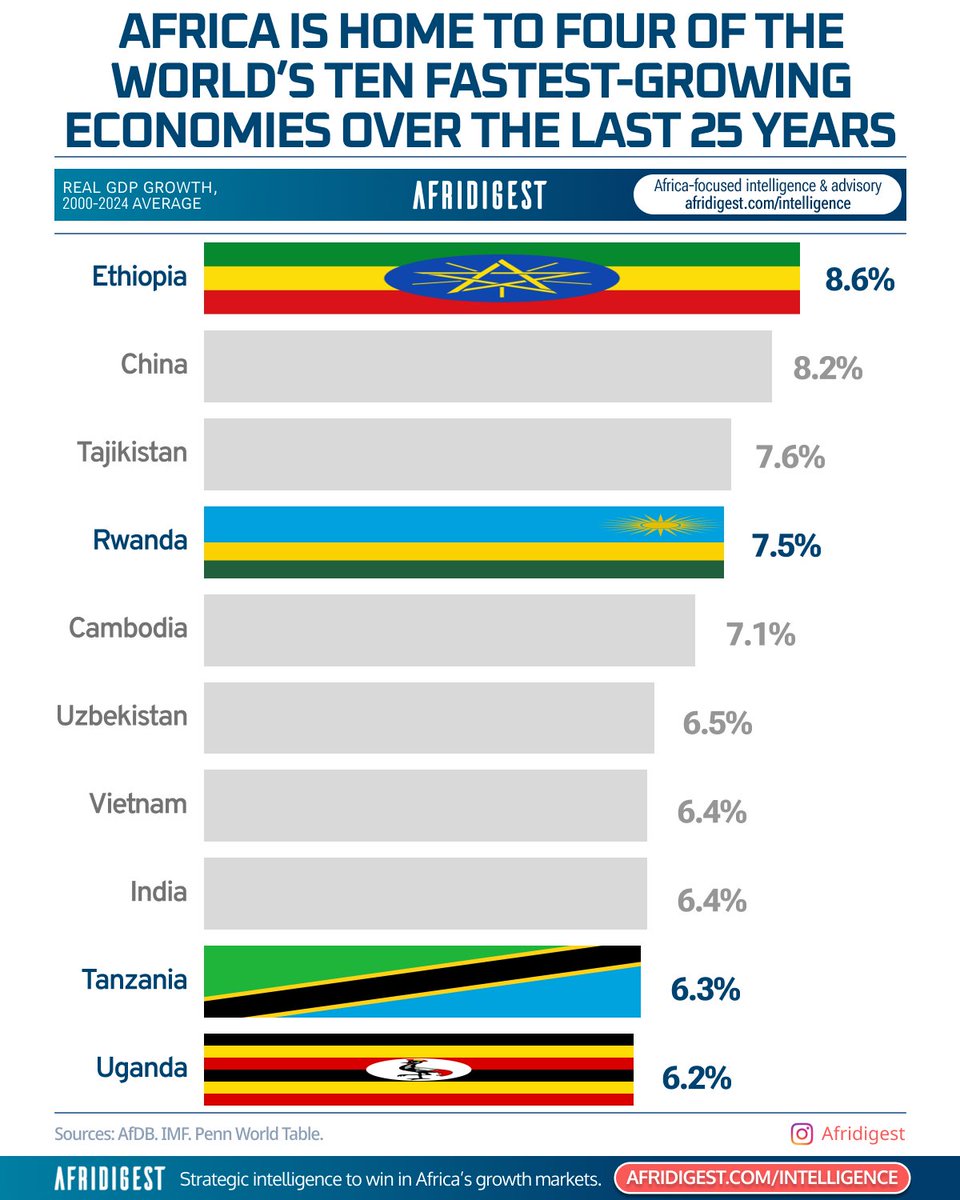
4 African economies rank among the top 10 fastest-growing in the world over the the last quarter century.
Not one year, but year after year for 25 years.
For the first portion of the 21st century, Ethiopia (#1), Rwanda (#4), Tanzania (#9), and Uganda (#10) have been writing the world's growth story alongside China, Cambodia, Vietnam, and India.
That's a story not enough people are talking about.
Of course, growth rates only tell part of the story.
GDP per capita, income distribution, poverty reduction, and other measures are important, too — and the picture there is less uniform
But a reality that's still underappreciated is this:
The world increasingly depends on Africa for growth — and these four economies are proving the continent can deliver it consistently.
—
Afridigest Intelligence — real intelligence & advisory to win in Africa's growth markets: https://t.co/pTeD1UjeWi | Follow Afridigest on LinkedIn & Instagram
4 African economies ranked among the top 10 fastest-growing in the world over the last 25 years.
What do they have in common with China, Vietnam, and Cambodia?
They all sustained growth in their physical capital stock — machines, buildings, roads, ports, factory and farm equipment, and other built infrastructure — above 7%.
That's the empirical threshold that separates the world's fastest-growing economies from the rest.
Specifically:
* 🇪🇹 Ethiopia poured capital into roads, railways, dams, and industrial parks — e.g., the Grand Ethiopian Renaissance Dam, the Addis-Djibouti railway — state-led investment financed heavily through external borrowing.
* 🇷🇼 Rwanda rebuilt physical infrastructure from scratch after 1994 — from fiber optic networks and the Kigali Convention Center to rural electrification — channeling public investment into construction, energy, and connectivity.
* 🇹🇿 Tanzania steadily expanded agricultural infrastructure, mining sector capacity for gold and natural gas, and construction — a diversified physical capital base with no single dominant sector.
* 🇺🇬 Uganda relied on commercial and services-sector investment — e.g., commercial real estate, trade infrastructure — and agricultural capital, without the large public infrastructure programs that defined its peers.
Meanwhile, the average for the African continent as a whole sat at less than half of these leaders for the last quarter century — 3.3% growth in the capital stock, resulting in 3.8% GDP growth.
To hit the GDP growth threshold that delivers jobs and poverty reduction at scale, the continent needs to more than double its capital stock growth rate — to 8.7% annually by 2030.
Closing that gap requires an estimated $3.5 trillion in additional investment over the next decade — capital deployed at a scale the African continent has never attempted before.
That requires a well-coordinated approach — unlocking domestic resources, and complementing them with regional and institutional investors, global private capital, and the diaspora, too.
The good news: Ethiopia, Rwanda, Tanzania, and Uganda have spent 25 years proving the formula works in different contexts.
What's left is mobilizing the capital to replicate it at continental scale.
—
Afridigest Intelligence — real intelligence & advisory to win in Africa's growth markets: https://t.co/pTeD1UjeWi | Follow Afridigest on LinkedIn & Instagram
@YemiBAE Two sides of the same coin, I'd argue
The forces pulling global attention, capital, & talent toward the continent are the same ones taking Africa's contributions global
"Africa to the World" also means building the conditions that make the world come to Africa to exchange value
For decades, the world wrote Africa's story.
Now Africa is increasingly writing the world's:
• The world depends on Africa’s minerals — according to the @WorldBankGroup, Africa holds significant current total world resources of platinum-group elements (76.3%), manganese (66.4%), graphite (57.0%), cobalt (50.5%), and various rare earth minerals essential for EVs, batteries, renewable energy, and defense technology
• The world depends on Africa for growth — across the world, just 41 economies are projected to grow at 4.5% or higher, and 59% (24) are African.
• The world depends on Africa for energy security — it represents ~10% of global oil production, ~40% of the world's solar power potential, and ~15% of the global natural gas reserves
• The world depends on Africa for food security — Africa possesses 60% of the world's uncultivated arable land and recorded the world’s fastest agricultural production growth rate between 2000 & 2020
• The world depends on African consumers — a growing African middle class is on track to drive a $2.5 trillion consumer market by 2030, and one in four people on Earth will be African by 2050
• The world depends on African producers — in the last 75 years, Africa went from 9% of the world's population to 19%. In the next 75, it's projected to double again to 38%, driving much of the world's output, from music to movies to the talent shaping industries worldwide
• The world's future depends on Africa's youth — within the next decade, Africa will have the world’s largest workforce, surpassing China & India, as other regions age and contract
The world doesn't just need Africa. It needs Africa to succeed.
And something is shifting.
African founders are building category-defining companies and playbooks that the rest of the world will eventually copy.
African investors are beginning to back them at scale — increasingly deploying domestic capital toward domestic opportunities and providing proof points for global capital.
Homegrown regional and continental organizations are coordinating, creating top down momentum.
And bottoms-up movements are gaining ground simultaneously, creating ownership and agency at the grassroots level.
Africans — on the continent and across the diaspora — are increasingly creating value for the world.
What's left is building the structures, platforms, and institutions to capture the value being created — and compound it into generational prosperity.
—
GAIA — Global Africa Investment Alliance: https://t.co/jmSXBIYq1V
"Until the lions have their own historians, the history of the hunt will always glorify the hunter." — Chinua Achebe
The photograph below was taken 63 years ago today — May 25th, 1963 — in Addis Ababa.
Kwame Nkrumah, Haile Selassie, Jomo Kenyatta, and 29 other heads of state gathered to sign the Organization of African Unity (OAU) charter — a declaration, in the most concrete terms possible, that Africa would write its own story.
The OAU transformed into today's @_AfricanUnion, whose Agenda 2063 lays out a vision for 'the Africa we want':
• good governance
• free movement of people
• a single market for goods & services
• inclusive growth that drives prosperity for all
• robust institutions that connect the continent to itself & the diaspora
• a negotiating position in international affairs commensurate with Africa's contributions to the world
As Achebe continued in the 1994 @ParisReview interview where he made the opening proverb famous:
"[Being that historian] is not one person’s job. But it is something we have to do."
Similarly, building the Africa we want is not one person's or one organization's job — but it is something we have to do.
The lions are still writing.
Happy #AfricaDay 2026.
—
Afridigest Intelligence — real intelligence & advisory to win in Africa's growth markets: https://t.co/pTeD1UjeWi | Follow Afridigest on LinkedIn & Instagram
When Jamie Dimon, CEO of @JPMorgan — the world's largest bank by market cap — visited Nigeria in 2024, he was asked how Africa could attract more private investment.
His answer was simple:
"Capital goes to where it's taken care of."
I was reminded of that while reading the latest news out of Senegal on Friday — that the country's President sacked the Prime Minister and dissolved the government.
It's a complex situation that comes after a months-long feud, and I won't pretend to know as much as my friends on the ground there.
But the bottom line is this: it increases uncertainty in a country already grappling with IMF bailout negotiations amidst a ~$13 billion debt crisis.
And as Dimon made clear to the audience in Abuja that day:
Capital hates uncertainty.
—
Afridigest Intelligence — real intelligence & advisory to win in Africa's growth markets: https://t.co/pTeD1UjMLQ | Follow Afridigest on LinkedIn & Instagram




![eajene's tweet photo. "Right now, I have a voice. Right now, I have the mouth to say, 'come and invest in Africa' — because I have demonstrated that these things are possible."
That's @AlikoDangote, Africa's richest man with a fortune estimated at roughly $32 billion.
He said that in a conversation with IFC Managing Director @Diop_IFC earlier this month on building the continent’s economic future — from his $20 billion investment in a Nigerian oil refinery to his continental-scale ambitions in energy, fertilizer, water and logistics.
And just yesterday, it was reported that Dangote became the single largest exporter of aviation fuel in April, according to S&P Global — not in the region, but the world.
Now, he's using the voice he has earned — perhaps provocatively.
Speaking to @TheTimes of London from his office in Ikoyi, Lagos, he shared this message for elites in the African diaspora:
Sell your Mayfair mansions.
Pull your kids out of Swiss boarding schools.
Fire your European bankers.
And come home.
"If we want to industrialize Africa, we Africans must move first. [African elites abroad] should sell those houses and come here and be in the trenches with people like us."
He's not asking the diaspora to sacrifice exactly.
He's saying that they're missing out — that those waiting for Africa to be "ready" before coming home are making a category error.
"We have waited for a long time for foreign investors to come and invest and make Africa great... But some of us realize that, no, that won’t happen. We have to lead in that transformation."
According to IMF estimates, his refinery currently contributes 1.5% to Nigeria's non-oil GDP.
And he's now planning a $10 billion expansion that would more than double its capacity, taking it to 1.4 million barrels per day — larger than any refinery on earth.
He's also targeting a $40-$50B valuation for that refinery in what's set to be the largest IPO in African capital market history — with subscriptions expected to open by August.
The man "demonstrating that these things are possible" is living proof of his own argument.
The question isn't whether Africa is worth betting on. Or whether outsized returns can be had.
It's whether Africans — in the diaspora and on the continent — are willing to bet on Africa themselves.
→ GAIA — Global Africa Investment Alliance: https://t.co/jmSXBIYq1V
→ Afridigest Intelligence — real intelligence & advisory to win in Africa's growth markets: https://t.co/pTeD1UjeWi
→ Follow Afridigest on LinkedIn & Instagram](https://pbs.twimg.com/media/HJjbb1RXkAQzvEs.jpg)




![eajene's tweet photo. "Until the lions have their own historians, the history of the hunt will always glorify the hunter." — Chinua Achebe
The photograph below was taken 63 years ago today — May 25th, 1963 — in Addis Ababa.
Kwame Nkrumah, Haile Selassie, Jomo Kenyatta, and 29 other heads of state gathered to sign the Organization of African Unity (OAU) charter — a declaration, in the most concrete terms possible, that Africa would write its own story.
The OAU transformed into today's @_AfricanUnion, whose Agenda 2063 lays out a vision for 'the Africa we want':
• good governance
• free movement of people
• a single market for goods & services
• inclusive growth that drives prosperity for all
• robust institutions that connect the continent to itself & the diaspora
• a negotiating position in international affairs commensurate with Africa's contributions to the world
As Achebe continued in the 1994 @ParisReview interview where he made the opening proverb famous:
"[Being that historian] is not one person’s job. But it is something we have to do."
Similarly, building the Africa we want is not one person's or one organization's job — but it is something we have to do.
The lions are still writing.
Happy #AfricaDay 2026.
—
Afridigest Intelligence — real intelligence & advisory to win in Africa's growth markets: https://t.co/pTeD1UjeWi | Follow Afridigest on LinkedIn & Instagram](https://pbs.twimg.com/media/HJJjK3YXAAA_u_N.png)


