The paper reinforces a need for joined-up, multilateral coordination on financial crime, digital governance, as well as intelligence-sharing. This is important to tackle hubs that are geographically-centred but becoming more diffuse in their organization and reach.
This new @IISS_org paper introduces a framework for identifying major criminal hubs in Southeast Asia - geographic clusters where transnational actors and multiple criminal economies converge, bringing cross-border threats and impacting regional security. https://t.co/NqsmFZnnHl
In this @WPReview briefing, I write that Laos must navigate geopolitical uncertainty and ongoing effects of its China-related debt crisis, as well as overcome domestic structural problems, if it is to build a more balanced and self-reliant economy. https://t.co/B1ywsVegwS
New metrics for @ReviewPacific ⤵️
Our Impact Factor has increased from 2.0 in 2024 to 2.4 in 2025, with our ranking among Area Studies journals 13/184.
Huge thanks to authors, reviewers, and all those that have engaged with the journal in the last year.
Since President Prabowo Subianto took office, Indonesia’s armed forces have returned to the center of national affairs in a way not seen since the fall of the Suharto regime in 1998, @JoshKurlantzick writes.
https://t.co/Mhipwhn0Q5
NEW REPORT | The Bangsamoro’s Moment of Truth
The peace process in the Bangsamoro, the newly autonomous Muslim-majority region in the southern Philippines, is confronting barriers. Manila and regional authorities need to work to continue the transition.
https://t.co/59J5J9zTSt
In this @WPReview briefing, I write about what might drive #Vietnam’s economy as To Lam targets 10% growth: export-led manufacturing, private sector reforms, and #infrastructure projects that aim to boost linkages in-country and with China to the north. https://t.co/AORT8mKors
Huge thanks as always to Editor @_IreneMia and the team at IISS. The report (covering July 2024 to June 2025) can be accessed here: https://t.co/N6OG9ZDnLk
It was great to see @IISS_org Armed Conflict Survey launched this week.
In the #Philippines: NPA insurgency persists, Bangsamoro elections again delayed. In southern #Thailand: peace talks stalled amid political upheaval and fallout from border conflict with Cambodia.
For context, no States Parties to @ISUCCM have used cluster munitions since the treaty entered into force in 2010 and all with stocks have since destroyed them, demonstrating its effectiveness.
Find out more: https://t.co/VfSgKuHI81
In Southeast Asia context: #Myanmar continues to produce and use air-dropped cluster bombs while #Thailand appeared to admit using cluster munitions in July border clashes with Cambodia. Lao PDR and Vietnam remain heavily contaminated long after use in 1960s-70s.
In @WPReview, I write that for the LPRP, securing future income from hydropower is tied not only to the state’s economic viability but also its legitimacy to govern, as #Laos seeks to forge a new national narrative centred on state-led economic development.https://t.co/qvOtysWkWX
In @Diplomat_APAC, based on research published in @ReviewPacific, @yaguerika and @hmberents argue that understandings of #peace and security in Southeast Asia can be enhanced via a focus on the role of #youth and their relationships with institutions. https://t.co/mXP3IqfSxq
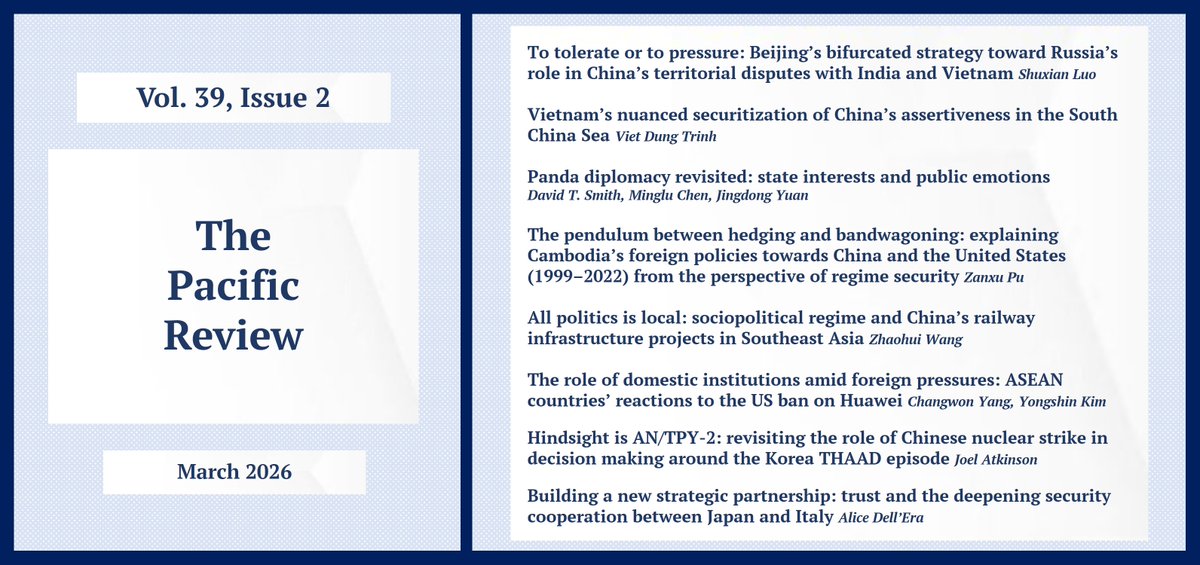
In this new article, Zhaohui Wang develops a sociopolitical regime framework composed of elite legitimization, inter-elite relations and elite-mass relations, to explain the outcomes of China’s railway infrastructure projects in Southeast Asia. ⤵️ https://t.co/cyHCEZz5kG