In this new paper, @SilviaMenegazzi examines China’s discourse power in shaping BRICS’s Global Governance Agenda through an analysis of summit declarations, leaders’ statements, and Chinese state-affiliated media.
Read it (open access 🔓) here: https://t.co/2ihXQg9JCk
In this new (open access 🔓) paper, @Mattlin_M and @LiisaKauppila explore how Finland, as a small technologically advanced state, seeks to maintain agency and manage security risks amid strategic technology competition between China and the United States. https://t.co/pu9QSF3hMT
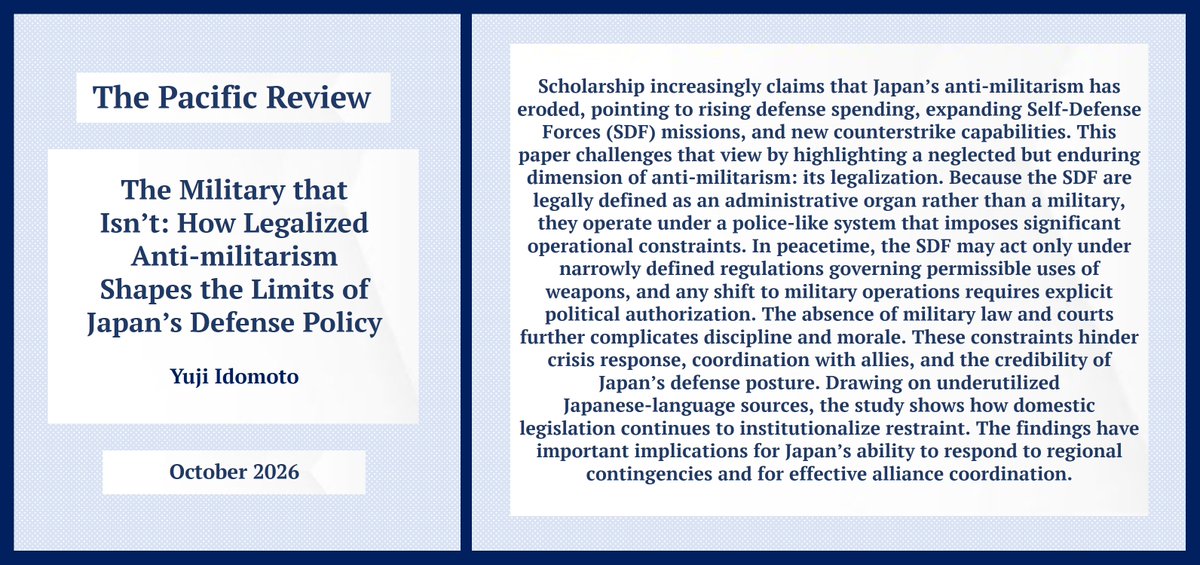
In this new article, @IdomotoYuji argues that the domestic legal definition of the Self-Defense Forces hinders crisis response, coordination with allies, and the credibility of Japan’s defense posture. https://t.co/9kfx7zBYOm
In this new paper, Haonan Hua (@KaKouNan0) argues that though minilateral cooperation, Japan seeks to strengthen strategic autonomy both within and beyond the US-Japan alliance while responding to uncertainty over the future of the regional security order. https://t.co/sdUSf7tKtv
In this new article, Yuhang Wei and Zhiqiang Sun argue that US-China strategic competition and spillovers of the Myanmar crisis shaped ASEAN’s policy evolution after the 2021 military coup, resulting in junta leaders’ exclusion from ASEAN summits. ⤵️ https://t.co/l0234iRidu
In this new article, Chia-yi Lee develops the concept of ‘two-way energy diplomacy’ to explain how China simultaneously addresses its traditional energy vulnerabilities while expanding its role in emerging green energy markets. ⤵️ https://t.co/X8Mcg22HzH
In this new paper, Charlie Pearson argues that China’s zonation strategy in the South China Sea combines maritime patrols, seasonal fishing bans, protected-area designations, and extraterritorial enforcement of national law to produce strategic effects. ⤵️ https://t.co/pDVxVR1a7E
In this new article, Morgan Thomas Rees argues that amidst growing uncertainty over the reliability of the US alliance, Australian foreign policy has been shaped by a recurring pattern of anxiety management. ⤵️ https://t.co/ANo29YVSLi
New article in @ReviewPacific “Fear of Abandonment and the US Alliance: The Paranoid Logic in Australian Foreign Policy.” Available open access!
https://t.co/TsZK60vwGg
In this new paper (open access 🔓), Sang Hun Seok traces the changing political meaning of nuclear weapons in North Korea, from representation as practical military instruments, to conditions for development and as a component of state identity. ⤵️ https://t.co/nISLAjh7nu
In this new article, @HiroOgi5 explains why the Japan Self-Defense Forces prioritised procurement efficiency and rapid capability acquisition over the domestic development of drone systems. ⤵️ https://t.co/8Tfhngf4pR
How do secondary powers develop anti-access/area denial (A2/AD) capabilities when facing asymmetric threats?
In this new article, @soulpark21, Inwook Kim, and Seung Joon Paik compare Vietnam, the Philippines, Malaysia and Indonesia. https://t.co/eIOte8SHDS
In this new article, Long Zhou argues Australia has enacted ‘emotional diplomacy’ toward Pacific Island states through constructing a discourse of the ‘Pacific family’, cultivating people-to-people ties and easing migration access. ⤵️ https://t.co/kY4t55uc7R
In this new paper, Seunghyun Kim compares policy processes behind Japan’s Basic Act on Ocean Policy and Basic Space Act, explaining why security-related claims acquired different statutory forms. https://t.co/qZ1paCSXxH
‘Residual dependency after diversification: Japan, China, and the midstream power of rare earths.’
Read this new open access (🔓) article by Vlado Vivoda ⤵️ https://t.co/hsXWvfi8WI
In this new open access (🔓) article, @GuangyiPan explains how middle powers function not as passive recipients of great-power regionalism but as active agents, recalibrating the spatial dimensions of regional cooperation to mitigate structural imbalances. https://t.co/xTDdXsHOUf
In this paper from our special issue on small European states’ relations with China, @DiegoTelias and @RQTurcsanyi explain how the Viktor Orbán government in Hungary approached ties with China, in the context of his worldview and domestic political agenda. https://t.co/fRwhL4MfXX
In this article from our special issue on small European states’ relations with China, @VictorDeDecker and Astrid Pepermans explain how in the case of Belgium, internal state structures complicate operationalisation of the EU’s economic security agenda. ⤵️ https://t.co/dGLT4wOEGx
‘A small state in big power politics: the securitisation or riskification of Sino-Irish relations.’
Read this paper by Niall Duggan, in our special issue on small European states’ relations with China. ⤵️ https://t.co/Vo78hwGa51