Something surreal happened a few weeks back. The (fairly new) front right tyre of my car burst on a potholed highway at 11.30pm in the middle of nowhere in western UP. The bursting of the tyre (though infuriating & dangerous) wasn’t the surreal part. What came next was. (Thread)
Something incredible is happening inside a lab in Pune, and I am not sure how many of us are aware of it.
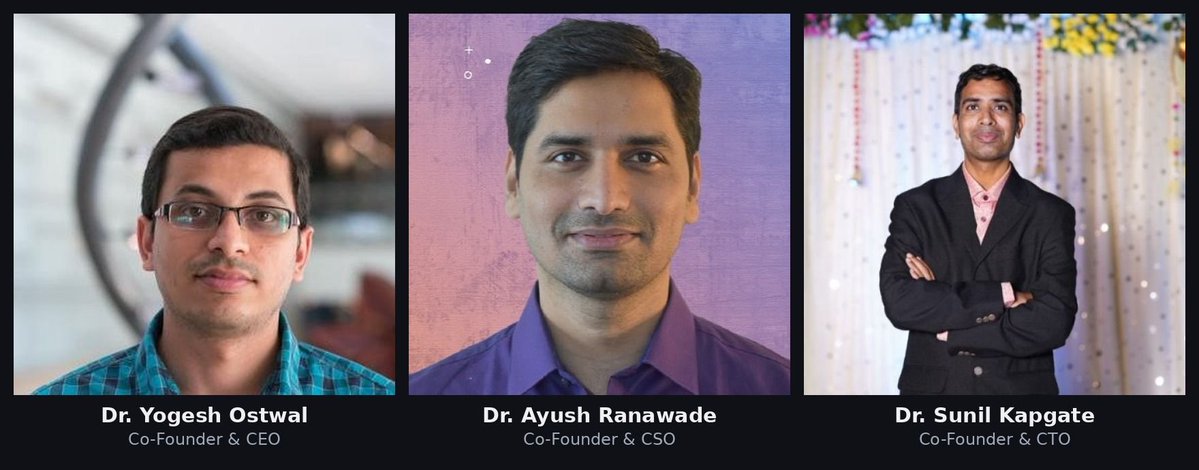
3 young PhD scientists, Dr. Yogesh Ostwal, Dr. Ayush Ranawade and Dr. Sunil Kapgate, are doing something that sounds like science fiction. They are designing viruses that hunt cancer.
Their startup is called Nucleovir Therapeutics, founded in 2024 at the incubation centre of IISER Pune.
The idea is simple to say and very hard to do. Cancer cells survive because our immune system fails to spot them. Certain viruses, called oncolytic viruses, can expose these hidden cells and also kill them directly.
Nucleovir uses its own AI model to design such viruses. Work that earlier took years can now be done in months.
Their 1st targets are glioblastoma, the most aggressive brain cancer, and pancreatic cancer. 2 of the toughest cancers we know.
And this is not just an idea on a slide. Nucleovir is the 1st licensed oncolytic virus manufacturer in India.
BIRAC picked them as 1 of the top 5 winners of its Bio AI Hub program in 2025 and funded them. Speciale Invest backed them in a seed round in June 2026, and BIRAC supports their AI platform under the government's Bio-AI program. NITI Aayog has featured them on its Frontier Tech portal.
Right now they are in the preclinical stage, preparing their 1st animal trials for the anti-glioblastoma virus. Human trials come after that.
It is a long road. But the question that started this company is worth reading twice: what if curing cancer could one day be as simple as taking a flu vaccine?
In a country where at least 15 lakh people battle cancer, 3 PhDs in a Pune lab have decided to fight cancer with a virus.
Names to remember: Yogesh, Ayush and Sunil. 🙏🙏
Sources: NITI Aayog Frontier Tech portal, Nucleovir Therapeutics, BIRAC
Photo: Dr. Yogesh Ostwal (CEO), Dr. Ayush Ranawade (CSO) and Dr. Sunil Kapgate (CTO), founders of Nucleovir Therapeutics, Pune. Credit: @SpecialeInvest
Not just a Mumbai phenomenon. Young radicalized boys itching for a fight. If you react, they will mobilize a crowd . We have moved away from mohallas to gated apartments where you don't know anyone. In 80s 90s, every street had those Mithuns & Govinda dadas who would rush to help
Guys, this is very serious and you have to read this right now. The Riemann Hypothesis may have just been solved, and if the claim holds, it's an insane achievement.
In mathematics there is a famous problem called the Riemann Hypothesis, and it's about prime numbers. Primes are numbers like 2, 3, 5 and 7 that can only be divided by 1 and themselves. Every other number is built by multiplying them together, so they're the building blocks of all numbers. You can never tell exactly where the next prime will show up, but if you step back, there's a pattern.
Around 1,000, about 1 in 7 numbers is prime. Around a million, about 1 in 14. Around a billion, about 1 in 21. Primes get rarer at a steady, predictable pace.
Because of that pattern, mathematicians can estimate how many primes there are below any number. But the estimate is never exactly right. It's always a little off, and the big question is how far off it can get. Think of flipping a coin 1,000 times. You expect 500 heads, but you'll get something like 480 or 520. It's a little off, but never wildly, and you can predict how far off it will be.
In 1859 a mathematician named Bernhard Riemann found that the prime estimate's error isn't random. It's controlled by a hidden set of special numbers. Where those numbers sit decides how big the error gets. Riemann guessed that every single one of them sits on one straight line. If he's right, the error always stays small, just like the coin, and primes are as orderly as they could possibly be. If even one of those numbers is off the line, the error can grow much bigger, and primes are far messier than we think.
So far computers have found trillions of these special numbers, and every single one is on the line. But there are infinitely many, so checking will never be enough. You need a proof that covers all of them at once. For 167 years nobody has found one. It's one of the seven hardest unsolved problems in mathematics, with a million dollar prize attached.
Now a mathematician has posted a note saying that, working with Claude, he believes he has that proof. He says a computer has already checked every step, and that Claude raced ahead of him near the end. Experts still need to confirm it, but this isn't a random internet claim.
If it holds, it doesn't mean we can predict every prime. It means we finally know the pattern can never go wildly wrong. Thousands of math papers that begin "assuming the Riemann Hypothesis is true" become proven fact overnight. We'd also get firm limits on how far apart primes can be, and a guarantee that a fast method for testing whether a huge number is prime always works. And no, your bank account isn't in danger. Online security depends on how hard it is to break a huge number into its prime factors, and this proof doesn't make that any easier. If anything, it gives the math behind encryption a stronger foundation.
If it holds, this is bigger than one math problem. A question that beat the greatest minds in history for 167 years would have been cracked by a human and an AI in a matter of weeks. If AI can find answers and computers can check them, the limit on science is no longer how smart we are. It's how many good questions we can ask.
Someone should take Ramanujan's notebooks, use the best AI tools, and start extracting world changing mathematics.
I'm sure some missed discoveries still lurk in them. Maybe @AravSrinivas can get Alladi Krishnaswami at UF Gainsville involved, and make it happen at Perplexity.
Rajdeep: "Even if 10% Guj doesn't agree with you, shouldn't you go and reach out?"
Modi: "Just because someone has got a chance to ANCHOR, he's twisting the event's agenda. Organisers should see this."🔥
Now I know why Rajdeep dislikes Modi so much😭