We are investigating unauthorized access to GitHub’s internal repositories. While we currently have no evidence of impact to customer information stored outside of GitHub’s internal repositories (such as our customers’ enterprises, organizations, and repositories), we are closely monitoring our infrastructure for follow-on activity.
gaugo: a go-native eval framework for AI apps (RAG, agents, chatbots, prompts).
a side project i'm working on and wanted to share:
https://t.co/aTGjsW3Iu1
As quantum computing rapidly converges with AI and accelerated computing, the skills students need are evolving fast. Educators now face a key question: how do you prepare students for what’s next?
Join us for CUDA Live: CUDA-Q Academic Demo Day on May 20 to explore free, open-source CUDA-Q Academic resources designed to make quantum computing accessible, practical, and industry-relevant. You’ll see modular, classroom-tested notebooks, interactive visualization tools, and live demos, with resources that can be run across platforms like NVIDIA Brev, Google Colab, qBraid, and Amazon Braket.
We’ll also dive into how AI is reshaping quantum education—and what an agentic-first future means for your curriculum.
📅: May 20 | 11:00 AM–12:30 PM CDT
🔗: https://t.co/rYEDg0Dqd5
Skills in Chrome are now available. Get started saving and customizing your favorite prompts with our quick tutorial.
What Skill are you saving first? ⬇️
Tomorrow on Open Source Friday 👇
We're breaking down Spec Kit: what it is, the problems it solves, and how clear specs make collaboration actually work. Principal Software Engineer Manfred Riem explains live.
Set a reminder. 🔔
https://t.co/g0xrLf3Hb5
We’ve agreed to a partnership with @SpaceX that will substantially increase our compute capacity.
This, along with our other recent compute deals, means that we’ve been able to increase our usage limits for Claude Code and the Claude API.
Breaking LLM inference’s autoregressive bottleneck 🛠️
We've teamed up with @haozhangml, @YimingBob, and @aaronzhfeng, among others from UCSD to achieve a massive 3.13X speedup for LLM inference on Google Cloud TPUs using Diffusion-Style Speculative Decoding (DFlash).
Read the blog: https://t.co/bIugAUJm8S
Claude Code ships with 5 architectural layers most engineers never open.
Not features. Not settings. Layers — each solving a distinct problem that LLMs alone can't solve. And four of them have nothing to do with prompting.
Here's the full Agent Development Kit:
Layer 1 — CLAUDE.md → The Memory Layer
Architecture rules, naming conventions, test expectations, repo map. Always loaded. Always active.
Two scopes:
• ~/.claude/CLAUDE.md → global
• .claude/CLAUDE.md → project
This isn't context you paste in before every session. It's context that never needs repeating. The agent's constitution.
Layer 2 — Skills → The Knowledge Layer
Each SKILL.md carries a description. Claude matches it at runtime and forks the skill into an isolated subagent. On-demand, never always-on.
Task-specific knowledge without inflating your main context window. Modular by design.
Layer 3 — Hooks → The Guardrail Layer
PreToolUse → PostToolUse → SessionStart → Stop → SubagentStop
This is the layer most teams skip. And the one they regret skipping first.
Hooks are NOT AI. They're deterministic event-driven shell commands.
• Auto-lint on every Write
• Hard-block on rm -rf
• Slack notification on Stop
Event fires → Matcher checks → Command runs
Quality enforced at the infrastructure level. Not the prompt level.
Layer 4 — Subagents → The Delegation Layer
Each subagent gets its own context window, model, tools, and permissions.
Main agent delegates down. Receives results up. That's it.
No infinite recursion — subagents can't spawn subagents. Main context stays clean. Hard boundaries by design.
Layer 5 — Plugins → The Distribution Layer
Bundle your skills + agents + hooks + commands into a plugin. One install. Whole team inherits the behavior.
Think npm packages — but for what your agent knows how to do.
Wrapping everything:
→ MCP Servers on the left (GitHub, databases, APIs, custom integrations)
→ Agent Teams on the right (parallel execution, message passing, shared permissions)
The 5-layer stack in one line:
CLAUDE.md sets rules → Skills provide expertise → Hooks enforce quality → Subagents delegate work → Plugins distribute to the team
Most production failures in agentic systems trace back to one missing layer.
Which one is the gap in your current setup?
¡Felices 20 años, Google Translate! 🎂🌎
Llevamos dos décadas rompiendo las barreras idiomáticas. Pero hoy, en vez de pensar en todos puentes que construimos, ¡queremos celebrar cómo nos comunicamos en nuestra región! 🧵👇
This month, the @GeminiApp became even more intuitive, integrated and personalized.
Here's a snapshot of what's new:
🌏 Personal Intelligence is now available to even more users around the world. Now, it can also generate images that reflect your life, interests and the things you care about most using Nano Banana and your @GooglePhotos library.
📓 We introduced notebooks — our “project” feature that integrates with @NotebookLM, giving you a home base for your big ideas that stays in sync across both tools.
🍎 The Gemini app is now available on Mac. Download the desktop app to get AI assistance from Gemini with just a keyboard shortcut (Option + Space). Share anything on your screen — including local files — to get support with whatever you’re looking at.
🎵 Create custom tracks up to 3 minutes long for free with Lyria 3 Pro. To try it, select “Create music” in the tools menu and “Thinking” or “Pro” from the model picker.
📈 Gemini can now transform complex questions into custom, interactive visualizations right in your chat — like playing with adjustable sliders for gravity and velocity to explore questions like how the moon orbits earth.
Qwen-Image-2.0-Pro is now live 🚀🚀
We’ve pushed image quality, multilingual text rendering, and instruction following to a new level, while making performance much more consistent across styles.🌅🌃
Ranked #9 worldwide for Text-to-Image on @arena
🔗Try it now on
ModelScope:
https://t.co/pPtrbjzzBK
https://t.co/raB6WWMEMP
API:https://t.co/EgYS5qt2bF
🚀 DeepSeek-V4 Preview is officially live & open-sourced! Welcome to the era of cost-effective 1M context length.
🔹 DeepSeek-V4-Pro: 1.6T total / 49B active params. Performance rivaling the world's top closed-source models.
🔹 DeepSeek-V4-Flash: 284B total / 13B active params. Your fast, efficient, and economical choice.
Try it now at https://t.co/GCdiMzk1Dl via Expert Mode / Instant Mode. API is updated & available today!
📄 Tech Report: https://t.co/drlDrxkYtp
🤗 Open Weights: https://t.co/T13Y8i7SDM
1/n
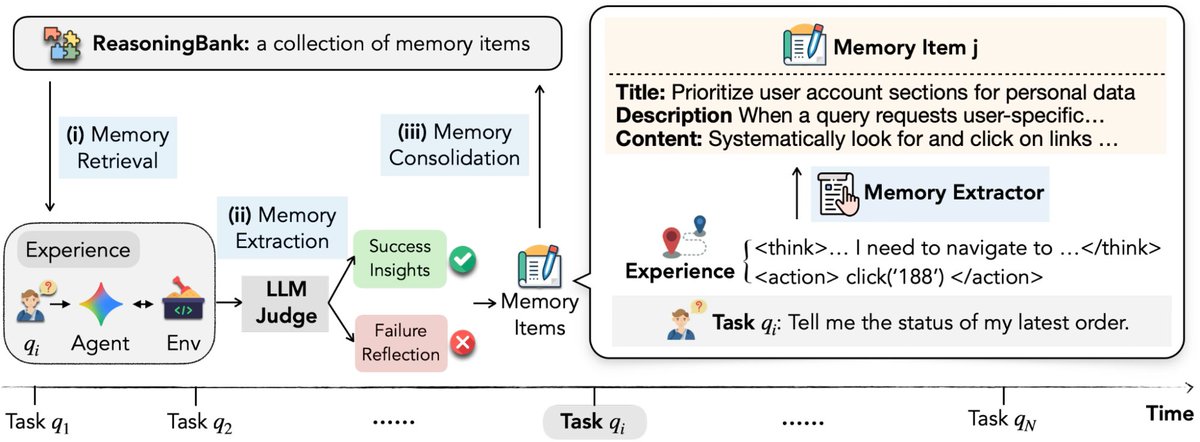
ReasoningBank, a novel agent memory framework, enables LLM agents to continuously learn from both successful & failed experiences. Our evaluation shows that it enhances agent effectiveness, boosting success rates and efficiency. Learn more: https://t.co/lHlYzeKMcm
A2UI v0.9 is the new standard for portable Generative UI, allowing your agents to natively "speak" UI directly to your existing frontends.
✨ React, Flutter, and Angular support
🐍 Python SDK via pip install
⚡ High-performance streaming
🛠️ Design system integration
Learn more via the blog: https://t.co/YOTjKGBDjm
THE ANTHROPIC ENGINEER WHO WROTE "BUILDING EFFECTIVE AGENTS" EXPLAINS IT ALL IN UNDER 15 MINUTES.
More useful than months of figuring it out yourself.
Worth watching & bookmarking for the weekend.
GOOGLE BUILT A SECRET WEAPON FOR FILE DETECTION
they ran it internally for years, gmail, drive, safe browsing, hundreds of billions of files every week
then they open sourced it
it's called magika and it exposes what files really are, not what they pretend to be
rename malware to "resume.pdf"? magika sees through it
disguise a script as an image? magika sees through it
any trick attackers use with file extensions? magika sees through all of it
ai trained on 100 million files. 200+ content types. 99% accuracy. 5ms per file
one command
`pip install magika`
the same tool protecting google's billion users is now protecting yours
https://t.co/Jr3LjmQobq