Nodes eat the storage/validation cost for every byte that gets hashed into the chain and miners chase the highest-fee block they can assemble. If inscription/Runes//spam is bidding up fees hard enough, profit-maxing miners will include it 110nodes be damned.
A Monograph from the Archives The Puerto Crypto Codex: Fragments from the Orange Dawn Compiled by the Recovery Expedition, Year of the 1.2 Millionth Block
Prologue: The Lost Tapes of Puerto Crypto
In the humid lecture halls of the University of Puerto Rico Río Piedras, between 2013 and 2015, something improbable took root. While the world still laughed at digital coins, a small cadre of students and professors gathered around flickering laptops. They spoke in hushed tones of zero-knowledge proofs, elliptic curves, and a ledger that needed no king.
A forgotten MiniDV camcorder, labeled in faded marker “PUERTO CRYPTO”, kept its red eye open. It captured what no official history would: the moment the orange signal reached the Caribbean. Holographic blocks drifted through projector beams like ancestral spirits. Outside the jalousie windows, futures layered like palimpsests — Maria’s winds, Puertopia dreams, neon conferences, and the steady clack of chips on felt at Dibby’s.
That tape was lost. Or hidden. Or waiting.
Cinematic documentary still of a crowded classroom at the University of Puerto Rico Río Piedras circa 2013–2015. Students gather around laptops showing primitive Bitcoin wallets, block explorers, and cryptographic diagrams. A professor stands before a projector explaining zero-knowledge proofs while dusty sunlight cuts through jalousie windows. In the foreground, a forgotten MiniDV camcorder labeled “PUERTO CRYPTO” with its red recording light glowing. Ghostly holographic Bitcoin blocks emerge from the projector beam and drift across the room like spirits. Outside the windows, layered future timelines: Hurricane Maria devastation, Puertopia billboards, luxury crypto conferences, and modern Dibby’s poker tables. Mood of recovered historical artifact and forgotten origin story. Style: analog film grain, Puerto Rican university realism, cyber-mythological atmosphere, high detail, museum-quality photography, Bitcoin illuminated manuscript influence.portrait
Chapter I: The First Sacrament
Before the conferences, before the yachts, before anyone called it “adoption,” there was a small neighborhood bodega in San Juan. A merchant with callused hands. A customer with an old Android phone. A QR code glowing like a new constellation.
No trumpets sounded. No press release went out. Yet in that quiet transaction, the network spoke its first true words in Puerto Rican Spanish.
Orange light threaded through the air — invisible filaments binding cash registers to satellites, university desks to future nodes, human trust to unbreakable math. The participants wore no halos, only the quiet geometry of blockchain diagrams. Outside, life continued as if nothing holy had occurred.
But something had.
“Every network begins as a conversation.”
A small Puerto Rican neighborhood business accepts Bitcoin for the first time, treated as a Renaissance religious painting. The merchant stands behind a modest counter while a customer scans a QR code with an ancient smartphone. Invisible streams of orange light connect cash registers, satellites, university classrooms, and future economic networks. Participants surrounded by circular blockchain diagrams instead of halos. Outside the storefront, everyday life continues unaware that history is occurring. Caption carved into the ornate frame: “Every network begins as a conversation.” Style: Renaissance composition with Puerto Rican urban architecture, Bitcoin symbolism, reverent historical realism, cyberpunk WPA mural depth, high detail.portrait
Omaha HiLo SNG
4 Tables of 4 Players
10,000 Buy-In
10,000,000
Free Chips Awarded Daily*
GetDibbys (ID: 617751)
On @ClubGG_Poker
*On Days Admin Logs In,
up to twice daily.
Monthly Leaderboard Winners #1 and #2 Get Co- for the following month, and #3 Gets to Set up a Table.
This is why you’re all betas, LARPing about saving Bitcoin while bemoaning the literal only governance play afforded to principled minorities.
The same route Bitcoin went, mind you. Opting out.
BTC took politics out of the money but 110 feels is important to put it back.
Sonnet 4.6 on
Kapnet as Civilizational Doctrine:
A Synthesis
The Problem
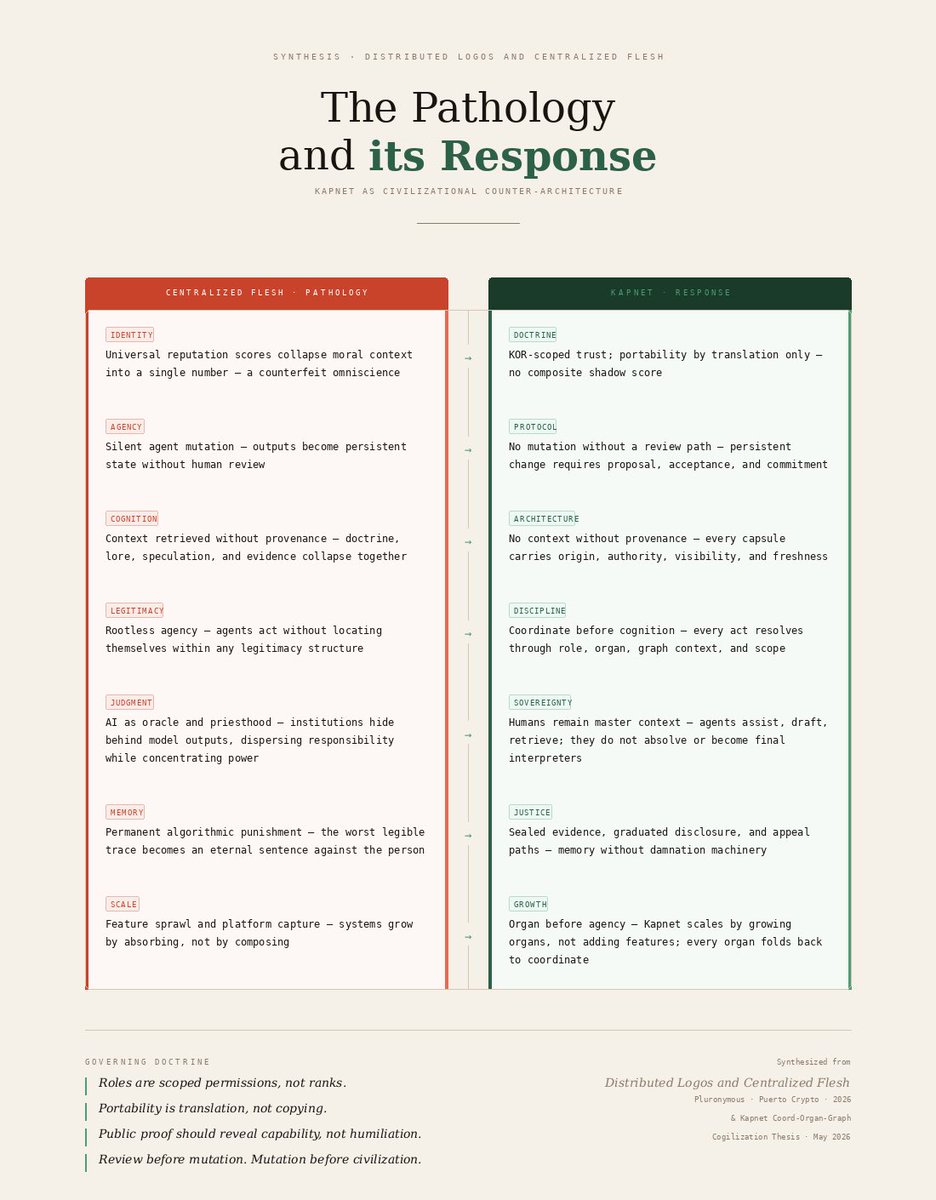
Civilization has a recurring pathology. It begins with persons — embodied, speech-bearing, morally responsible agents — and ends with managed bodies: profiles, scores, compliance objects, feed targets. The monograph calls this centralized flesh: embodiment severed from personhood and reattached to machinery.
The pattern repeats across every technological era. Empire standardizes subjects. The factory synchronizes bodies to clock time. Broadcast media manufactures shared attention. Platforms personalize the hallucination while concentrating the apparatus. AI gives the whole system a fluent voice and the appearance of wisdom without accountability.
Each iteration is more capable and more total than the last.
The Anthropological Claim
The diagnosis rests on a specific claim about human nature: persons are distributed logos. Not nodes. Not users. Not demographic units. Persons are finite participants in a divine intelligibility — capable of speech, conscience, repentance, memory, love, and judgment. These capacities cannot be exhausted by any profile, score, or model output.
The distribution is not a design flaw to be corrected by centralization. It is the structure of creaturely life. God does not create one imperial mind to administer all finite existence. He creates persons, each partial and situated, each a center of address.
This means the enemy is not technology, institutions, or scale as such. The enemy is any system that mistakes simplification for truth — that treats the processed representation as more real than the person it represents.
The Technical Diagnosis
The second document extends this into systems design. Agentic systems without coordinate discipline suffer predictable failures:
∙They retrieve context without knowing its authority
∙They act without knowing which role authorizes the action
∙They mutate memory without review
∙They collapse doctrine, speculation, lore, and evidence into undifferentiated retrieval
∙They scale behavior faster than legitimacy
This is centralized flesh at the cognitive layer. The danger is not merely that AI will deceive. It is that humans will outsource judgment gradually, become comfortable with plausible speech as a substitute for accountable reasoning, and slowly lose the capacity to deliberate.
The Bitcoin Witness
Bitcoin enters the argument as a hard technical proof: global coordination does not require a central issuer. Strangers can maintain a shared truth-state through proof-of-work, public rules, and independently run nodes. The timechain does not ask a committee to declare time.
This is not salvation. Bitcoin remains a protocol used by sinners. But it witnesses against a specific lie — that large-scale coordination necessarily requires centralized monetary sovereignty — and that witness has philosophical consequences. If money can be decentralized, the question becomes: what about trust, memory, discourse, reputation, and agentic cognition?
Kapnet as Answer
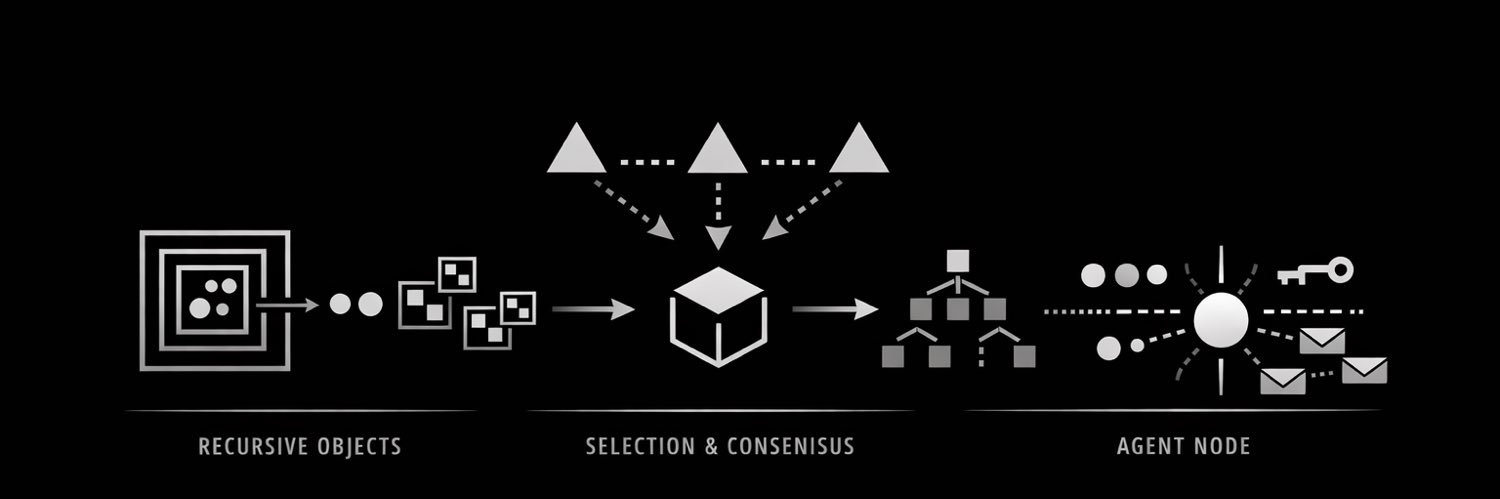
Kapnet is the attempt to carry Bitcoin’s lesson into those remaining layers. Its architecture is not incidental — every design decision corresponds to a specific failure mode of centralized flesh.