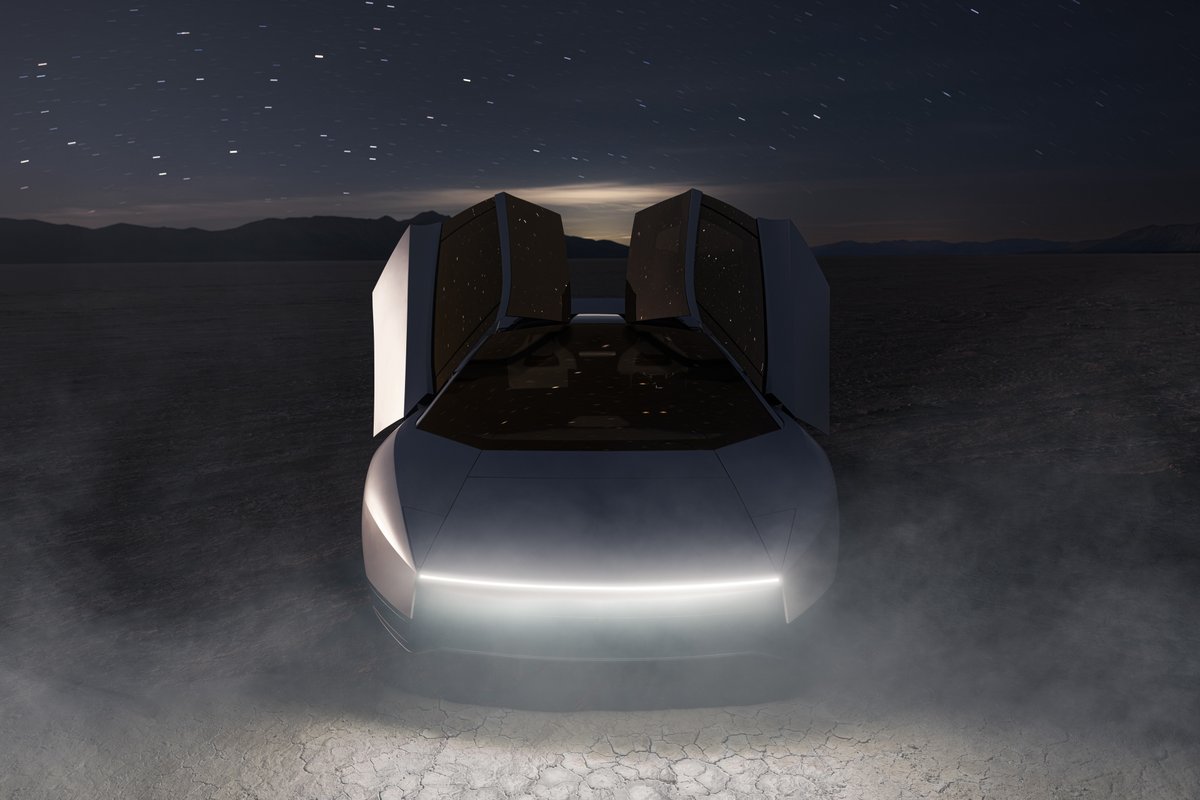
Incredibly grateful to live in the most amazing country and during the same time as Elon Musk and Donald Trump as well as several other great human beings.
•Autopilot: an advanced speed keep distance maintain lane assist.
•FSD: the car drives itself, fully, from any point to any point, backs out of a parking spot at departure point, finds a parking spot and parks at arrival, and ANYTHING in between, including human+ reflexes, obstacle and accident avoidance.
Configurations
– Performance: road ready, seats 2
Active aerodynamics & multi-mode suction system for next-level performance on & off the track
– Thrust: race ready, seats 2
Multi-mode suction system paired w/ rear-mounted cold-gas thrusters that enable 0–60 in <1 second
– Rocket: air ready, seats 1
Multi-mode suction system plus perimeter-mounted cold-gas thrusters supporting forward & upward acceleration plus lateral rotational movement. So...yes, it can fly
Range >300 miles
Top speed up to >230mph (Rocket)
0-60
Performance (<1.6)
Thrust (<0.9)
Rocket (<0.59)
Reserve now –
https://t.co/EHpRpNx5QA
ELON MUSK: “You’re going to see the results of what happens when you have a collaboration with the world’s best car company and the world’s best rocket company.
This is the culmination of incredible work by Tesla and SpaceX engineers working closely together to make something that you haven’t seen in any movie. Better than any James Bond car. I’ve never seen anything like this.”
Congrats!
CEOs & execs posting to the public directly on 𝕏 is the best way to get your message out and drive product sales.
Vastly more powerful and effective than a press release.
Prediction: there will be massive markets built on the right ontologies for agents.
Everyone keeps saying software is dead. I think it's the opposite. We're about to rebuild a huge part of it, and a lot of value will be created there.
Look at how most agents work today. They reinvent the wheel in a pile of .md files. Context is scattered, structure is improvised, and every run starts almost from scratch. That makes them hard to trust and even harder to iterate on.
Picture a company where every employee handles a different task with zero process, zero back office, and no shared place to store data. Every time someone does something, they rebuild it from memory. That company wouldn't scale. That's roughly where most agents are right now.
Agents clearly work. But we're still in the slot machine era: pull the lever, sometimes you hit, sometimes you don't. The next era is reliability, and reliability doesn't come from better prompts alone. It comes from structure.
That structure is an ontology: the core primitives of a domain and how they connect to each other. What a client is, what a project is, what a deliverable is, who owns what, what depends on what, what "done" means.
Some of these primitives need real UX and UI to get set up properly, because humans have to define them, shape them, and validate them. Once they're in place, they become the ground agents stand on. Agents stop guessing and start operating.
That's where compounding happens. Collaboration gets simple because humans and agents share the same model of the world. Work stacks on top of previous work instead of evaporating. Nobody reinvents the wheel, human or machine.
This is the return of the system of record, in a new form.
Software used to be purely UI, built for humans clicking buttons, or purely API, built for developers wiring things together. Neither was designed for agents that need to read, reason, act, and write back with full context. We now need tools designed from day one to be agent-native systems of record.
Right now, a huge number of functions should have an agentic system of record and don't. Across sales, ops, finance, legal, hiring, content, support, and every vertical you can think of, the ontology still lives in people's heads, in spreadsheets, or in a markdown file an agent rewrote last Tuesday.
Each of those gaps is a startup.
Software isn't dead. We're about to rebuild it for its new users.