How is it possible that some Zimbabwean medical aid companies in 2025 prepared their financial statements using ifrs 4 or/ conventional method instead of ifrs 17, & still got clean audit opinions? Auditors, what am i missing?
Road safety tip: Put your phone away before you drive.
Switch on “Do Not Disturb” or place your phone in the glovebox before you set off. Your phone can wait. Getting home safely can’t. Read more👉 https://t.co/F3P2IxKIjo
Through the VOICE trial, Terry is using his Neuralink implant to help fine-tune a brain-to-voice interface for himself and others who can’t speak. He trained the algorithm first by miming speech as best he could, then by simply thinking the words and hearing them come out in his own natural voice.
Powered by Grok Voice from @SpaceXAI
On the taxation issue. Engage the taxman and ask DHL which ZIMRA office computed the taxes. Bring your supporting documentation: receipts and invoices for the jersey & courier. They should recalculate the duty for you, using the evidence you provide. Most likely, the taxman used their own estimate when they assessed. They use a tariff handbook for these calculations, which makes it standardised. You also need an accountant friend in your life [banter]. They'll help you in these circumstances.
If you are an organization where managers do not know how much their direct reports earn, and have no meaningful say in what those employees are paid, you are probably running one of the most opaque remuneration systems possible.
You have effectively made managers accountable for attracting, motivating, retaining and managing people while denying them visibility and influence over one of the most important parts of the employment relationship: pay.
That disempowers managers. How can a manager discuss performance, promotion, retention risk or career progression intelligently when they don't even know what the employee earns or where that salary sits within the pay range?
When we encounter this with clients, one of the first things we push for is clear managerial accountability for remuneration decisions. HR should provide the governance framework, market data, pay ranges and controls, but managers must understand the pay of the people they manage and have an appropriate role in pay decisions.
You cannot hold managers accountable for their people while keeping them in the dark about what those people are paid.
@ipcconsultants
@mk_tycoon Good governance! From my lived experiences, good governance is propensed to fail when a business is owner-managed. The two seem to be mutually exclusive this side of the Limpopo.Unless the owner has integrity.
Do not stay too long with one employer if you can help it. Loyalty does not guarantee career growth, salary progression or job security. Sometimes the only way to move forward is to change jobs. Never become too comfortable in any role. The position you believe is secure today can disappear in one meeting tomorrow, leaving you completely unprepared for the job market.
As a board member, one of the worst things you can do is remain silent when wrongdoing, illegality, or unethical conduct occurs within the organisation.
Be prepared to stand alone for truth and integrity, even when the majority is heading in the wrong direction. In time, the truth will vindicate you.
Stand firm. Ask the difficult questions that no one else is prepared to ask. Never go along simply to get along. Silence in the face of wrongdoing is a terrible way to govern.
@ipcconsultants
May 2026 give 🙏 . May it also give to my close family members🙏.
May our honest hard work pay off. The ideas, the execution, the decision making.
May we have an unfair competitive advantage.
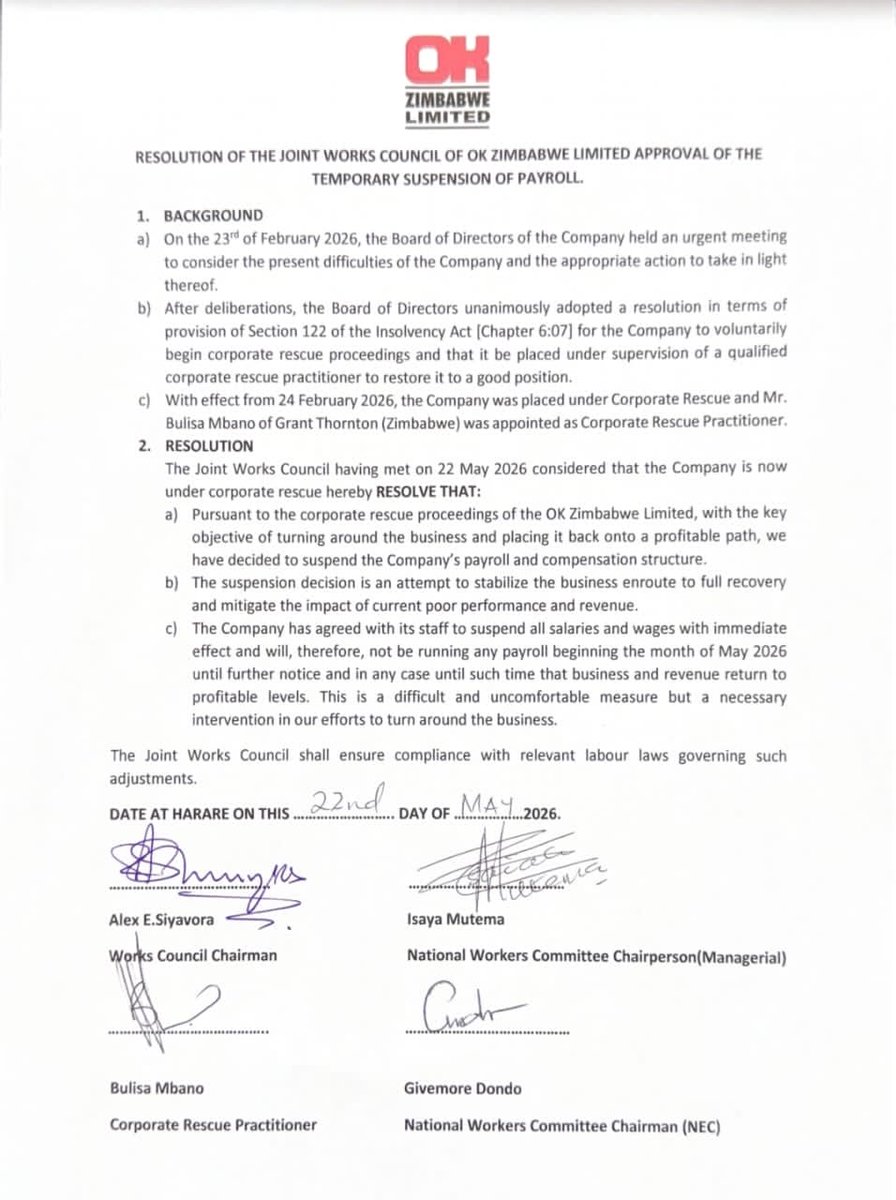
𝗦𝗵𝗼𝗰𝗸 𝗮𝘀 𝗢𝗞 𝗭𝗶𝗺𝗯𝗮𝗯𝘄𝗲, 𝘄𝗵𝗶𝗰𝗵 𝗶𝘀 𝗰𝘂𝗿𝗿𝗲𝗻𝘁𝗹𝘆 𝗼𝗽𝗲𝗿𝗮𝘁𝗶𝗻𝗴 under corporate rescue, has suspended its employee payroll to "facilitate recovery."
The retail giant is basically asking its staff to work for free. We are highly sceptical of this plan, which is as bizarre as it is unfair. While the supermarket chain is indeed in deep trouble, this move highlights a darker side of local corporate culture:
* 𝗟𝗮𝗯𝗼𝘂𝗿 𝗘𝘅𝗽𝗹𝗼𝗶𝘁𝗮𝘁𝗶𝗼𝗻: Big companies in Zimbabwe exploit the fact that the unemployment rate is extremely high. Management knows desperate workers will endure unpaid labour just to avoid losing their jobs entirely.
* 𝗧𝗵𝗲 𝗘𝘅𝗲𝗰𝘂𝘁𝗶𝘃𝗲 𝗗𝗶𝘃𝗶𝗱𝗲: The same executives who splash massive bonuses on themselves during the good years cannot seriously expect ordinary shop-floor workers to bear the brunt of a collapse.
Forcing staff to work under a total salary freeze pushes the burden of institutional failure directly onto families who can least afford it. 🛒📉
Can a retail giant seriously expect to turn things around with an entirely unpaid workforce?
Join the 𝗭𝗶𝗺𝗽𝗿𝗶𝗰𝗲𝗰𝗵𝗲𝗰𝗸 WhatsApp Channel for more corporate updates and market trends:
https://t.co/YFpwAWekkX
#Zimbabwe #OKZimbabwe #CorporateRescue #LabourRights #Zimpricecheck