Further to Blair. Literally every honest sensible person in all the main parties privately agrees with all these propositions:
- welfare spending is too high and is throwing good people on the scrapheap
- defence spending is too low
- the triple lock is unsustainable
- without cheap energy we cannot exploit the AI revolution
- we should be investing in EVERY form of energy: renewables, nuclear and the North Sea
- migration needs to be controlled to boost social cohesion and because the boats look like a huge failure of the state
- any new relationship with the EU will be imposed on us until we are stronger and cannot involve the closeness some desire without freedom of movement
- we are deeply embedded with America in ways which the public does not understand and cannot be told and however joyous it makes us feel to hate Trump, disengagement at the deep state level is not only wholly unrealistic but also undesirable
- Whitehall needs a total overhaul so specific project expertise and political appointees can be brought in quickly
Blair basically says all that.
The one thing he doesn’t say and which the same group of people agree on is this and it’s something Blair left behind:
- judges and quangos have too much power, are unaccountable and without redressing the balance in favour of parliament it is very difficult to do anything big fast
- the bare minimum that needs to change in this regard is to reform judicial review and planning law so we can put building and economic growth ahead of newts and NIMBYs
None of that above really ought to be up for discussion. It is all common sense but not one of our politicians will publicly say all of it
Whatever you think of Blair, engage with what he’s saying not how he makes you feel. The bare minimum we should expect from any leader is that they have an analysis of the current situation and a plan to deal with it which is as coherent and realistic as his intervention. Pretty well every critique I’ve read so far has failed to meet this requirement.
Over to Andy and Keir and Kemi and Nigel and Zack and all the others
Also includes @RianCFFWhitton on reindustrialisation, @_SiobhanCT on Half Man Half Biscuit, @bukesisback on why everyone is a British nationalist now, and @bureaucatliu's new Palm Springs School for Social Research.
https://t.co/ooKxowgEU3
Dispatches from a discontented country.
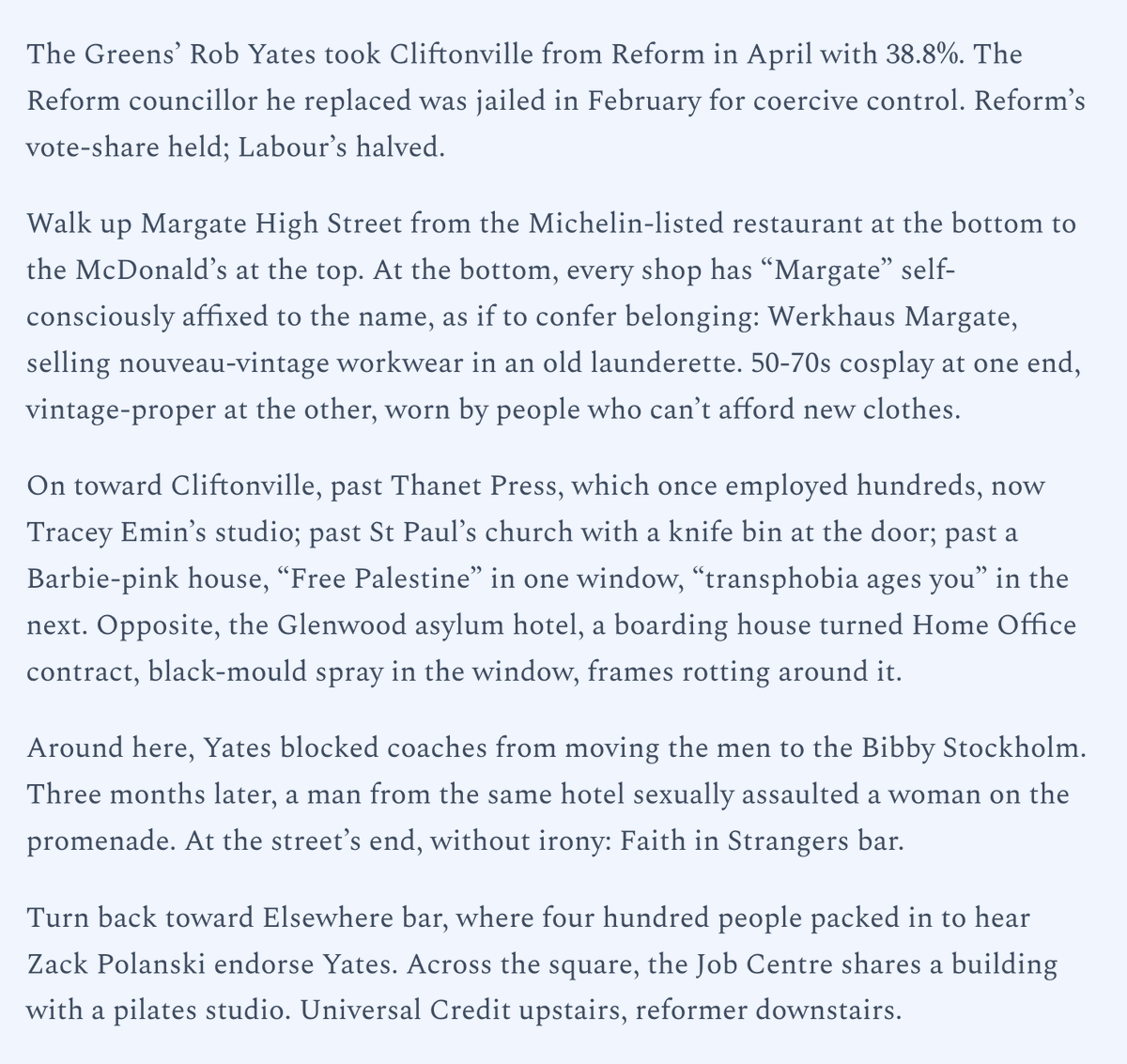
First up, @_SiobhanCT on the two faces of Margate.
"Someone tried to open a jazz bar opposite Elsewhere a few years ago. It closed within a year. You can’t put a jazz bar in a Shoe Zone, we said. Now they’ve put the Greens in Margate."
Last week, the country expressed itself at the ballot box. While Westminster once again obsesses about Westminster, we are publishing dispatches from across the country - from Margate to Liverpool, South Wales to Newcastle, Bromley to Blackburn.
Read below.
New essay on the economics of structural change and the post-commodity future of work.
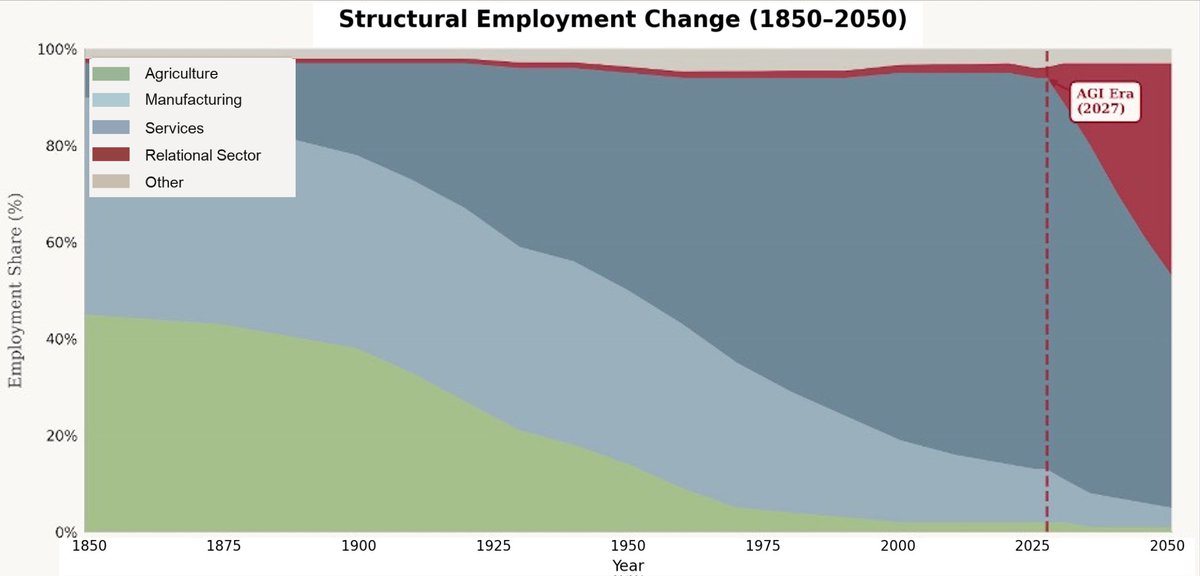
1. Almost any question about the impact of advanced AI on the economy needs to start at the same place: what is still scarce? Answer that, and the analysis becomes pretty straightforward. This essay explores what becomes scarce if AI really can replicate most of what humans do in production, and what this mean for the future of jobs.
2. My conjecture, working through the economics: labor reallocates across sectors, and the sector it reallocates to has properties that keep labor a meaningful share of the economy. Ultimately this is about the structure of demand itself. For this, we have to go back to Girard, Augustine and Rousseau: once people's base needs are met, their preferences shift to comparative motives (e.g., status, exclusivity, social desirability). This motive is inherently non-satiated.
4. The key paper is Comin, Lashkari, and Mestieri (Econometrica 2021). As people get richer, they don't buy proportionally more of everything. They shift spending toward sectors with higher income elasticity. They estimate income effects account for 75%+ of observed structural change.
5. The ironic consequence: the sector that gets automated becomes a smaller share of the economy, not a larger one. Agriculture got massively more productive and its share of employment collapsed. Manufacturing too. The "stagnant" sectors absorb the spending and the jobs.
6. So the question is: which sectors have high income elasticity in a post-AGI world? I argue it's what I call the relational sector. Categories where the human isn't just an input into production, it is part of the value.
7. Why does the relational sector have high income elasticity? Because human desire has a mimetic, relational dimension. We don't just want things for their intrinsic properties. We want what others want, and we want it more when others can't have it. Girard, Rousseau, Augustine, and Hobbes all saw this.
8. In work with Kristóf Madarász, we showed this experimentally: WTP roughly doubles when a random subset of others is excluded from the good. And in new work with Graelin Mandel, AI involvement kills the premium. Human-made art gains 44% from exclusivity; AI-made art only 21%.
9. This all comes together for the core argument. The sector that absorbs spending as AI makes commodity production cheap is one where human provenance is part of the value, and demand for it grows faster than income. Exactly the profile that keeps labor meaningful.
10. To be clear about the claim: I'm NOT saying aggregate labor share must rise. It may fall. The claim is about sectoral composition, i.e., where expenditure and employment go once commodities get cheap, and the fact that the sector that will absorb reallocated labor maps to a substantial component of human preferences and desire.
11. If you're interested in the formal model, a linked companion technical note works out all the economics.
Read the essay here: https://t.co/NcjVgn2o8g
New blog: using AI models for research.
In choosing a researcher, you’d be better off with a) Paid Claude or GPT with token limits set to the pro rata salary of an MP (maybe several MPs!), over b) hiring any one of ~99% of MPs.
Experiments on fact checking, resolving disputes between historians, analysing conspiracies, analysing the changing ideas of elites over time.
If you get paid models to study Bismarck’s diplomacy 1862-66, they then generate far better analysis of contemporary problems than 99% of MPs.
The ‘jagged frontier’ of the models.
The perception gaps between SW1 and the Valley
Why deployment will be very jagged too.
Why the DEMAND PROBLEM of SW1 guarantees pathological failure on AI.
Therefore a small number of entities will accelerate away from political control, which will also accelerate elite fragmentation/polarisation.
The Valley is failing on politics/communication but hopefully will pivot.
This is a particularly weird subject for politics because a) the very small network who have been most optimistic about technical progress for 20 years were derided by the 'experts' yet have consistently been vindicated, b) the straight lines on the graphs are exponential and c) we saw in 2020 that western political networks can't cope with exponentials...
My predictions about AI going mainstream 2022-3 and SW1 responding pathologically have sadly been vindicated.
My predictions about drones and war and the MoD refusing to learn the lessons and instead *suppressing feedback from those returning from the front lines* have also sadly been vindicated...
~All the things we started in 2020 to get Britain ahead were shut down. The cash was put into hiding disasters like AJAX, fake innovation, and the giant >50B secret nuclear black hole instead. SNAFU.
No surprise that Whitehall is more interested in lawfare against the SAS than listening to warnings from the SAS returning from Ukraine about drones and the MoD's corrupt shitshow...
The lesson for politics is not 'use AI to centralise more in Operations Centres run by people far from the problem' but 'use technology to help ancient lessons of leadership and management'. It's inconceivable that SW1 will absorb this.
Coping with all this — especially as biotech also transforms and democratises — is *a regime-complete problem*.
Meanwhile our political parties and Whitehall continue to implode in a historic cycle fo regime change... They can't cope with the simplest thing, never mind the biggest things...
Link below
There's an interesting tension between:
(1) the idea that the rise in business degrees with poor graduate outcomes is a bad thing (as argued in this FT piece) and
(2) the very popular belief that Britain's economic problem is poor management skills in average-to-low-end firms and that this can be fixed through government intervention.
https://t.co/CwBzvoTZ9Q
Is AI killing jobs?
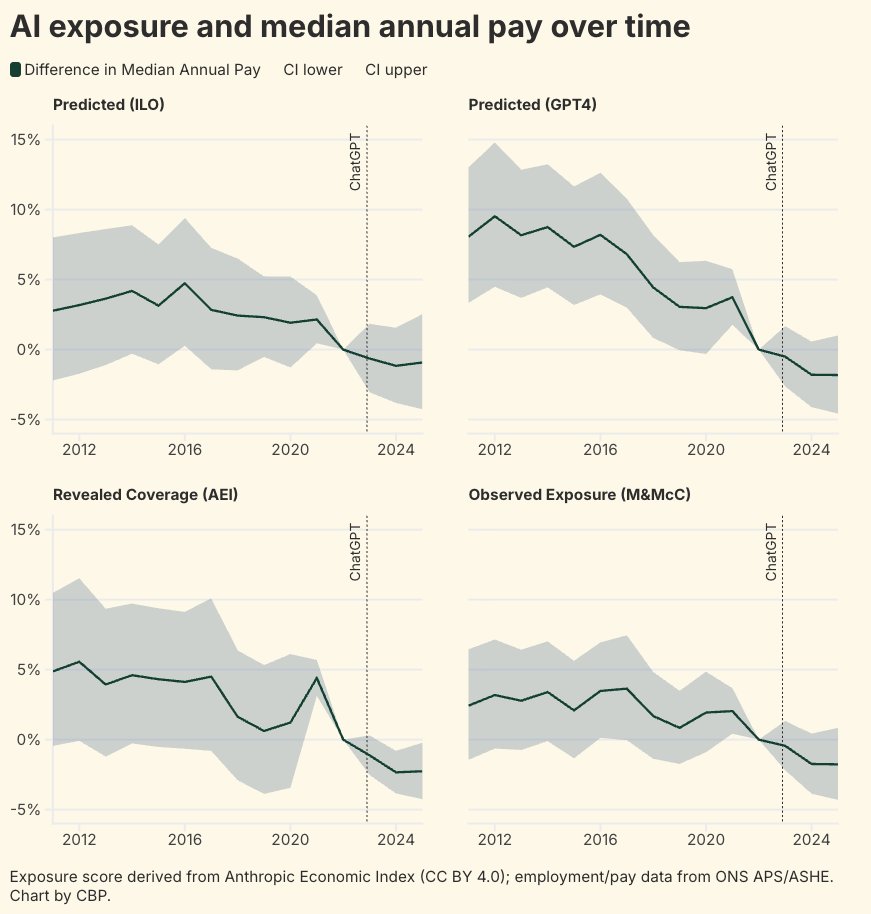
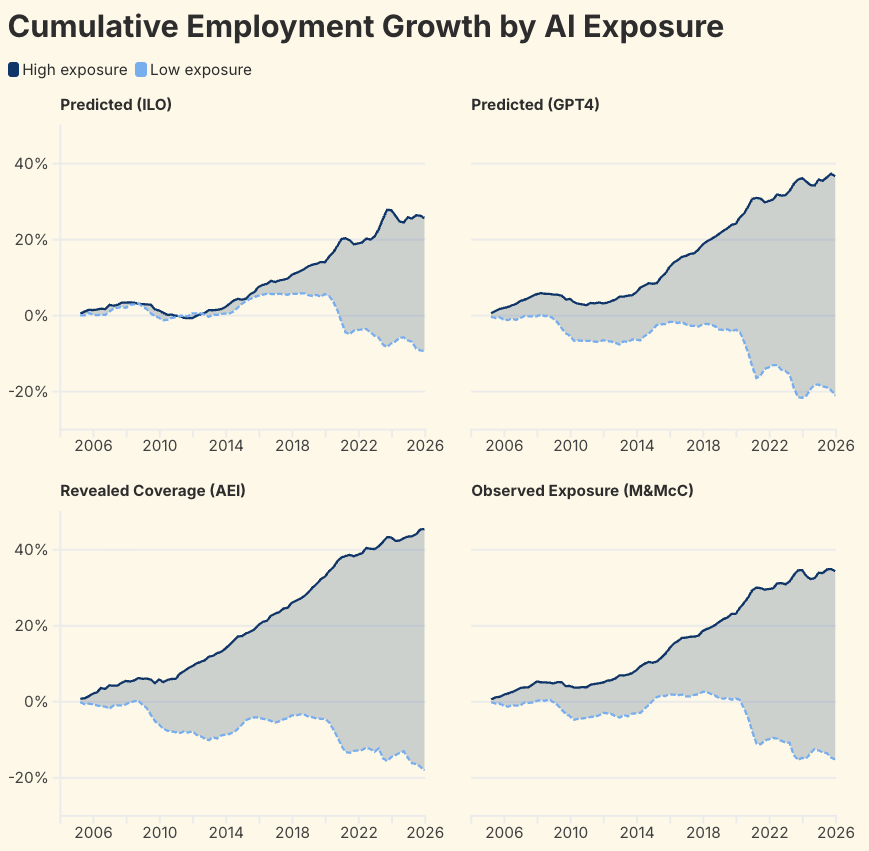
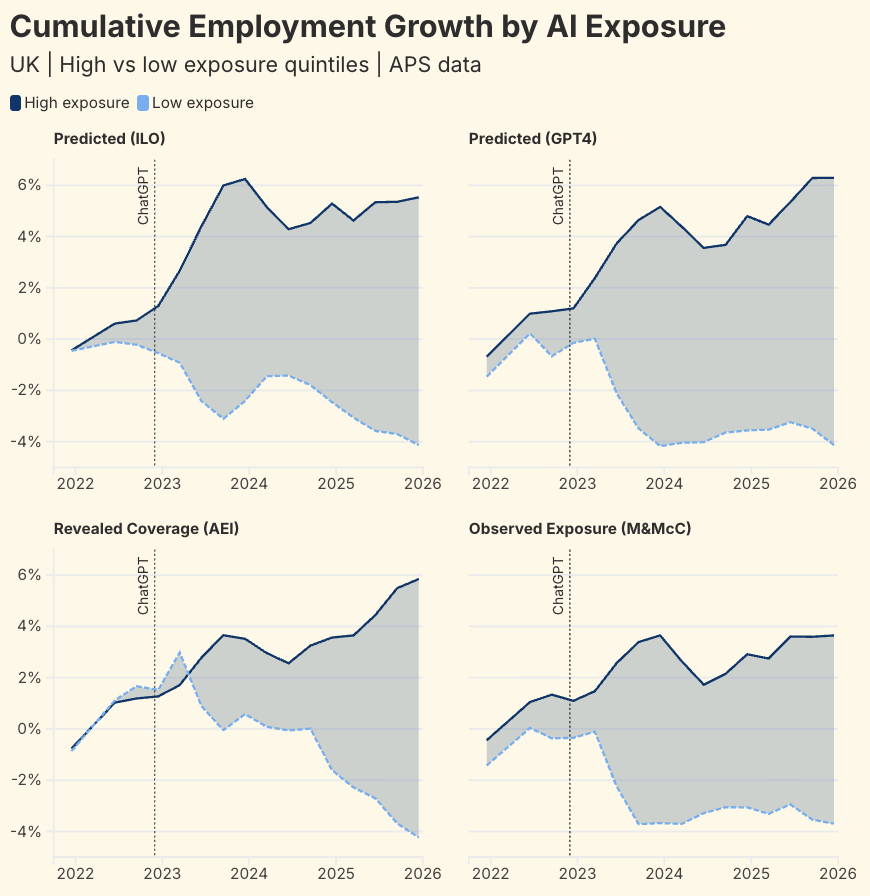
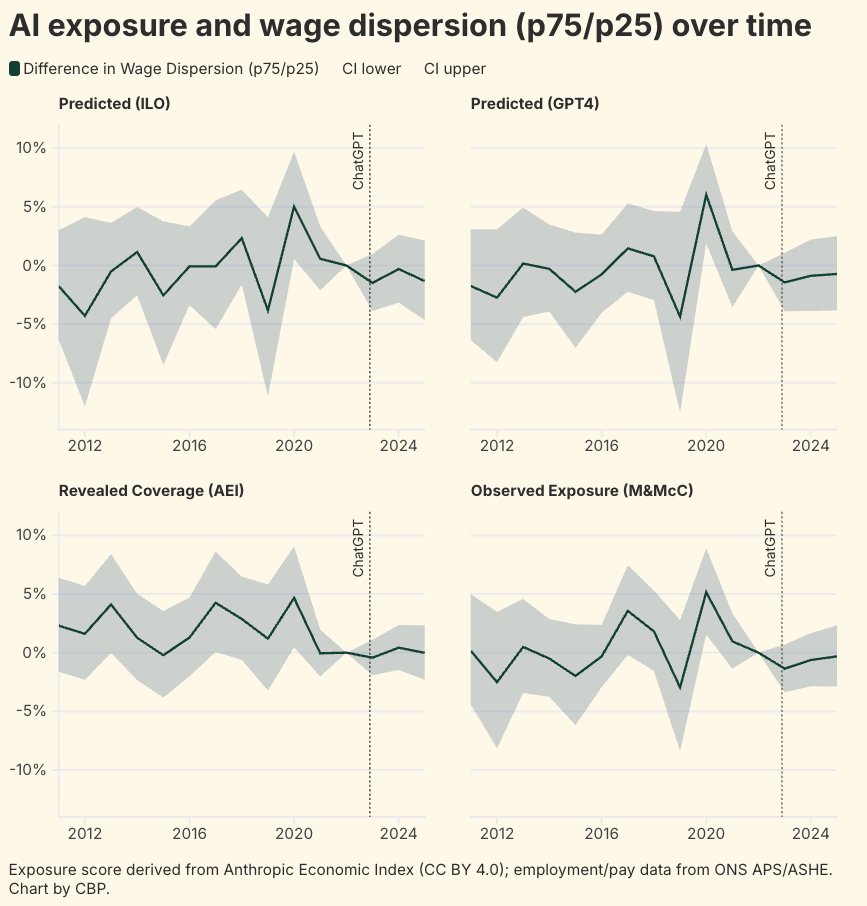
New data shows that, more than three years after the release of ChatGPT, there is no evidence for a significant impact of AI on overall employment in the UK.
In our new report, we break down the labour force into different occupations and use four measures of AI exposure to determine how likely they are to be affected by the technology.
Surprisingly, occupations with higher exposure to AI have grown faster than least-exposed ones, not slower. This holds across all four measures, and across two different data sources.
The wage picture is different. Pay in AI-exposed occupations has lagged the rest of the labour market since 2019.
But that gap opened three years before ChatGPT, which makes AI an unlikely candidate for the observed wage compression.
This flattening of the wage structure is visible across the within-occupation distribution and strongest at the top quartile, which is consistent with labour market dynamics that predate generative AI.
Today, I launch The British Cræft Prize.
A new £60,000 national award for maverick and misfit
makers, technologists, designers, and engineers.
Seeking inventions that fuse the deep wisdom of
heritage crafts of the past with cutting-edge
technologies of the future.
🧵👇
one of the qualities i most value in a person is “fun to disagree with,” and that, more than anything, has really shaped for me a life of wonderful, passionate weirdos
every philosopher needs to write a book called Beyond the Scope of this Paper where they deal with all the issues that were allegedly beyond the scope of the papers they've published or else they can't retire.
I made queso. I'm writing a paper about pictorial illusionism. It's well known (thanks to Margaret Livingston) that Monet's sunrise is a nice example of an equiluminance effect. You know, where the letters swim, unreadably. So I sampled sun and nearby. Yep. Hard to read.
The Encyclopedia of Women Philosophers: A New Web Site Presents the Contributions of Women Philosophers, from Ancient to Modern https://t.co/0xYhXZGTZd