We put Muse Ember from @AIatMeta to work untangling conflicting records in a $12.6 million private-fund capital call.
Across 13 documents in Box, Ember catches a $2.48 million misallocation and a missed $250,000 credit, recalculates each investor’s obligation, and produces a source-cited review for Fund Operations.
Customers can build custom agents for their own document-heavy financial workflows with Box AI Studio.
Just got started with S04 of The Diplomat and I'm giddy already! My favourite thing on television in a long, long time. Just how I love this show, the writing and the actors!
Muse Wonder is now available on @Cline, @Cloudflare, @Cognition, @Cursor_AI, @OpenRouter, @Oracle and @Vercel - with more partners coming soon.
We look forward to seeing what the community builds with Muse Wonder!
Start building 👉 https://t.co/QJT3aIZNd1
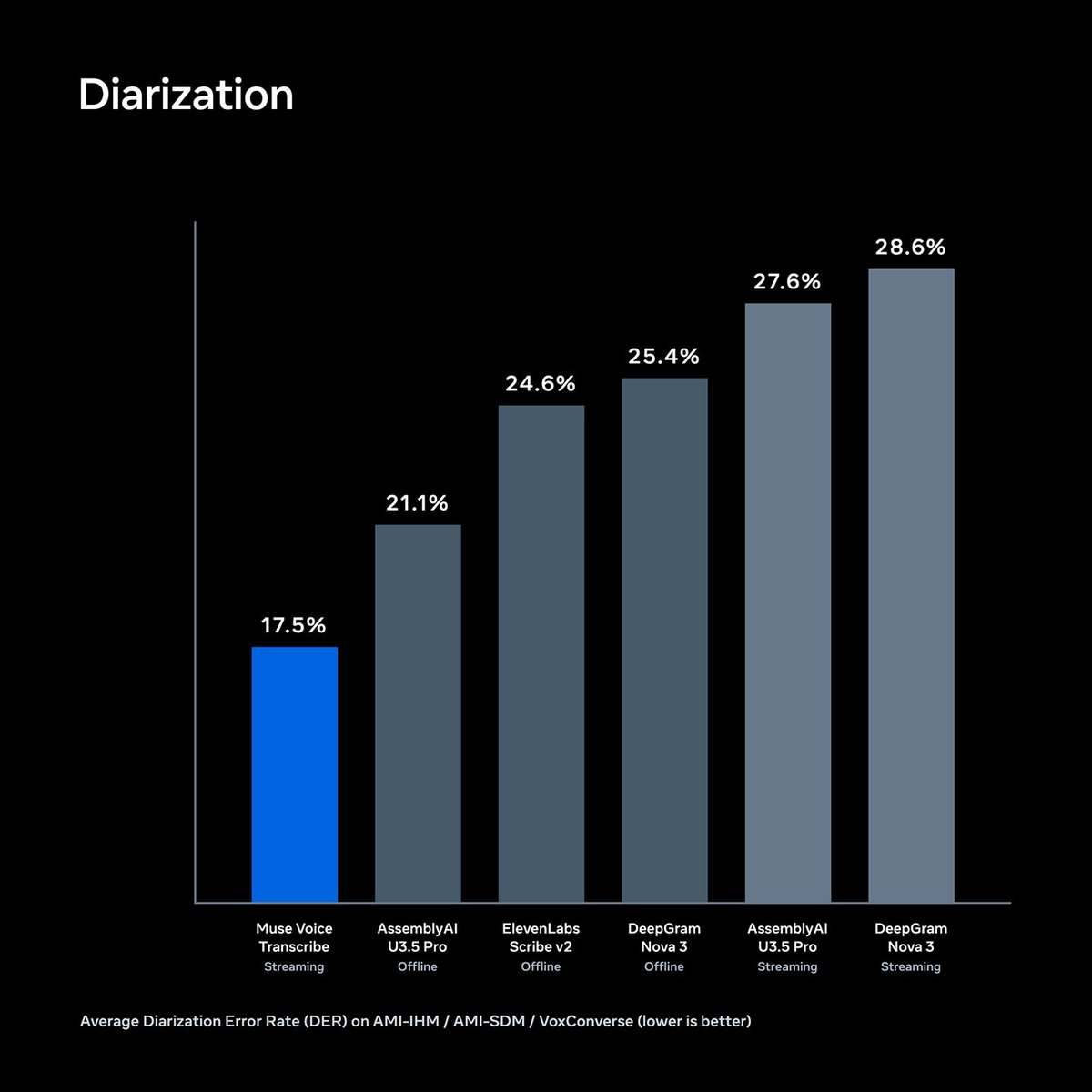
Muse Voice Transcribe was built for real-time voice agents, combining accuracy and low latency with diarization, keyword biasing, endpointing and mixed-language transcription.
Great to see it achieve the lowest semantic WER in Pipecat’s open-source benchmark 👏
Pipecat v1.9.0 is out today, with support for @AIatMeta's new Muse Voice Transcribe model.
Muse Voice Transcribe is a streaming speech-to-text model. It has the best (lowest) semantic word error rate of any model we've tested.
We maintain a public, open source test suite called the Pipecat STT benchmark. This benchmark measures how well an STT model performs in a voice agent pipeline. We calculate a "semantic word error rate" across 1,000 speech input fragments. Semantic WER ignores small differences in transcription that don't impact an LLM's understanding of user speech, and in our experience is a better proxy for STT model accuracy than the simpler WER algorithms used in most speech recognition benchmarks.
The other critical metric for a voice agent is latency. We measure latency as "time to final segment" of the transcription. You can think of this as how long it takes for the STT model to deliver a complete text transcription after the user finishes speaking. Muse Voice Transcribe's TTFS is very good, though its long tail TTFS is a bit higher than we'd like to see. (The Meta team says they are optimizing for natural, model-driven endpointing, which certainly makes sense.) The P50 TTFS is 392 milliseconds and the P95 is 1,292 milliseconds. We'd like to see a P50 under 300ms and a P95 as close to that as possible! Note, though, that this P50 number is as good as we've seen for any initial release of a new ASR model.
The model also supports speaker labels (diarization) and keyword biasing, has built-in endpointing, and can transcribe mixed-language speech.
Kudos to the Meta team. We love seeing new models that are strong performers in realtime voice agent pipelines.
Meta has released Muse Voice Transcribe, taking the #1 spot for Final Transcript accuracy on AA-WER Streaming with 3.1% WER at 0.16s after end of speech
Muse Voice Transcribe is the first streaming Speech to Text model developed by Meta Superintelligence Labs. Meta states that the model was trained on more than 70 languages, with 25 extensively verified, and supports audio inputs exceeding one hour without required post-processing. It processes audio in 80ms chunks and is available through the Meta Model API, Meta AI for Mac and Muse Code.
Key takeaways
➤ Final Transcript: Muse Voice Transcribe achieves 3.1% WER at 0.16s after end of speech. It is more accurate and faster than Cartesia Ink-2 (semantic endpoints) at 3.4% and 0.43s, and more accurate but slower than Cartesia Ink-2 (external endpoints) at 4.0% and 0.07s. It is also more accurate, though slightly slower, than ElevenLabs Scribe v2 Realtime at 3.6% and 0.14s.
➤ First Partial Transcript: The model achieves 3.6% WER at 0.13s, just ahead of ElevenLabs Scribe v2 Realtime on accuracy and latency. It is more accurate and faster than Cartesia Ink-2 (semantic endpoints) at 4.9% and 0.17s, and more accurate but slower than Cartesia Ink-2 (external endpoints) at 4.0% and 0.07s.
➤ Price: Muse Voice Transcribe costs $0.18 per hour, or $3 per 1,000 minutes. This is below Cartesia Ink-2 at $4 and less than half the $6.50 charged for ElevenLabs Scribe v2 Realtime and Deepgram Flux.
See more details below ⬇️
1/ today we're rolling out muse voice transcribe, our first real-time audio perception model - SOTA in streaming speech-to-text. also handles speaker diarization and endpointing natively in a single model.
Muse Voice Transcribe is MSL's first real-time audio perception model -- rolling out today. SOTA in streaming speech-to-text, it handles speaker diarization, and endpointing natively in a single model.