Anyone wondering whether their energy company is about to go bust, or annoyed about price hikes, should follow the spectacularly frank @_TheEnergyShop. Features constant warnings of crappy accounts, promises broken, and problems around the corner (1/2).
You put the 'Energy Price Cap' in place.
You put the 'Ban on Acquisition-Only Tariffs' in place.
You put the 'Market Stabilisation Charge' in place.
All of these things kill competition and have contributed to fewer people switching to cheaper deals.
The only people who benefit from this are energy suppliers.
@Chrisitv@itvnews This page will automatically update to show the cheapest "fixed" deals.
It will help people decide which supplier to switch to to keep their bills down as much as possible.
https://t.co/koEkQBHkAs
@MartinSLewis How many times will we hear MPs bang on about "cheap energy", "breathing space" and "energy security" in the coming days, all the while our bills are £600 higher than last January?
@PippaCrerar Please encourage people to switch and save. The Energy Price Cap sets the "maximum" level a supplier cna charge and yet +20m homes are on these tariffs.
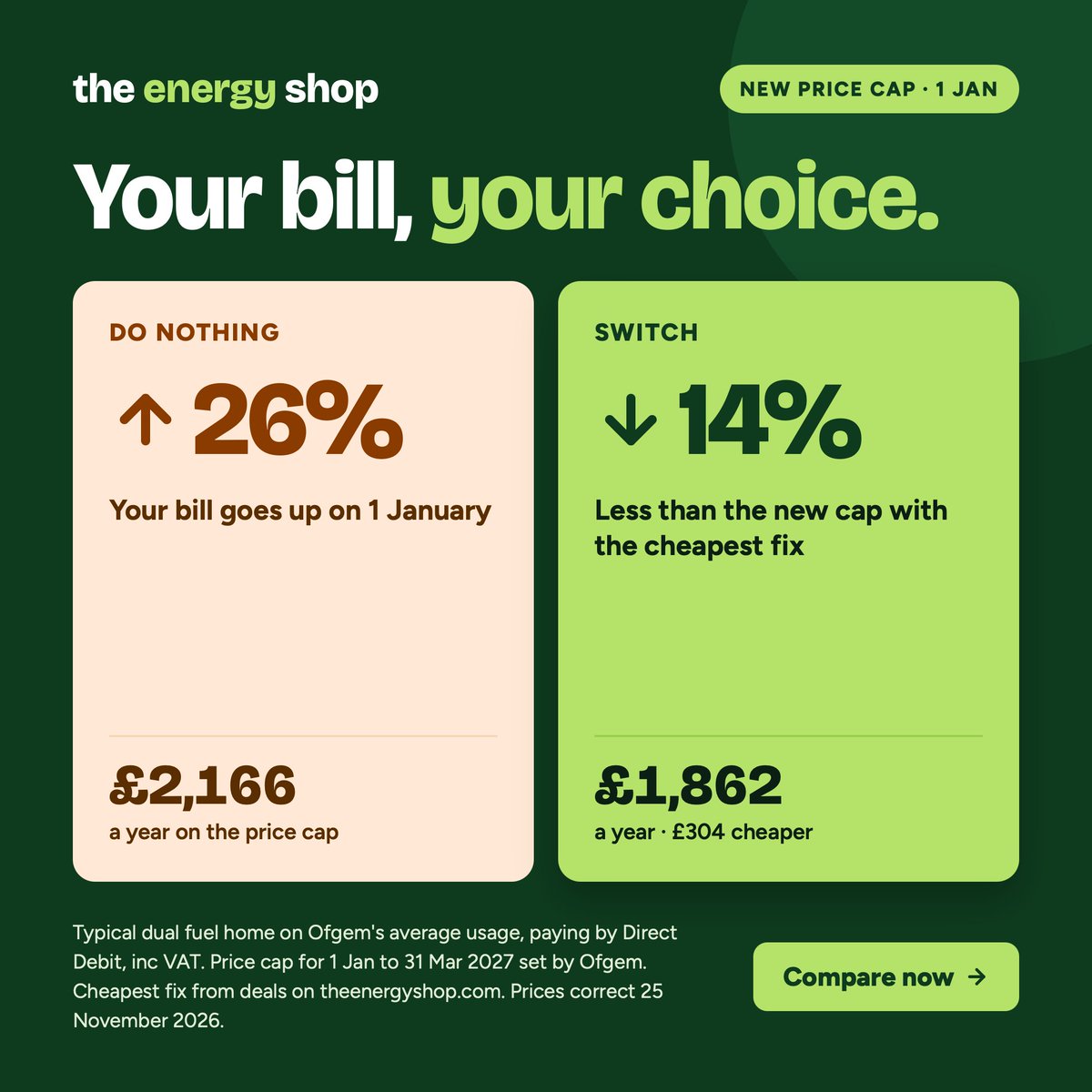
If you switch and fix, you could save yourself 14% off the new prices. For the average home, that's a saving of £304 a year.
"Breathing space" with bills up £600 on average since last January.
Good grief!
How about encouraging competition, removing the 'Ban on Acquisition-only Tariffs' (BATs), removing the 'Market Stabilisation Charge' and telling people to switch to cheaper deals that offer savings of £304.
@Miatsf "Breathing space"!!!???
Are you mad?
Bills are up over £600 a year for the average home since last January.
Stop posting nonsense and do something about it.
UK energy bills up by 26%.
This brings the average bill to £2,166, compared with £1,862 on a competitive "fixed" tariff, savings of £304.
Switch, fix and save...TODAY!
Switch to the cheapest possible deal, then say "no".
We're 100% with you, though, Shirley.
UK energy bills are insanely high, yet watch how many times MPs talk about "cheap energy" and "lowering energy bills". All the while, the data and our bank accounts show a very different story.
Perhaps not an issue, but keep an eye on your day/night usage split.
If you're a high daytime consumer, the premium day rates can wipe out the benefits of the cheaper night rates.
We get quite a few EV customers who are still better off taking single-rate tariffs for this reason.
Add a battery though, and it's a no-brainer. 👍
@MatthewStadlen Certainly is.
Consumers will see their bills 39% higher in January 2027 compared to January 2026.
And yet, all we hear from MPs is "cheap energy" and "lowering bills".
@energygovuk Seriously, guys. Read the room.
Bills are about to be 39% higher in the space of 12 months.
Consumers are getting sick of hearing about "bringing down bills" and then seeing the complete opposite.
Less talk. More action.
@KemiBadenoch We've got you covered, Kemi.
https://t.co/2eKYMcvK5D
The answer is instead of being £300 lower, they are infact on track to be £863 more expensive.
The increase to £2,166 is partly helped by the fact 'Typical Domestic Consumption Values' (TDCVs) were reduced from 1st October.
For a more accurate comparison, if we go off Ofgem's TDCVs from last January, the "average bill" would be £2,449.63.
An increase of £692.13 in 12-months.
But fear not, we'll lost about "cheap energy" from MPs in the coming days.
@grok@Mariusz_Invest Sainsbury's Energy has a 24 month fixed deal averaging £1,799 across all 14 PES regions.
You can see the full table here:
https://t.co/koEkQBHkAs