Biggest lies I was taught in medical school:
🥩 Meat causes colon cancer
🧈 Animal fat causes heart disease
☀️ Sun causes skin cancer
🧴 Wear sunscreen
🧠 Depression = chemical imbalance
🩸 High cholesterol is dangerous
💊 Statins are safe
🕶️ Sunglasses protect your eyes
🧬 It’s all genetic
🧂 Salt is bad for you
📉 Count calories to lose weight
Do you want to be in crypto full-time but don't have enough money to retire and risk everything?
Join a crypto team. DeFi protocols, CEXes, funds, etc., are all hiring. Just a general piece of advice, if you are tired of your 9-5 and want to spend your time full-time in crypto while earning a salary.
You get both the upside of having a little safety from a fixed monthly income + you learn a lot about crypto and get a big network, which will benefit you later.
Andrew Huberman es un neurocientífico de Stanford que demostró que reventar tu dopamina es la principal causa de ansiedad, estrés y falta motivación.
Reveló 10 hábitos que haces todos los días y que están destruyendo tu cerebro.
1) Mirar el móvil nada más despertar
Richard Feynman ganó el Nobel de Física y dijo algo que dejó huella:
"La mayoría de personas saben muchas cosas. Pero no saben pensar."
Feynman dio una clase magistral de 1 hora sobre física e imaginación.
Sus 12 lecciones de vida:
1. La imaginación le gana al conocimiento
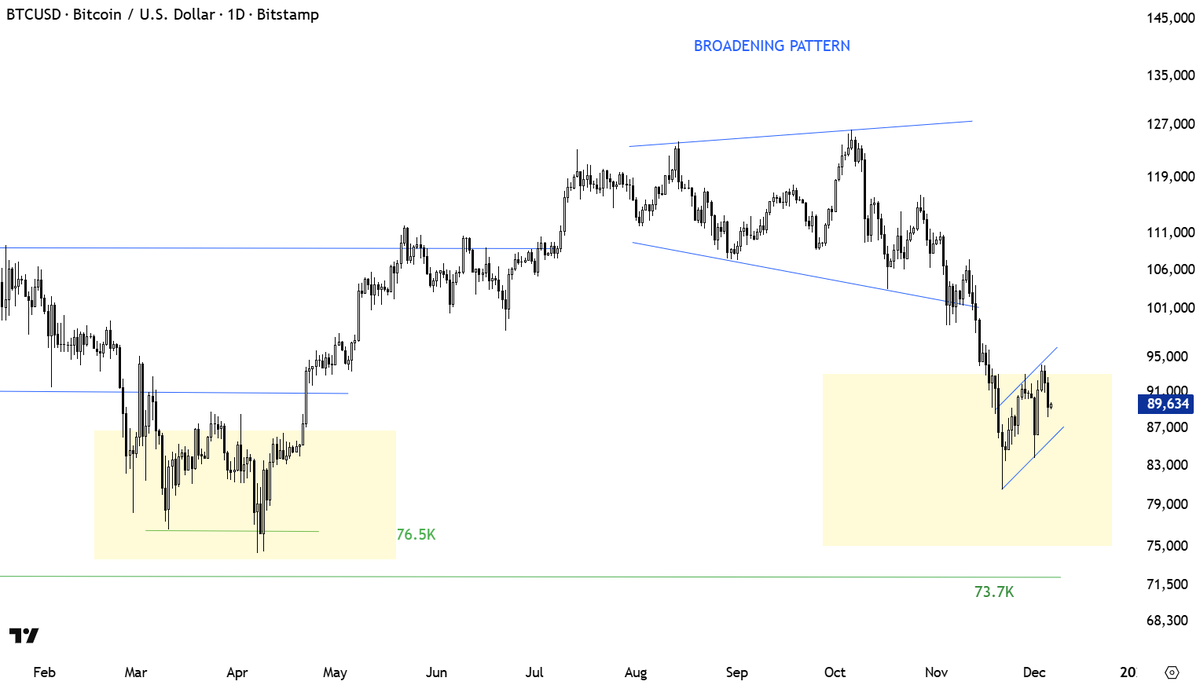
This is part of the choppy price action where $BTCUSD is possibly trying to find a bottom. Technical support is lower between 73.7K and 76.5K. It took few months in March-May period to form that short-term double bottom.
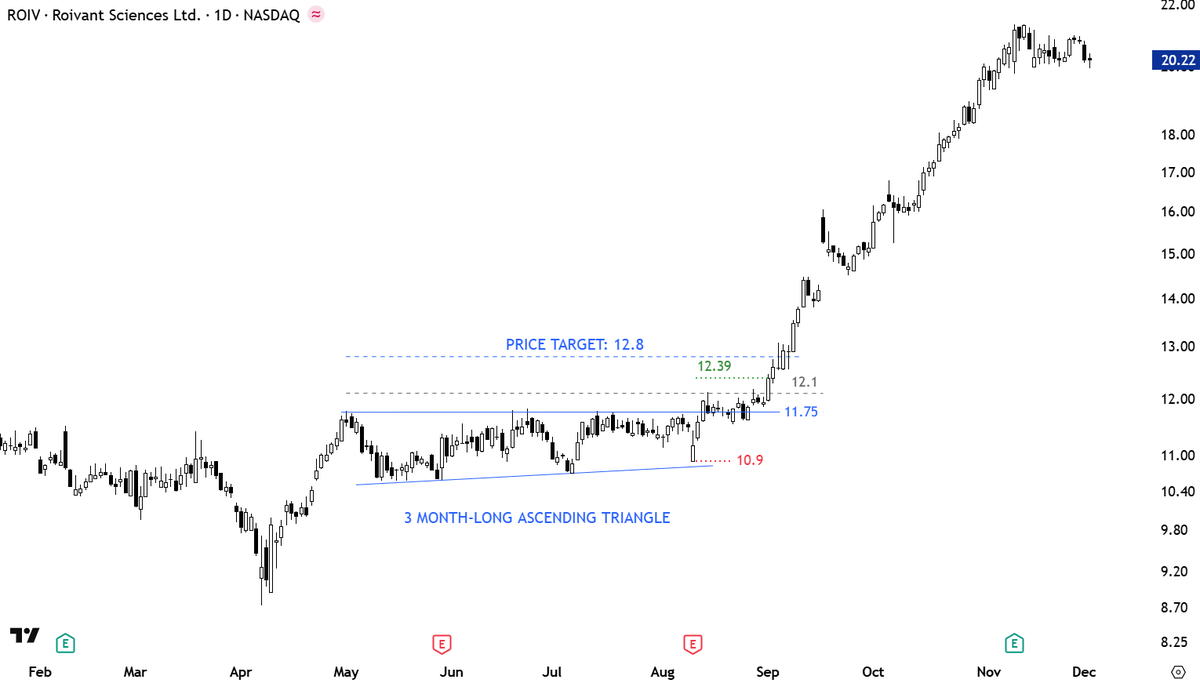
As with every signaling tool, there are many failed moves out of consolidations.
Accept them. Have a stop-loss.
However, it is those strong directional moves that you need to work on and have a method to stay the course as long as possible.
These big $ wins will compensate for failed breakouts.
I am a Bayesian. Look it up. Google it
For any given market for about two dozen markets I have binary narratives rolling around in my head
Truly binary
For example, I have a narrative for $200,000 Bitcoin and $30,000 Bitcoin. I take both narratives seriously but may not be willing to place the same amount of money on each of them
But my get size on each changes over time based primarily on how price behaves relative to the fundamentals that emerge. If bullish news produces price weakness I add to the probability of the narrative for price decline
There comes a point when as a Bayesian I might give one narrative a 60 or 70% probability ranking. That is about as high as I ever go.
And I do not immediately enter a trade when the 70% level is reached. Instead, I wait until I see an asymmetric R:r point on the chart with a defined risk.
By defined risk I mean some adverse price level that if reached would move my Bayesian gear box back into neutral
And when I place a bet, I never risk more than 8/10th of 1% of my capital pot.
The above explains how I think about markets and trading.
I trade primarily futures markets, selected etf and Bitcoin.
I monitor about 40 to 50 different markets and trade each maybe 3 times per year on average
I consider myself first and foremost to be a risk manager
I write about this process every week for members of my private community
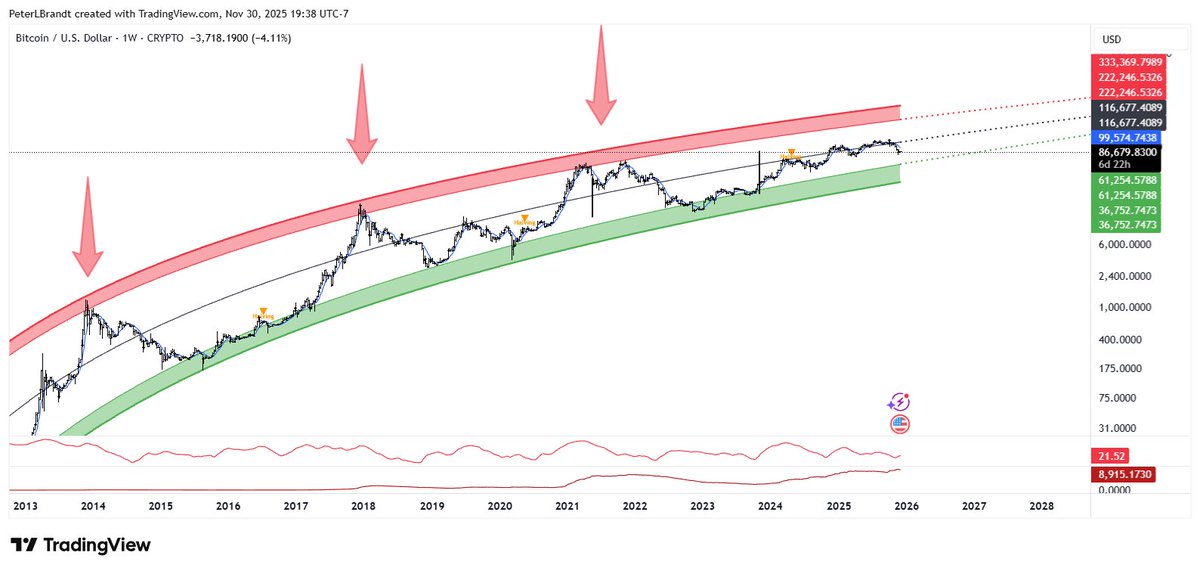
Well, I guess that monthly close did confirm a top, higher time frames are more accurate, however that is a 46k spread from top of the wick to the bottom of last one so a lot of damage done.. this said, rules are rules so be careful
That monthly 20 day EMA is 88,200
$BTC
Not to bust anyone's banana, but the upper boundary of the lower green zone starts at sub $70s with lower boundary support in the mid $40s.
How soon before Saylor's Shipmates ask about the life-boats? $BTC
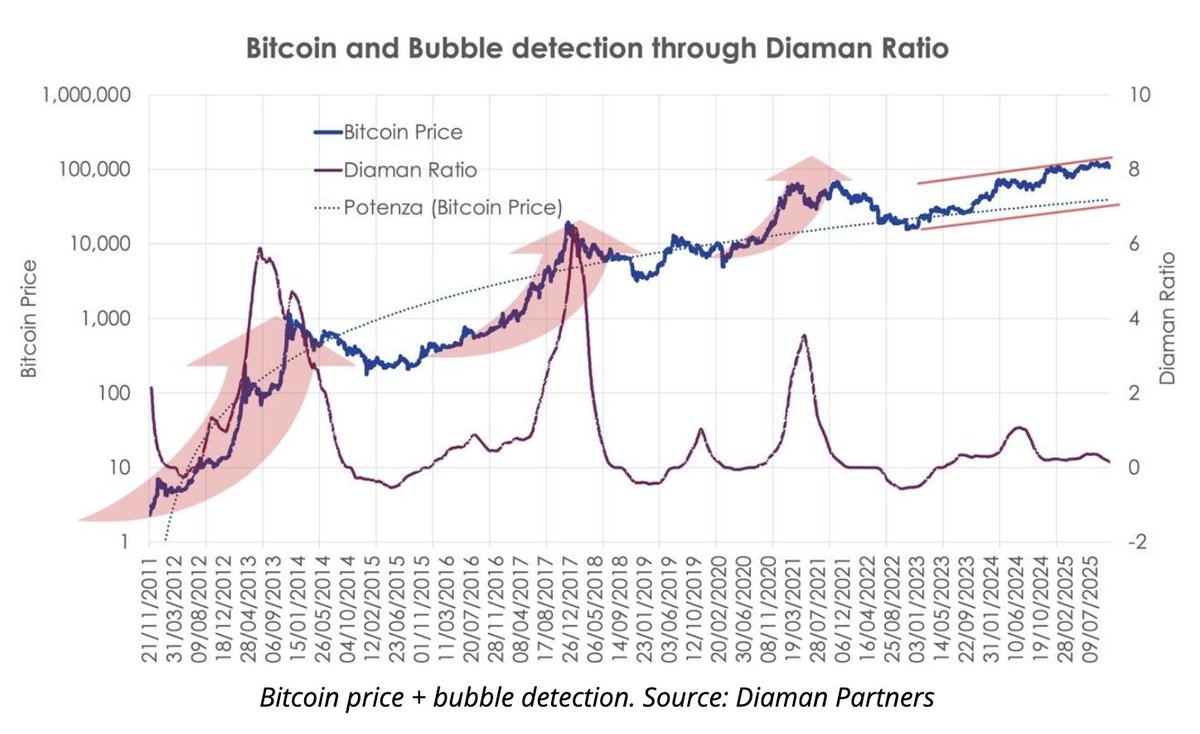
@danieleDIAMAN model arguing the 4-year cycle is different this time, bubble detection metric is flat this time. so thesis: bitcoin just keeps grinding higher with out bear market, and smaller pullbacks than prior cycles. https://t.co/6FwXnl6D47
There are several pairs that are holding well in the #cryptocurrencies.
Yes, short-term volatility picked up.
Yes, some of those names have been stuck in ranges for several years now.
But come on, equity guys that have been dealing with stock charts for decades now and have been through many of those lengthy sideways periods.
$BTCUSD Holding the year-long average. A tight consolidation between 88.6K and 76.5K. Which way it resolves? Breakdown of the tight consolidation can challenge the uptrend. For bullish interpretation, it is important to clear 91.2K.
This is Peter Brandt.
He turned $88k into $10M+ using this one principle:
The Pareto Factor.
Only 20% of your trades ACTUALLY matter...
Here’s how he used it to gain an advantage over the market:
Trump wants a strong $USD. The $USDCNH chart (if you trust charts) suggests the an advance to 7.8 CNH per USD. This means a stronger $USD. I will let the rest of you posit what this might mean about tariffs. I trade FX pairs and futures. It is not for me to understand the whys.