NVIDIA just made AI voice conversations feel a lot more human
PersonaPlex-7B is a free, open-source model that listens and speaks simultaneously, enabling natural, real-time conversations.
This is terrifying.
50 legendary internet rabbit holes you can spend hours exploring👇
1. https://t.co/4rx3uQ2nh1 — Watch the world via live satellite imagery
2. https://t.co/rTNdFGTNgH — See every plane currently in the sky
3. https://t.co/KyEYeRU5bH — Track all ships at sea in real time
4. https://t.co/8Y9ekDUBD6 — Live map of winds and storms
5. https://t.co/Rwp8iL6WCH — Watch lightning strikes hitting Earth in real time
6. https://t.co/SZ2E12fFno — Live list of recent earthquakes
7. https://t.co/XuFdu0F9Ar — Ocean cables carrying the internet
8. https://t.co/e8w3PyjDtI — Watch forests disappear from space
9. https://t.co/0hTqCcK6PL — The world's statistics, second by second
10. https://t.co/s2jI84r8Cw — Current number of tweets and searches being posted
11. https://t.co/3x3gIa6wPf — Compare the true sizes of countries
12. https://t.co/O9evZPTgek — Maps from centuries ago
13. https://t.co/us9maMx4PK — Archive of 150,000 historical maps
14. https://t.co/ZWJmzhysZc — World map drawn by volunteers
15. https://t.co/agrLJzhb8o — Look out the window of a random person around the world
16. https://t.co/XIvN1jekXG — Virtual walks through cities
17. https://t.co/lycP6J0DRO — Teleport to a random spot on Earth
18. https://t.co/81689bM2kz — Catalog of the world's strangest places
19. https://t.co/Btk6AvORN0 — Interactive knowledge experiences
20. https://t.co/4I9iX5h0Dg — Scale journey from atom to universe (Updated HTML5 link)
21. https://t.co/OH89MfjXuT — Explore the solar system in 3D
22. https://t.co/7S3t5CbHKP — Real sky map in your browser
23. https://t.co/d4opLxIvod — NASA's astronomy picture of the day
24. https://t.co/JEY2HvGlPe — NASA's entire visual archive, free
25. https://t.co/1iNLBBGXx1 — Visual articles told through data
26. https://t.co/abKlV1Ly8p — The state of the world with real data
27. https://t.co/jMOmbWcPzL — What we mistakenly think we know about the world
28. https://t.co/sd1MfAFmnc — Visualizing complex data
29. https://t.co/jLySh6bfKD — World Bank's open data
30. https://t.co/t186QWzR1C — Turkey's official statistics database
31. https://t.co/rMWGn62x2K — Archive of millions of books, films, and software
32. https://t.co/zf1TEgclVb — 70,000 free books whose copyrights have expired
33. https://t.co/dHRvaEes4G — Record of every book in the world
34. https://t.co/5O6pT4FEkt — U.S. Library of Congress digital archive
35. https://t.co/FCclMfzeuJ — Europe's cultural heritage archive
36. https://t.co/UKQNdFMjsP — America's digital library collection
37. https://t.co/mc4aVSsim0 — Tour museums from home
38. https://t.co/xmTl1a3GfM — Download artworks in high resolution
39. https://t.co/fdwD8ibcAp — Archive of 250,000 artworks
40. https://t.co/DtannTZT60 — Forgotten visual treasures of history
41. https://t.co/lr0e0lUN9U — Free archive of culture and education
42. https://t.co/6fVUGlBV2r — Met Museum's open collection
43. https://t.co/C0jLVqLapF — Family tree of music genres
44. https://t.co/gQgSNT8kwy — Pick a country and decade to listen to that era
45. https://t.co/CGElTSuOlJ — Turn Wikipedia edits into audio
46. https://t.co/bV9SoCrT6Z — Random knowledge well
47. https://t.co/Hl7zDZkJvl — Time, sunrises, and sky events
48. https://t.co/zvXV7OeWsf — Live stream of science news
49. https://t.co/ai9aVsys7u — Free preprints of scientific papers
50. https://t.co/uJ6w6V9Csr — Visualize data with live code
Save this. You’ll definitely need some of these later. 🔖
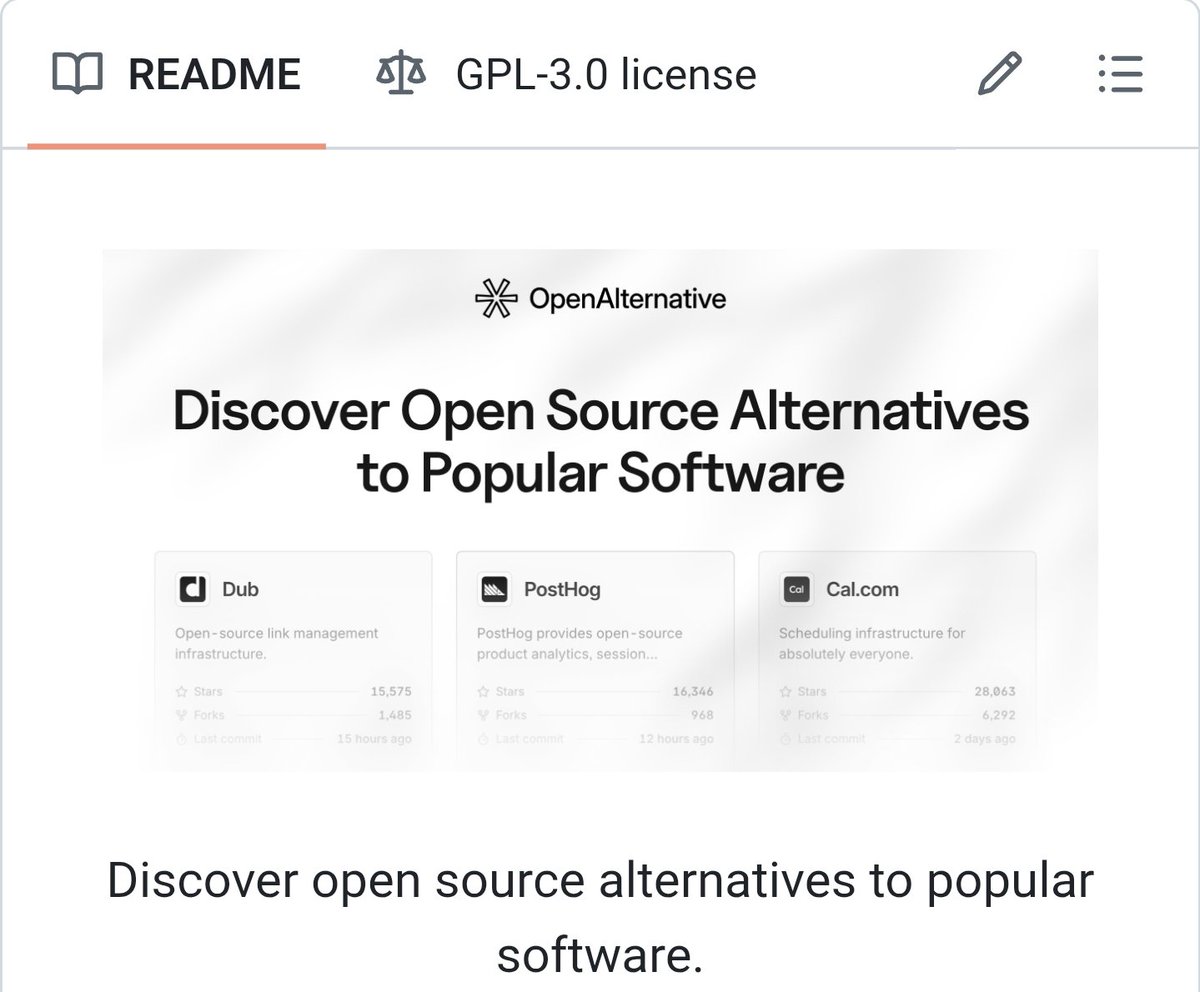
jev was released less than a week ago, and there are already tons of OSS alternatives
SemIf is basically as good as jev, costs 50% less, and has no waitlist
10 GITHUB REPOSITORIES THAT FEEL ALMOST ILLEGAL TO BE FREE
And yes, they're all open source.
1. Archify
Turn codebases into architecture, workflow, sequence and data-flow diagrams with AI.
https://t.co/3jLToYDzic
2. OpenMAIC
A multi-agent environment where AI agents can collaborate and work together.
https://t.co/0g98VBKflm
3. DeepSeek Harness
An open-source harness for building and running AI coding workflows.
https://t.co/c45mNs83y6
4. Ponytail
A simple approach to helping AI coding agents write less unnecessary code.
https://t.co/UdFeGXFvjL
5. Agent Skills
Reusable skills that give AI coding agents more specialized capabilities.
https://t.co/KkT71vIiR3
6. OmniVoice Studio
An open-source studio for experimenting with AI voice generation workflows.
https://t.co/zfiVHiHYWe
7. Scientific Agent Skills
Specialized skills for AI agents working on scientific research and analysis.
https://t.co/w8HCUPfmQ7
8. Orca
Run multiple AI coding agents in parallel inside one development environment.
https://t.co/rINx3HgPEZ
9. MiniMind
A compact project for learning how language models work by building one yourself.
https://t.co/sz3WQWSLQz
10. God's Eye View
A visual project exploring how AI can understand and represent complex systems.
https://t.co/H7tiOUFLLu
All open source.
Some are useful today.
Some are worth studying.
Some could become much bigger.
Bookmark this list for the weekend.
DocJev is the fastest way to classify and split complex document packets ⚡️. (and the default is fully free and OSS!)
I made a sick teaser video below. TY Opus 5.5 🙏
check it out: https://t.co/fgSUUCWcwI
Adding JEV to an AI agent does not automatically make the loop faster
speed comes from finding the decisions an agent makes again and again, then routing them on purpose.
formula: Faster Agent Loop = Trace + JEV Routing + Model Fallback + Verification
9% -> capture the loop. Log model calls, tool actions, retries, latency, and cost so you can see exactly where time goes.
22% -> group repeated decisions. Find choices like “use a tool?”, “retry?”, and “is this done?”, then define the correct outcome for each one.
46% -> give JEV the relevant state and clear criteria. Let it route routine decisions without sending the whole conversation through a deep model.
76% -> set confidence thresholds. Uncertain or novel cases should fall back to the stronger model.
100% -> verify and measure. Check the result, then compare total loop time, cost, and error rate against your baseline.
JEV handles the repeated choices.
The deeper model handles the hard problems.
Verification catches bad routes before they turn into bad actions.
I visualized the full JEV Engineering loop below ↓
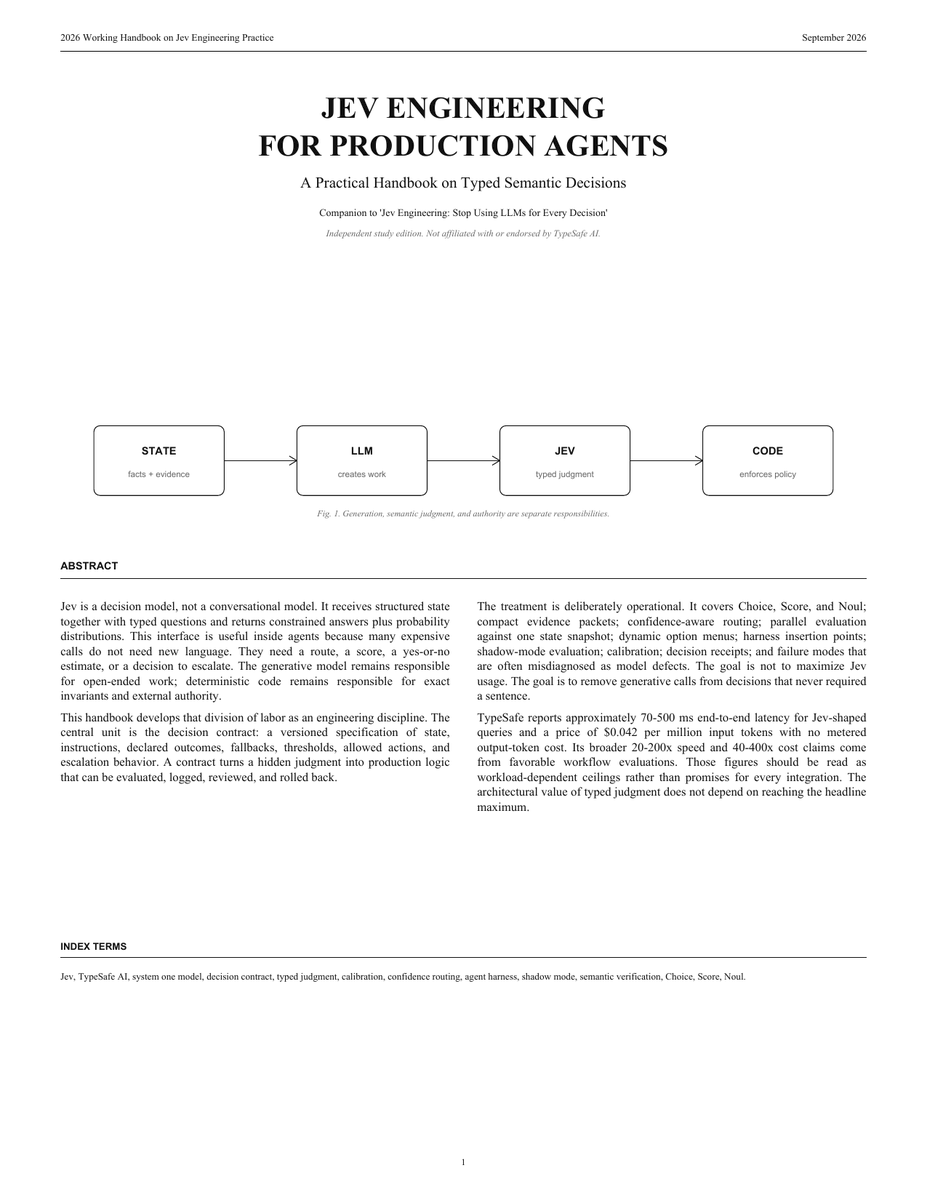
Jev Founder, Diogo Amogo, just released 12-page PDF on building a Jev Harness for production agents
This is a 10-step blueprint for making agent decisions up to 200x faster and 400x cheaper without giving a model authority over your system:
step 1 → meet the decision layer: the LLM creates, Jev judges, code enforces and the harness decides what happens next
step 2 → expose every hidden decision: routing, evidence checks, retries, approvals, escalation and stopping should be visible parts of the agent graph
step 3 → stop dumping the entire transcript into every call: build a compact state packet with only the current goal, facts, evidence, constraints and available actions
step 4 → turn prompts into contracts: declare the possible outcomes, describe what each one means, add an escape route and version the decision like code
step 5 → route by confidence and consequence: automate high-confidence internal work, collect evidence in the middle and send dangerous actions to a human
step 6 → ask independent questions together: choose the next worker, estimate urgency and check approval against one immutable state snapshot
step 7 → build menus from live state: Jev should only see tools, workers, files and browser controls that actually exist and are allowed right now
step 8 → make retrieval decision-aware: deterministic filters remove impossible candidates, Jev keeps the evidence that matters and the LLM receives the smallest useful context
step 9 → create a receipt for every decision: preserve the state, contract version, full probability distribution, threshold, selected route and resulting action
step 10 → deploy in shadow mode: compare Jev with the existing agent, measure calibration and automate the safest branch before expanding the boundary
TypeSafe reports roughly 70–500ms for Jev-shaped decisions and pricing of $0.042 per million input tokens with no metered output-token cost
The real unlock is bigger than one benchmark:
Your most expensive model stops wasting time on decisions that never required another sentence
Send this PDF and the article below to your Claude Code or Codex instance and start rebuilding your agent around typed judgment ↓
first came jev. then laya. then laya-mlx. and now kev.
all system one decision models. all within a span of 3 days. never seen a race this fierce before.
let us breathe, folks. let us breathe.
After co-inventing ChatGPT, I kept asking myself: why have superhuman chat models not led to AGI?
I’ve spent the last 2 years in stealth building a new way to train models (RLCD), and a new type of frontier AI model that we are releasing today: Jev
• 20-200x faster
• 40-400x cheaper (w/ output tokens free)
• Frontier composable intelligence optimized for decisions
AFAICT the shortest path to AI-based economic revolution
GOOGLE BUILT A SECRET WEAPON FOR FILE DETECTION
they ran it internally for years, gmail, drive, safe browsing, hundreds of billions of files every week
then they open sourced it
it's called magika and it exposes what files really are, not what they pretend to be
rename malware to "resume.pdf"? magika sees through it
disguise a script as an image? magika sees through it
any trick attackers use with file extensions? magika sees through all of it
ai trained on 100 million files. 200+ content types. 99% accuracy. 5ms per file
one command
`pip install magika`
the same tool protecting google's billion users is now protecting yours
https://t.co/Jr3LjmQobq
👋 What are you building with Gemini 3?
The @GoogleDeepMind Gemini Hackathon is live — focused on reasoning + multimodal builds, from experiments to full prototypes.
💰 $100K in prizes
🗓️ Deadline: Feb 9
🔗 https://t.co/fv0BuxVW8j