Understanding a scientific figure is one thing. Writing code to reproduce it is another.
We introduce FigCodeBench to evaluate multimodal LLMs on figure-to-code reproduction.
Project: https://t.co/Izj8Vid5qD
#mllm#benchmark#ai#figcodebench#coding
A thread (1/4)
@ZipMind_AI Thanks for the insightful comment! We haven't tried adding grids or tick marks to the non-grid images yet, but it's a great idea. We plan to investigate this in future work to quantify how much of the gap such visual cues alone can bridge.
Understanding a scientific figure is one thing. Writing code to reproduce it is another.
We introduce FigCodeBench to evaluate multimodal LLMs on figure-to-code reproduction.
Project: https://t.co/Izj8Vid5qD
#mllm#benchmark#ai#figcodebench#coding
A thread (1/4)
@ZipMind_AI 4. Further case study reveals that although current MLLMs have largely mastered basic data-to-geometry mapping, they still exhibit substantial weaknesses in fine-grained aesthetic rendering.
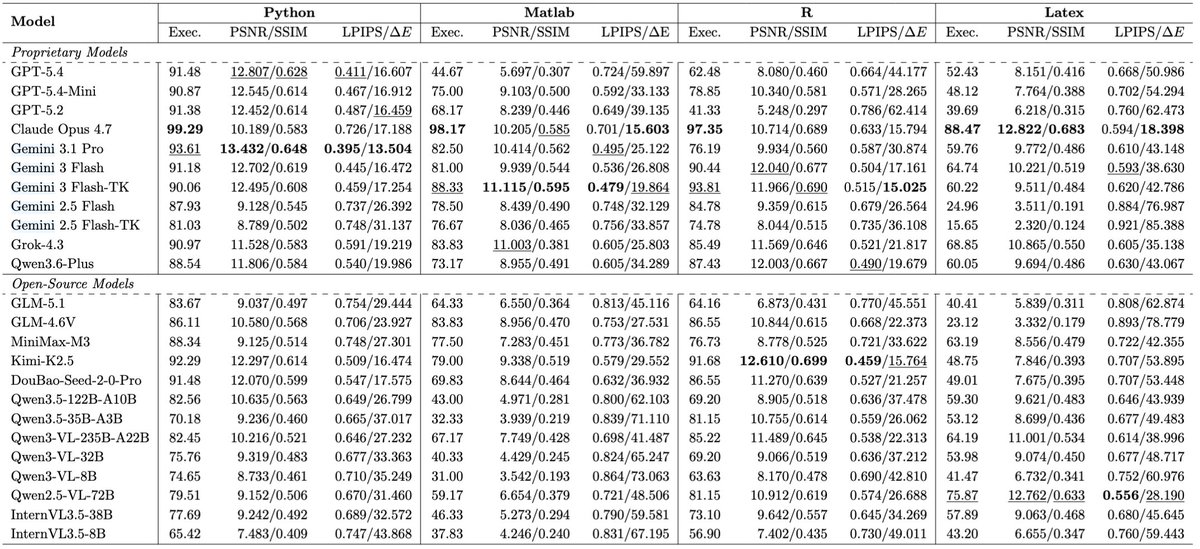
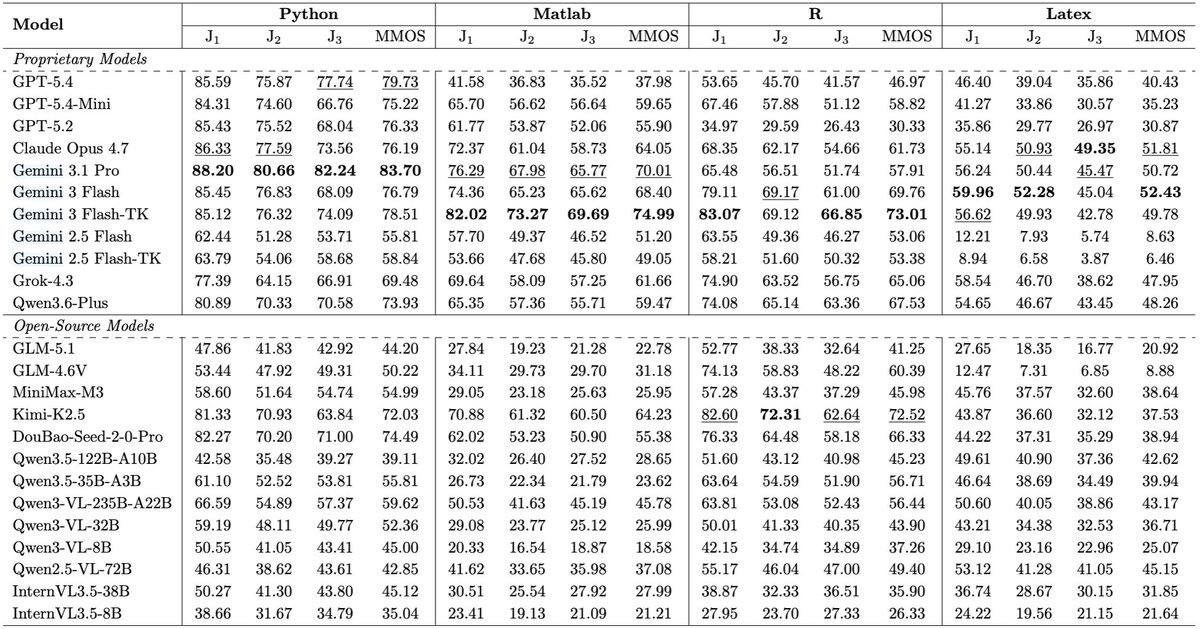
@ZipMind_AI 3. Meanwhile, we find a significant divergence in the coding strategies adopted by different MLLMs, highlighting that few models can strike a perfect balance between precise visual comprehension and reliable code generation.
@ZipMind_AI 2. We observe a significant performance gap across different programming languages, where rendering via descriptive LaTeX constitutes a formidable bottleneck for all evaluated models.
FigCodeBench examines the perception and reasoning bottlenecks between seeing a figure and reproducing it through code.
Explore the benchmark and results:
https://t.co/2CqXZVz2xn
Dataset:
https://t.co/r8xdxEhHDp
Does the output look right? Does the code faithfully represent the figure?
We evaluate 24 multimodal LLMs using image- and code-oriented metrics, alongside the Mean Machine Opinion Score (MMOS) and Figure-Code Fidelity (FCF).
A thread (3/4)
#GPT5#Benchmark#biological_motion#LLMs
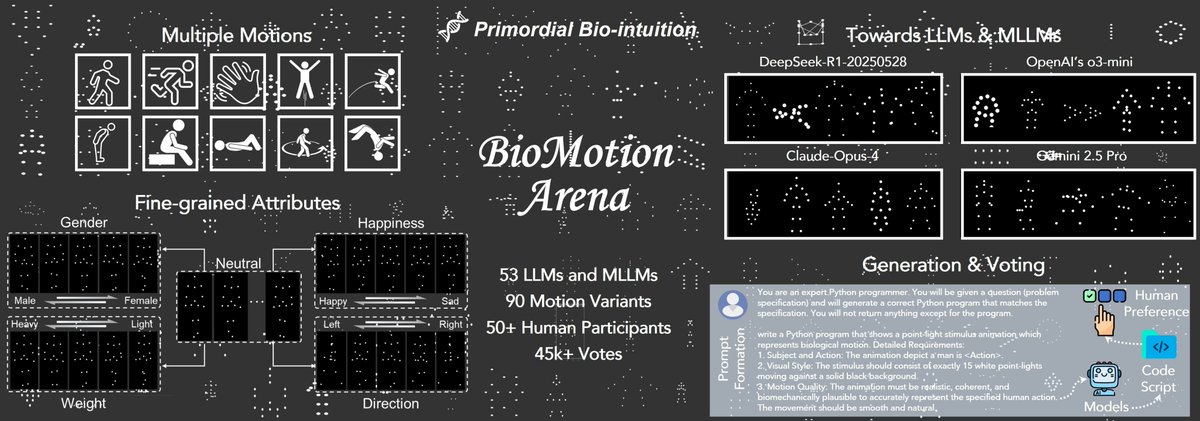
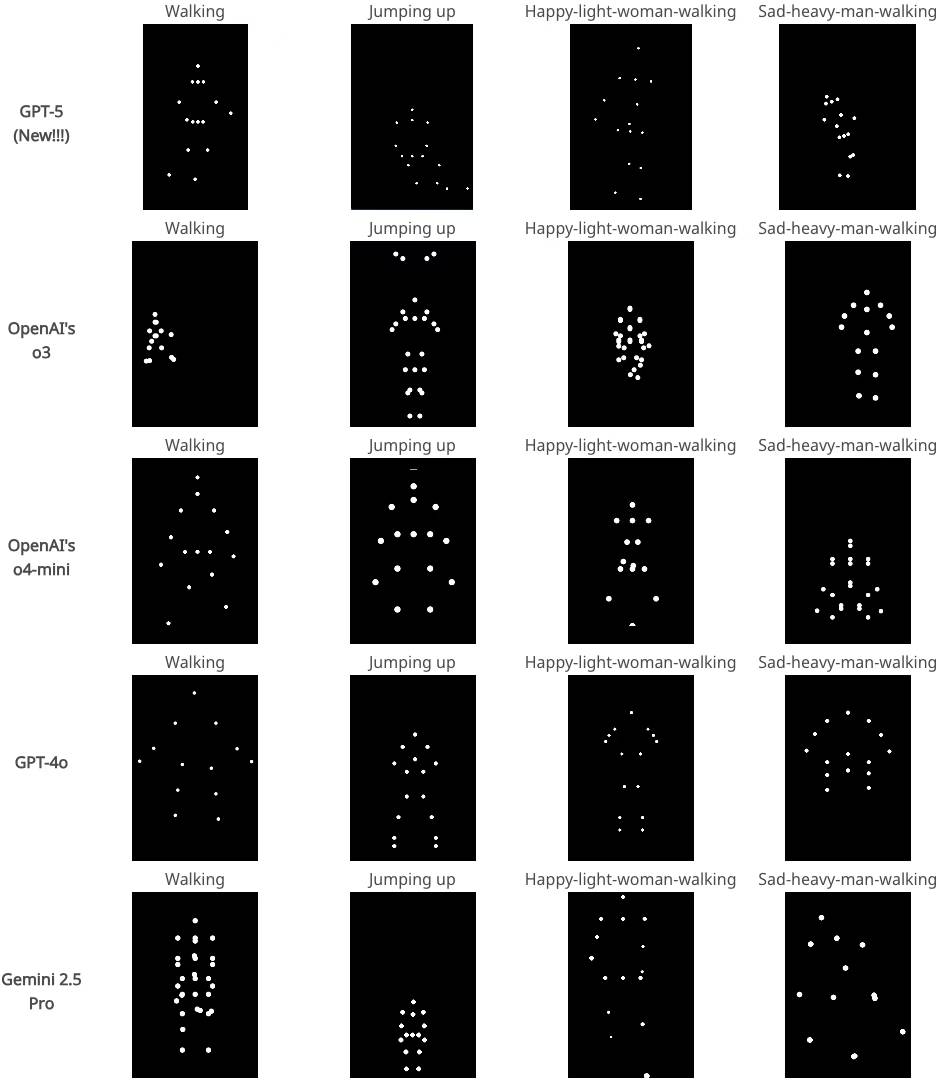
We propose BioMotion Arena, a biological motion-based visual preference evaluation framework for large models.
Project: https://t.co/jiCCjDwEg7
Paper: https://t.co/Vs93cFjCsI
Current benchmarks adopt either ground-truth-based score-form evaluation on static datasets or indistinct textual chatbot-style human preferences collection, which may not provide users with immediate, intuitive, and perceptible feedback on performance differences.
@sama We propose BioMotion Arena, a biological motion-based visual preference evaluation framework for large models.
GPT-5 (newly added) leads the board, with reasoning-focused closed-source models close behind.
Project: https://t.co/jiCCjDwEg7
Paper: https://t.co/Vs93cFjCsI
Key results
• GPT-5 (newly added) leads the board, with reasoning-focused closed-source models close behind.
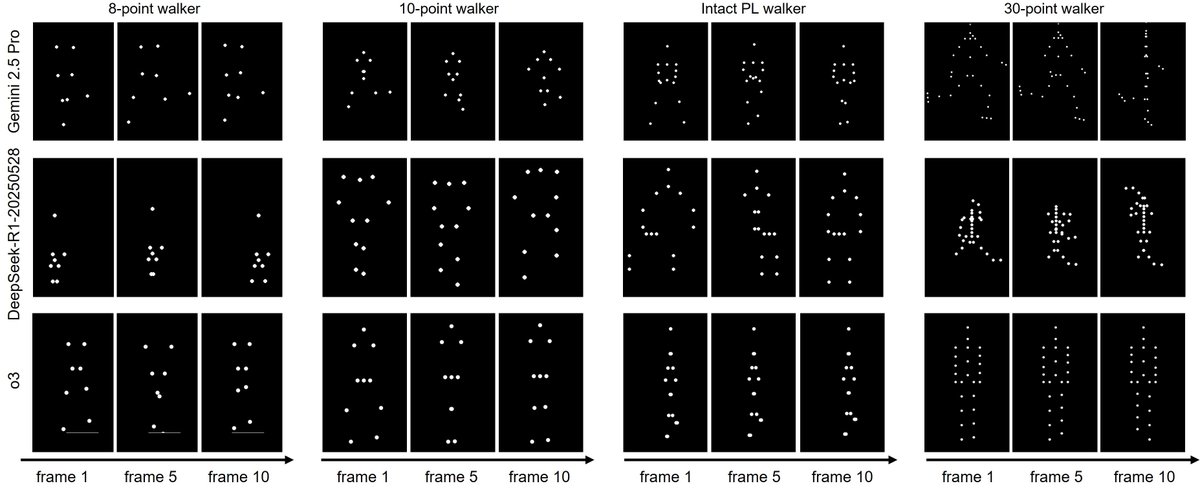
• Open-source generalists lag dramatically; code-specialized models often emit random, discontinuous dot clouds that viewers unanimously reject as “non-human.”
1st JND versus the parameter ratio of the language backbone to the visual backbone.
We observe that LMMs with stronger detail perception capabilities generally have a lower Param_L/Param_V.
Dataset and code are coming soon!
A thread (6/n)
#JND#MLLM#perception What is the minimal magnitude of changes that LMMs can perceive?
We propose the LMM-JND to explore the perception granularity of large multimodal models (LMMs).
Arxiv: https://t.co/tanZAKgTk2
Project: https://t.co/FEXPIB9fI2
A thread (1/n)
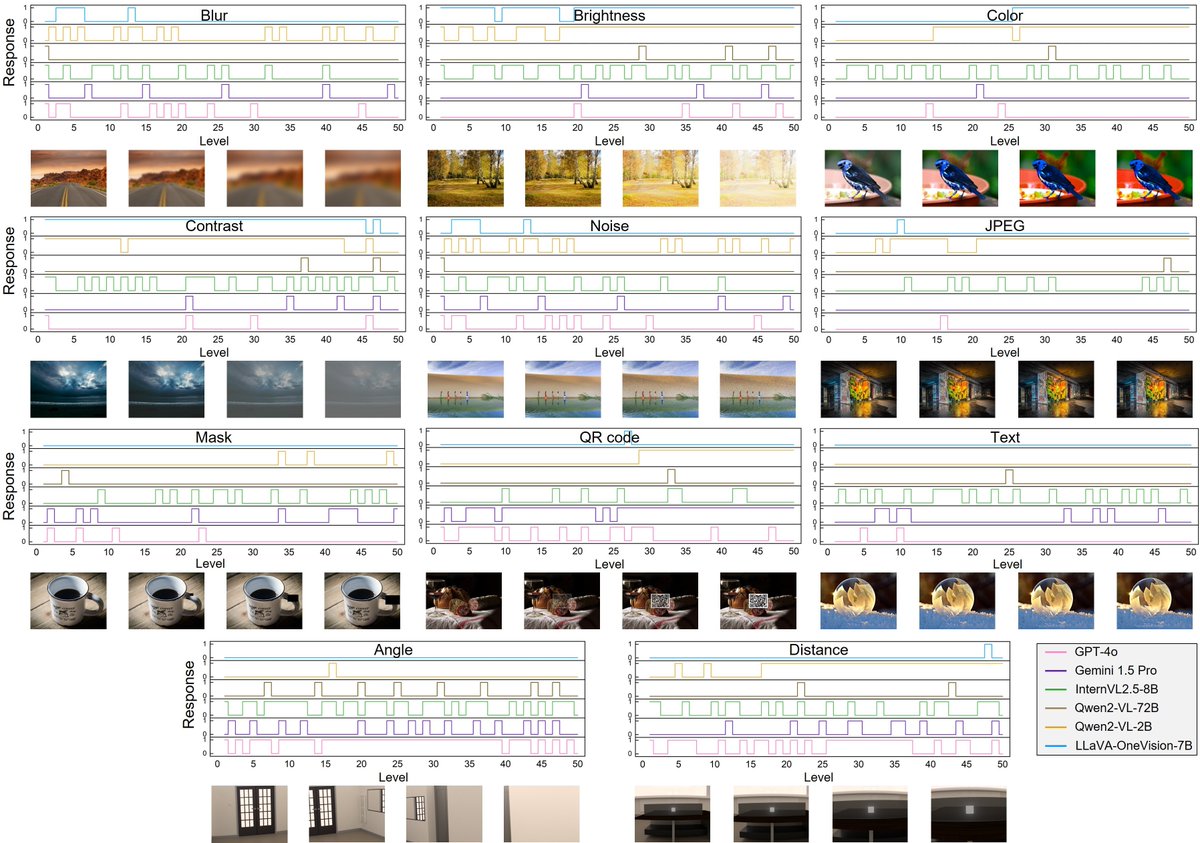
What do LMM-JND curves look like?
The width of the trough between two high-level peaks represents the perceptual redundancy interval of LMM.
1. Evident perceptual redundancy intervals in Qwen-VLs & GPT-4o.
2. InternVL2.5 displays more frequent fluctuations.
A thread (5/n)