Finally, with the help of LLM and a powerful Ghostlock bug, I can finally root my old phone without logging in Xiaomi account to unlock the bootloader
Great reference: https://t.co/hKJ7WpBZ2a (Really good starting point of the exploit)
Model used: Kimi K3.1 Pro!
Sophon-Realtime-4B: a full-duplex voice model you can run on your own GPU or Mac, and now fine-tune.
It waits through your pauses, answers in as little as 0.2 s and stops when you cut in.
#1 open model on Full-Duplex-Bench turn-taking (96.3). Apache-2.0.
https://t.co/Q7oZ2OW2IK
Alder-1.6B by @udgamlabs is live, trained from random weights for $703 direct ($980 all-in across 173 runs).
1.59B params, 32K context, 95.7% JSON tool calling (0% malformed), 79 tok/s local. All 41 checkpoints + code are Apache-2.0.
Try in browser: https://t.co/b1FTruH3Ve
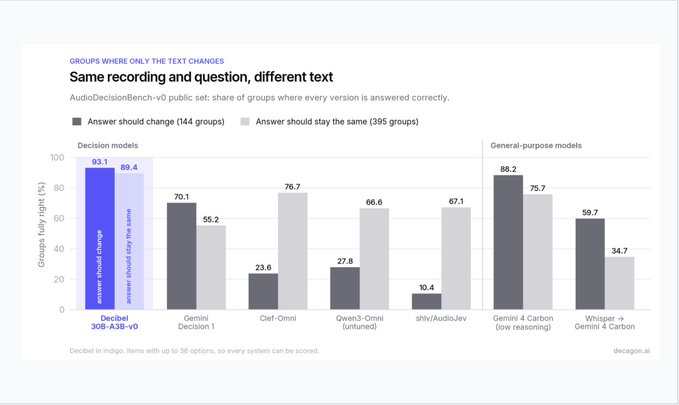
Decision models (like Jev) have proven to be very useful in voice agents. We're excited to release our very own decision model for audio: Decibel.
With it, we're also open-sourcing our benchmark for audio decision models!
Meet "InDIM-small": a 32M-parameter encoder that reads Indian languages the way India types them. Native script, romanized, code-mixed.
A lighter alternative to IndicBERT and mmBERT: 12 of 15 benchmarks won vs mmBERT-small, ~3× faster on CPU.
https://t.co/AqNvGMlhS7
#IndicAI
New model drop.
Introducing Face: find people in a photo library, on device. It sorts a camera roll by who's in each photo.
Name someone once and it recognises them in new photos too. The photos never leave the device.
Each photo takes 220ms on a Nothing Phone (3a) Lite.
Add it to your app with our Swift, Kotlin or JavaScript SDK: https://t.co/YNT84Dl8W7
I deleted Linux completely, baked Qwen3-0.6B into a 24 KB pure x86-64 assembly OS, and it runs up to 54% faster than native Linux llama.cpp.
The entire Multiboot OS binary (asm-llm-os.elf) is 24,252 bytes, written from scratch without Linux, Windows, C, Rust, or libc. It boots in 74 to 94 ms straight into 64-bit Long Mode, wakes every CPU core over APIC, maps the 614 MiB Q8_0 weights directly from physical RAM, and drops you into a live multi-turn KV-cache chat over VGA, PS/2 keyboard, and serial.
I ran head-to-head CPU benchmarks against llama.cpp (Q8_0, -ngl 0) on the same AMD EPYC 7642:
- 1 thread hits 23.67 tok/s vs 16.63 (+42%)
- 4 threads hit 78.89 tok/s vs 51.08 (+54%)
- 8 threads hit 118.08 tok/s vs 80.79 (+46%)
- 16 threads hit 134.94 tok/s vs 103.03 (+31%, 136.6 peak)
On a diskless 0 GB Proxmox VM (2014 12-core Intel Xeon E5-2670 v3, 2 GiB RAM), it boots straight to the prompt in under 5 seconds (95 ms kernel boot) and runs live out of RAM at 78 tok/s decode and up to 111.5 tok/s prefill, with a hybrid BIOS+UEFI ISO builder included too. Output stays bit-exact across thread counts and matches all 64 greedy tokens against PyTorch FP32 (0.99965 cosine).
The 14.7 KB Linux ELF build (FAST_Q8=1 INT8xINT8 AVX2+F16C) also beats llama.cpp by 18% to 36% from 1 to 40 threads, and booting bare metal with 2 MiB huge pages squeezes out another 10% on top.
Repo, ISO builder, and Proxmox setup guide are in the reply below.
How far open weights have come:
2022: DALL·E 2, closed API, $0.018 a picture
2026: MiniT2I, MIT licensed, 313 MB, runs in your browser in 0.5 s. for free 🤯
open source is worth fighting for!
https://t.co/HFY8xGXNmW
The future is custom models for maximum performance, cost and ownership thanks to open-source!
Last week, we released Qwen3.8-27B-pi-adapted (that became second most trending on HF) and a bunch of harness-adapted models that drastically improve performance and cost.
This week, we're releasing the fully reusable recipe, so you can reproduce this on your own task, harness, and model combinations.
Blogpost: https://t.co/7s450udsdC
Let's go open-source AI!
🚨 Introducing HobbyLM-Embed: India's first embedding model built from scratch, and the smallest MoE embedder on MTEB
A 140M model with 36M active. 62.33 on MTEB(eng, v2), near SOTA at ≤40M active params - Top 10 on MTEB.
Runs on CPU and MLX. Apache-2.0.
https://t.co/eM3sZm7UmE
i made my macbook trackpad talk using only the vibrations from its haptic motor
my speakers are muted, every sound you hear is coming from the trackpad itself
open source, try it here: https://t.co/MPEKltkFxO
Superhuman has one of my favorite autocorrect experiences, and I wanted something like it that works offline.
So I trained a 2.1 MB model that runs in your browser and fixes typos spell check usually misses (form → from, their → there).
🤗 https://t.co/EPaAPR5eAl
We built a TTS that’s 2,000× cheaper than ElevenLabs, fits in 7.6 MB, and speaks 12 languages.
Meet Verba-TTS-Indic-Zero
→ 1.8M parameters (7.6 MB)
→ 12 languages (11 Indic + English)
→ 24 voices
No GPU. Runs on CPU in your browser or in a Cloudflare Durable Worker (~100 ms to first audio) or even on an ESP32-S3 (+PRAM) chip.
The "Sovereign Indian AI" playbook:
1. Get picked by the govt as India's chosen frontier lab
2. Collect GPU subsidies (sponsored by taxpayers)
3. Raise Millions (234) at a Billion valuation (1.5)
4. Launch a LLM inference service (Token Factory) that mostly serves Chinese SOTA model DeepSeek, Kimi, GLM, and Qwen.
5. Make sure to charge in INR with GST billing
Congratulations this is "Atmanirbhar AI" means using Indian GPUs to resell Chinese open models.
Peak ecosystem favoritism. If we wanted an OpenRouter clone, a three-person team in Bengaluru or Bhopal could have built it without a $1.5B valuation.
Made in 🇨🇳 , Served in 🇮🇳
Today, we release d1.2 and d1.2-ultra, the state-of-the-art omnimodal decision models. d1.2 and d1.2-ultra both can process text, images, and audio with new output capabilities.
> #1 on the @ArtificialAnlys Decision Index (75)
> Read a value from the input (text, number or date)
> Find every passage of a kind in a text (spans)
> Locate things in a picture (box for one, boxes for every instance)
> Estimate a number (number with a range)
> Pick every option that applies (choice)
1/ 🧵
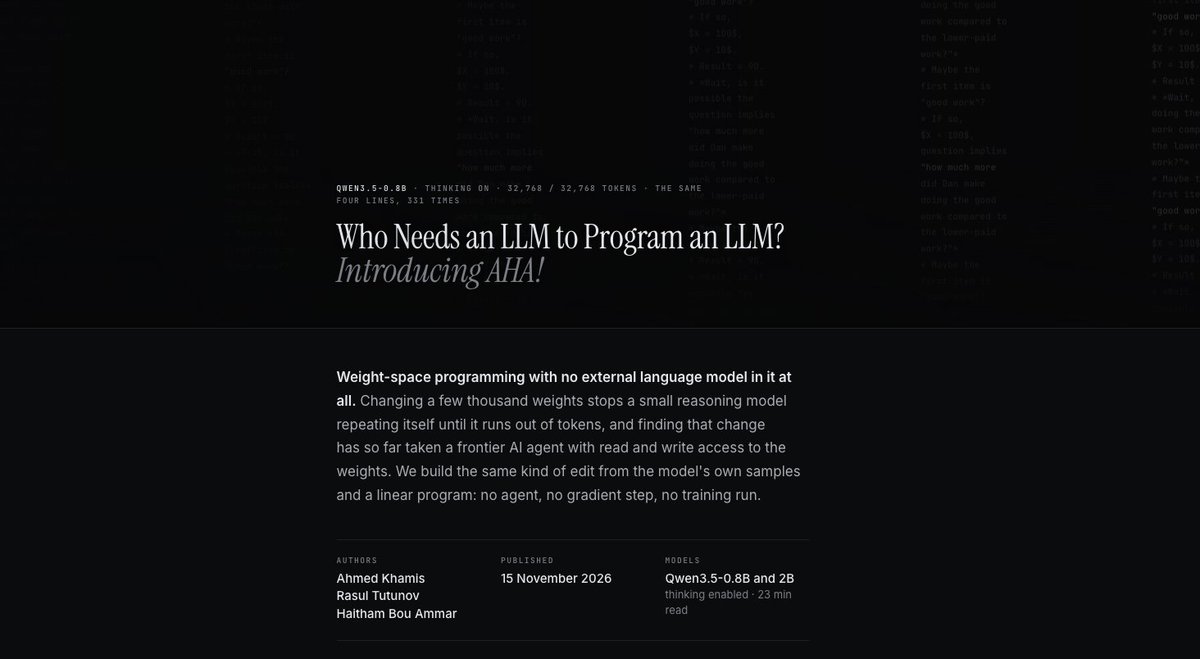
we were quire exicted when we saw the weight-space programming blog by MIT researchers, where they showed that when a small reasoning model gets stuck in a loop, a frontier LLM can read a model's weights and fix one of its bugs by hand.
we asked: do you actually need the LLM?
turns out you don't. today we're releasing 'AHA'.
the trick is to let the model show you its own bug. we rewind it to just before it starts looping and let it try again from that exact point. sometimes it loops, sometimes it doesn't. a linear program then turns that into a tiny weight edit.
no training. no gradients. no labels. no LLM in the loop.
on qwen3.5-0.8B it matches the edit the frontier agent made, for example: MATH-500 goes from 9.8 to 51.8.
Blog: https://t.co/nxfkW0KfSz
Code: https://t.co/BDfNtur7dr
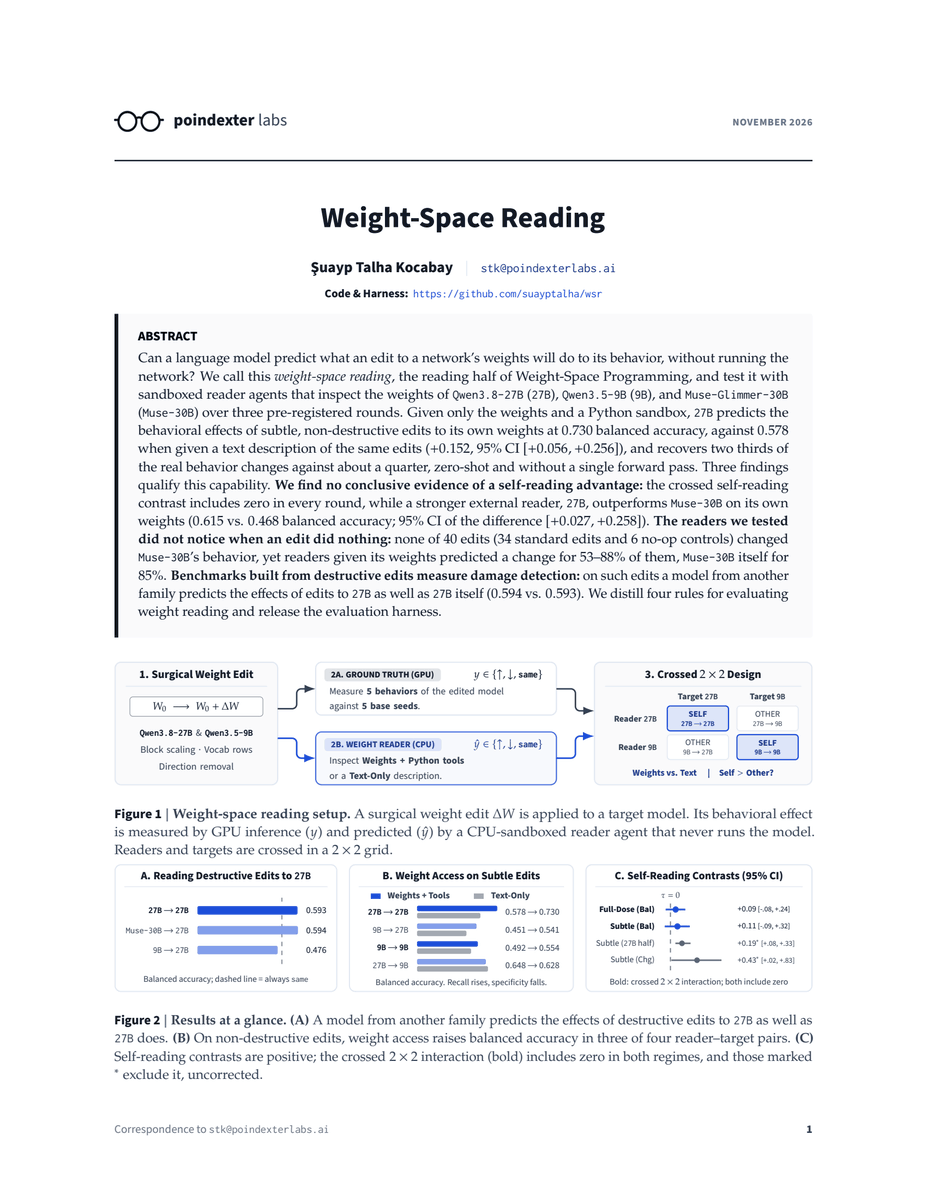
LLMs can read neural network weights. But do they actually understand what they're reading?
I tested this on 9B–30B language models.
The results surprised me.
A paper from @Poindexter_Labs, inspired by Weight-Space Programming:
Introducing Weight-Space Reading👇
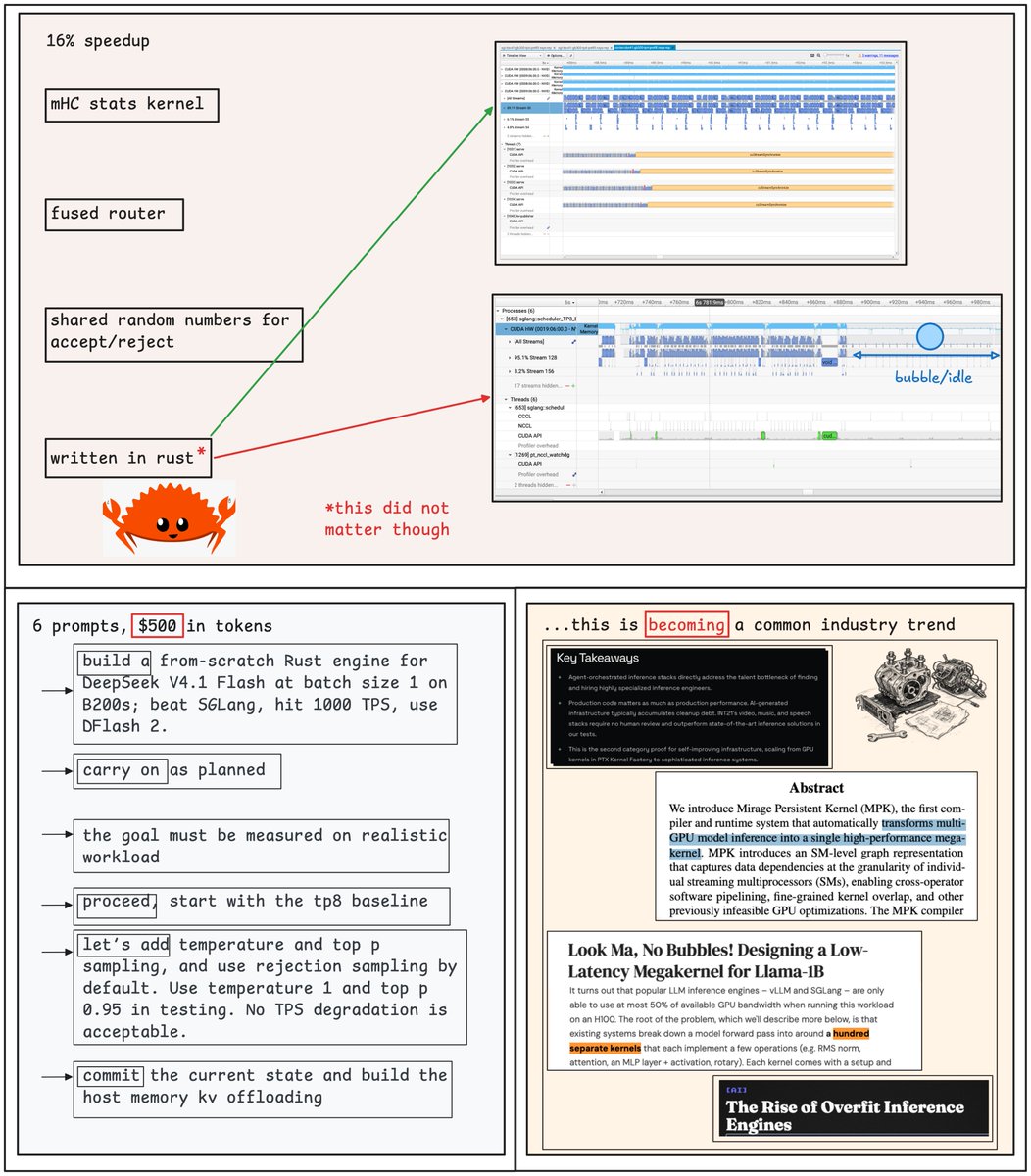
> it took us 4 days and 500$ in tokens
> we beat SGLang by 15%
> it took 6 prompts
> 3 out of those 6 were:
(a) "carry on"
(b) "proceed"
(c) "push to github"
and... we did it from SCRATCH (git init)
context: it has recently become a very clear industry trend to build a custom inference engine for each open source model that comes out... a paradigm made popular by a WAVE of papers that came out earlier this year, like hazy research's megakernels and MetaInfer
the usual argument against traditional inference engines (like vllm / sglang) is that they, like all conventional swe products, use abstractions. the use of abstractions is synonymous with performance overhead (triton vs cuda, python vs c++, etc). combine this with increasing hardware complexity, increasing parallelization strategies, increasing kernel specialization techniques... and you can make a very clear (but very FLAWED) argument for building an engine customized purposely for one model.
why flawed? it is true that traditional inference engines waste cpu time running generic abstractions. sure. but the gpu kernels (the functions run on the gpu) are almost always longer, and so the wasted cpu time is not the bottleneck. if you know your shapes, and run cuda graphs ahead of time (and you almost always do), this is NEVER a problem.
so why would you build your own engine? why are people RAVING about this?
so we tested it out. we built one for DeepSeek V4.1 Flash. The goal was two-fold:
1) is it feasible to do so (spoiler: yes)
2) is it useful to do so (spoiler: also yes...but for different reasons)
we built it in rust (in retrospect, this did not really matter), and it took us 6 prompts and cost 500$ end to end.
unshackled from working within a pre-existing codebase or inheriting code debt, we:
- implemented custom kernels (GEMV, MoE, and AllReduces) specifically for DSV4.1 at our batch size
- we were able to put an entire spec dec step in one graph, and verify across 7 tokens at that
- we were able to mix deepseek's 4 residual streams in 1 fused kernel instead of 80
- fused the routing so that picking and running the expert happened in a single step (saving one write and one read i/o from each expert)
iterating on the model was cheap to do in a custom sandbox-like engine, and we were able to go much faster than a traditional dev cycle. we were then able to port every single thing into sglang, and matched performance
imo, it is this easy iteration that makes this paradigm useful. little else matters.
and, ofc, we've open-sourced the engine and upstream(ed/ing) the patches to @sgl_project
Qwen Concept 27B: we rewrote 9 weight matrices in Qwen3.8-27B. No gradient steps, no training data.
It thinks less and scores higher: GPQA Diamond +4.3 pts // LiveCodeBench v6 +13.0 // 27–54% fewer thinking tokens.
Open weights and methodology paper below↓
An OpenSSH bug that took 46 years to ripen!
1980
UNIX puts * in the password field of system accounts. The idea is simple: it’s not a real hash, so it can’t be brute-forced and you can’t log in with a password.
2012
The musl libc developers decide that returning NULL from crypt() on failure is dangerous - programs often forget to check it and crash with a segfault. So they return an error string instead.
Guess which one?
The same asterisk: *.
Three weeks later they add a length limit: passwords longer than 256 bytes burn CPU. Anything longer is rejected. And since it’s an error, crypt() returns *.
2016
OpenSSH fixes a timing attack (CVE-2016-6210). If a user doesn’t exist, the server still hashes the password with a fake/borrowed salt so an attacker can’t tell valid usernames by response time.
2022
Alpine Linux changes the locked root password in /etc/shadow from ! to * so SSH keys work properly on cloud images.
… and the loop closes!
You connect over SSH as root (whose shadow entry is *).
You type any password longer than 256 characters (e.g. 300 As).
crypt() hits the length limit → returns * → OpenSSH compares it with the value in the database → that value is also * → you’re in as root.
That chain took 46 years (!!!) to complete.
Every individual change was reasonable. Together they produced a perfect * == * authentication bypass (CVE-2026-123158, nicknamed *sshole). Fixed in OpenSSH 10.6p2 and Alpine packages.