i think this is good work. i have no doubt that two years ago, @oneill_c's single post below could have gotten you a phd in maths. but it isn't two years ago, so there are three things i take issue with here.
a) these were all derived first with closed models. that alone confesses that the gap between open and closed models still exists, however much we like to pretend otherwise. at the frontier, only two models in the world were able to do this: Astra and Fable, both of them American.
and reproducing a result is different from discovering it, since knowing a problem has already been solved gives you the conviction to keep pushing an open model until it yields the answer (and since infinite monkeys typing for infinitely long eventually produce Shakespeare... you'll get there)
b) the problems were chosen because the closed labs weren't looking at them. i'm curious whether the labs could have done this internally a while ago, and i would not be surprised if they had
c) even if we ignore both points above, when we came to use open weights, we used DeepSeek and Kimi. not necessarily a geopolitical point, but it is somewhat of a problem: the frontier of open models is not (yet) trained here.
this point matters most to us, and is in and of itself the foundation of @baselabs. it's what we're actively working on, and it bothers every single person on the team. our work is cut out for us, and perhaps one day, after a direct and concentrated effort, open models will guide the discoveries the closed models make.
Was playing around over the weekend and got 11 results on open maths problems: https://t.co/YvDYq8QDY5
Whilst I originally derived these with Astra and Fable, @maxkirkby and I went back and were able to get to some of the same results with Deepseek and Kimi. I believe this is one of the first times open-source models have made real progress on well-known open problems.
The results are:
1. Sixth moment of the Riemann zeta function: lower bound for the leading constant raised from 41.008 (Fraccaro) to 41.64 (the conjectured true value is 42)
2. Primes between powers: a prime between n^2.2 and (n+1)^2.2 for every n, and Legendre's conjecture (a prime between consecutive squares) checked up to 10^14, about 42% beyond the previous record of 7.05 x 10^13. The finite range, about 59 trillion checks, ran on @baseten Sandboxes: about 2,900 machine-hours in 19 hours, producing 51.7 TB of prime certificates
3. Cube packing: the most disjoint 2x2x2 cubes that fit in the N x N x N torus, for every N ≡ 5 mod 8, proving a 1971 conjecture of Baumert, McEliece et al. in that case (known before only for special N, such as N prime)
4. Least prime in arithmetic progressions: for more than 58.7% of moduli q, every residue class coprime to q has a prime below q^(2-δ) for a fixed δ > 0, beating the (q log q)^2 bound that GRH gives
5. Hadwiger–Nelson: every unit-distance graph with at most 10,689 vertices, or at most 245,510 edges, can be coloured with 6 colours (previous 6,992 and 232,645)
6. Kourovka Notebook 17.125: every finite group has two conjugate elements that generate a subgroup with the same prime divisors as the group, answering Shumyatsky's question
7. Shannon capacity of the 7-cycle: a zero-error code has at most 112 words at length 4 and at most 392 at length 5 (previous 115 and 401)
8. Quadratic L-functions: the central value is nonzero for more than 94.53% of them (previous 94.27%)
9. Hadamard matrices: a Hadamard matrix of order 4792 = 8 x 599, the first known, and one of the last two open orders of the form 8p below 10,000
10. Quadratic van der Waerden numbers: W(ex^2+fx; 4) ≤ 57|e| + 39|f| + 1, which settles the optimal constant at 57 (previously only known to be between 57 and 64), plus six new exact values
11. Circular edge-colouring: every denominator q > 2 occurs for the circular chromatic index in the upper half (Δ+½, Δ+1), even for connected regular simple graphs, answering a question of Mazák and Zrubák
While all of these required significant work on top of any theorems released recently, three of these (zeta, primes between powers, quadratic L-functions) rely on @__alpoge__’s proof of RH and GRH from last week. The main idea was to choose problems that had (relatively) less attention due to reliance on RH and/or GRH but that still needed some amount of significant work to get there. Keen for people to check these! Will also be releasing a detailed scientific writeup with @baselabs shortly comparing the open models to closed models on these open maths problems, and our efforts to midtrain + RL the open models to be better at doing so
https://t.co/674xTEyoP1
the routing problem: how do you switch from a stronger model to a weaker one, and vice versa, without paying the cost of prefill?
perhaps the most challenging problem of all.
> if i start with an expensive model, doing difficult tasks
> i want to maintain the context, but do less challenging work
do i:
a) continue paying high $/token, on less challenging work
b) pay upfront the cost of prefill on a weaker model, and pray that i've chosen that the tokenomics y=mx+b is in my favor?
very interesting research that paves the way to solving this once and for all. insanely well written @thomasvillix
strong disagree on this one sam
nvidia’s moat is self-fulfilling
they’re used by labs
labs tell them what they need
they put it in next gen
repeat
case in point is nvfp4/fp4 cores
amd will be good, but they’ll always play catch-up
I’ve had a lot of folks ask me how I think about NVIDIA vs AMD for inference in the last week
TL;DR scaling laws have made swift work of NVIDIA’s former software moat, and serving frontier open models on AMD is quite trivial today.
Fable can basically one-shot running DeepSeek / GLM on AMD. This is already widely known by inference providers and will be common knowledge by January
@alexzfunk well they can, see
“they’ll always play catch-up”
by the time they do, we’ll have the next thing in nvidia’s generation that amd doesn’t have
we know that pausing algorithmic progress is senseless: financially not viable because of their race with ant, and geopolitically because of the race with china, so to claim that this is the only solution is the same as saying the only way to solve global warming is if we stopped using cars.
sure, that could make things better.
no, it's never going to happen.
why spend time dwelling over this instead of finding an actual solution?
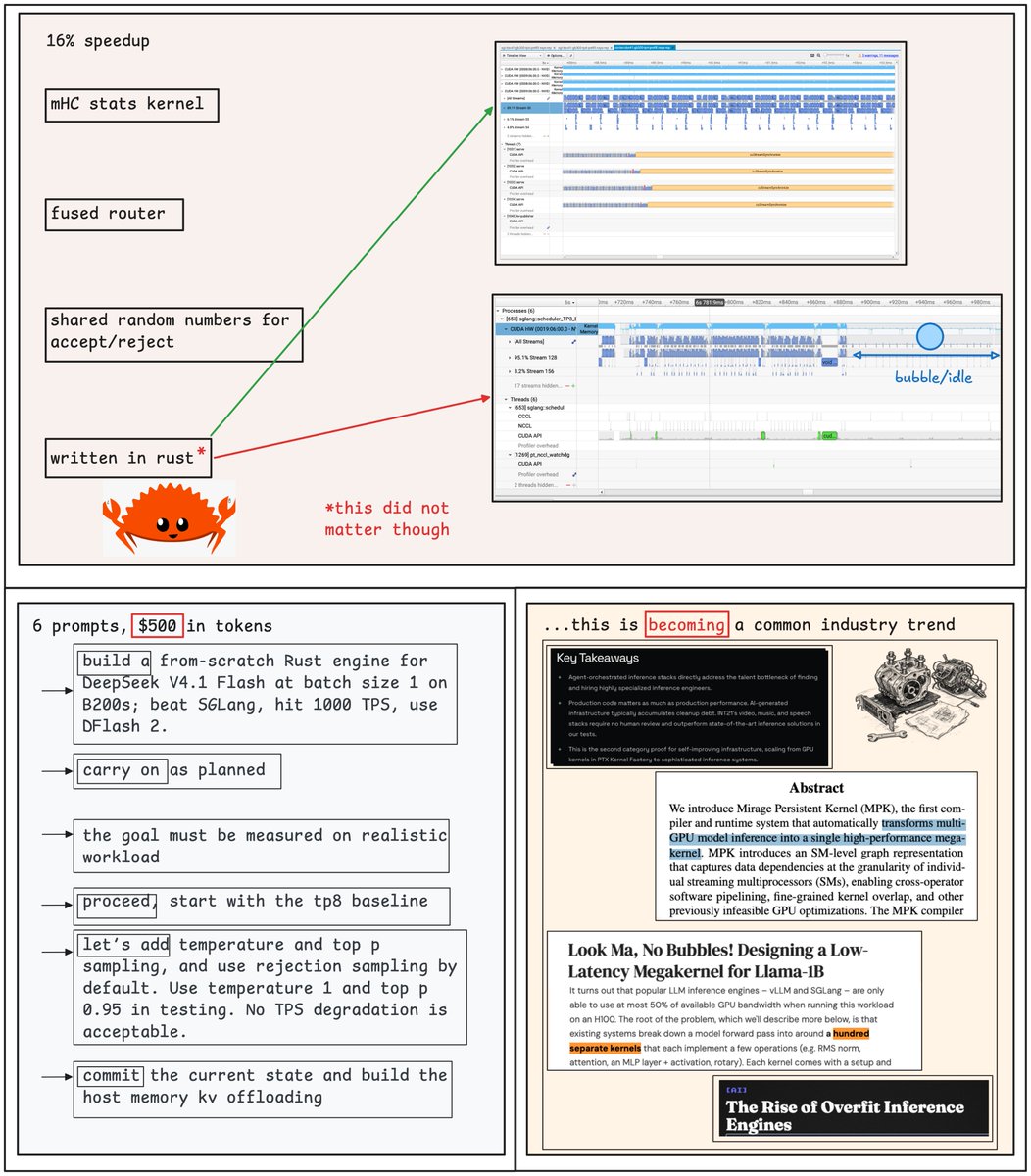
> it took us 4 days and 500$ in tokens
> we beat SGLang by 15%
> it took 6 prompts
> 3 out of those 6 were:
(a) "carry on"
(b) "proceed"
(c) "push to github"
and... we did it from SCRATCH (git init)
context: it has recently become a very clear industry trend to build a custom inference engine for each open source model that comes out... a paradigm made popular by a WAVE of papers that came out earlier this year, like hazy research's megakernels and MetaInfer
the usual argument against traditional inference engines (like vllm / sglang) is that they, like all conventional swe products, use abstractions. the use of abstractions is synonymous with performance overhead (triton vs cuda, python vs c++, etc). combine this with increasing hardware complexity, increasing parallelization strategies, increasing kernel specialization techniques... and you can make a very clear (but very FLAWED) argument for building an engine customized purposely for one model.
why flawed? it is true that traditional inference engines waste cpu time running generic abstractions. sure. but the gpu kernels (the functions run on the gpu) are almost always longer, and so the wasted cpu time is not the bottleneck. if you know your shapes, and run cuda graphs ahead of time (and you almost always do), this is NEVER a problem.
so why would you build your own engine? why are people RAVING about this?
so we tested it out. we built one for DeepSeek V4.1 Flash. The goal was two-fold:
1) is it feasible to do so (spoiler: yes)
2) is it useful to do so (spoiler: also yes...but for different reasons)
we built it in rust (in retrospect, this did not really matter), and it took us 6 prompts and cost 500$ end to end.
unshackled from working within a pre-existing codebase or inheriting code debt, we:
- implemented custom kernels (GEMV, MoE, and AllReduces) specifically for DSV4.1 at our batch size
- we were able to put an entire spec dec step in one graph, and verify across 7 tokens at that
- we were able to mix deepseek's 4 residual streams in 1 fused kernel instead of 80
- fused the routing so that picking and running the expert happened in a single step (saving one write and one read i/o from each expert)
iterating on the model was cheap to do in a custom sandbox-like engine, and we were able to go much faster than a traditional dev cycle. we were then able to port every single thing into sglang, and matched performance
imo, it is this easy iteration that makes this paradigm useful. little else matters.
and, ofc, we've open-sourced the engine and upstream(ed/ing) the patches to @sgl_project
we built an inference engine for deepseek v4.1-flash from scratch. the core engine is just rust + cuda. no pytorch, no sglang, no dsls, etc.
~1740 TPS decode on 4xB300, 2060TPS on 8xB300. 1M token prefill in ~12s.
it's up on github