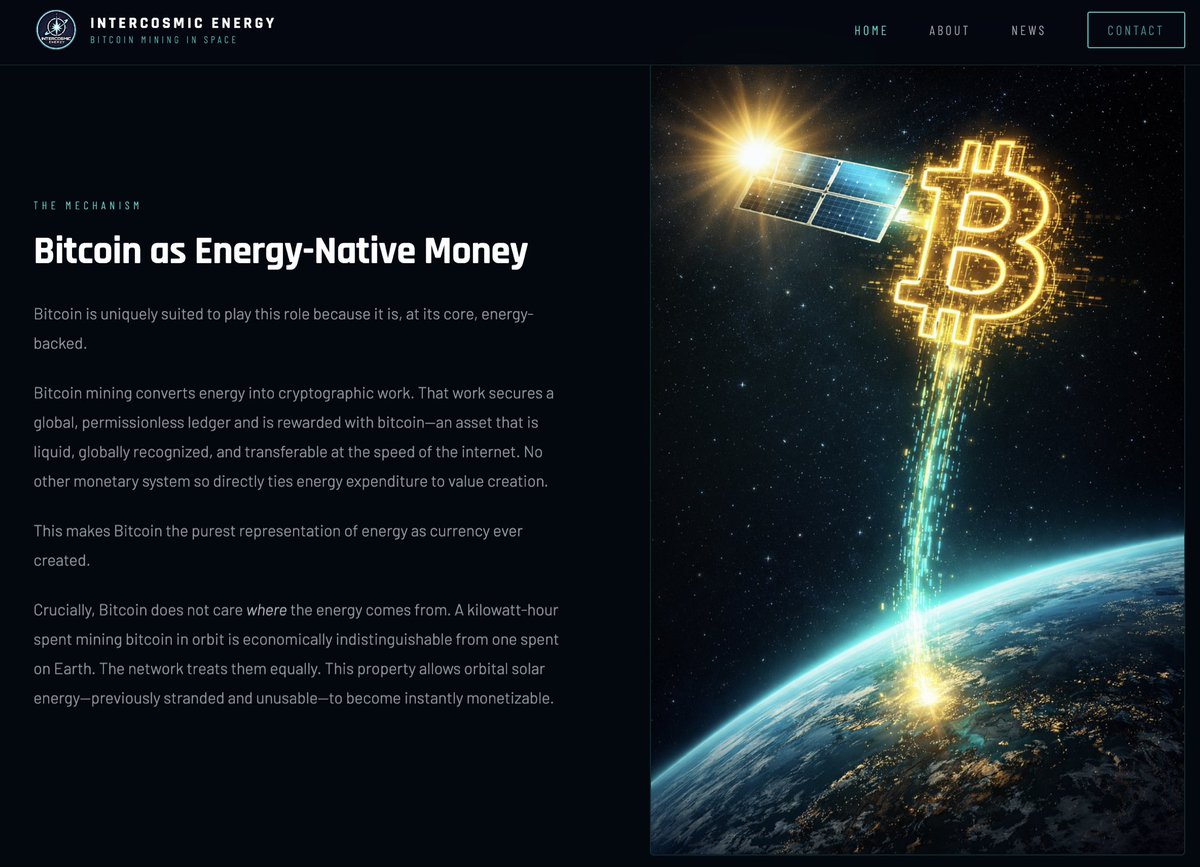
Pioneering Bitcoin Mining in Space to monetize stranded orbital solar energy. Turning sunlight in space into digital value. Co-Founder @IntercosmicNRG 🛰️
Thank you @APompliano for this 5 star article about my BIG idea of monetizing stranded solar energy with bitcoin miners attached to orbital solar panels in space. I am deeply humbled.
Let's make this a reality!🚀
(Click the link below, not the picture)⬇️
https://t.co/koyWFTNx3A
SpaceX is the gateway to orbit.
The orbital economy is already ~$500B and projected to hit ~$2T by 2035.
Starship will make access 10x+ cheaper, unlocking satellite mega-constellations, in-orbit manufacturing, orbital data centers, tourism, and Mars.
Starlink alone did $11.4B revenue in 2025 (high-margin, recurring) and is scaling fast. The $5B loss? Heavy capex building the infrastructure for that future, exactly like early Amazon or Tesla.
This isn’t about last year’s P&L. It’s about owning the rails to a multi-trillion-dollar orbital economy. 🚀
Love the news block, Great takes Natalie. 🤝
SpaceX is setting the foundation to mine Bitcoin in space at a scale that has never been seen before…
SpaceX will have more than 18,712 BTC in the future & it won’t come from outright purchase.
Would love to talk to you more about that sometime. It’s the most exciting thing to happening in the Bitcoin space by far & it’s barely even being talked about! 🚀
Damn Vlad, this is spot on. Take notes, people. 🎯
I'm living proof of what Vlad is saying. Believe me, he's giving y’all some damn good advice.
One example from my own life: About 10 years ago, I made a commitment to myself that I wasn't going to spend my entire life dependent on a 9-5 for my freedom and financial security. I made the concuss decision (after some time of intense & dedicated research) to invest every extra dollar I had earned from that point from my career into Bitcoin.
I had the realization that if I wasn't willing to take calculated risks financially while I was still young, I probably never would. I didn't want to spend most of my waking hours working a blue-collar 9-5 just to earn 2–3 weeks of freedom each year until I was legal retirement age.
Deep down, I knew I'd rather take the risk and potentially lose it all than spend the rest of my life wondering what could have been. The regret of not acting felt far worse than the risk of failure.
Looking back, I'm grateful to my 23-year-old self for having the foresight, patience, and conviction to follow through with it. Because in hindsight, the regret would have been far worse than the risk of failure.
Today, I'm the founder of a startup that is pioneering space-based solar power infrastructure to power Bitcoin mining and AI data centers in orbit. The fact that I have the opportunity to work on something this revolutionary still blows my mind sometimes.
The biggest lesson I've learned is that your life can look radically different in a decade if you're willing to think long-term, make the needed sacrifices, and take calculated risks when opportunities present themselves.
A decade flies by faster than you think. The decisions you make today often have a much bigger impact on your future than you realize in the moment.
Thanks for posting this, Vlad. It gave me a chance to reflect, and hopefully it inspires someone else reading this to bet on themselves. The greatest returns in my life have come from doing exactly that.
🎯
SpaceX’s disclosure of 18,712 BTC on its balance sheet underscores a forward-looking strategy not only for their treasury but for future operations…
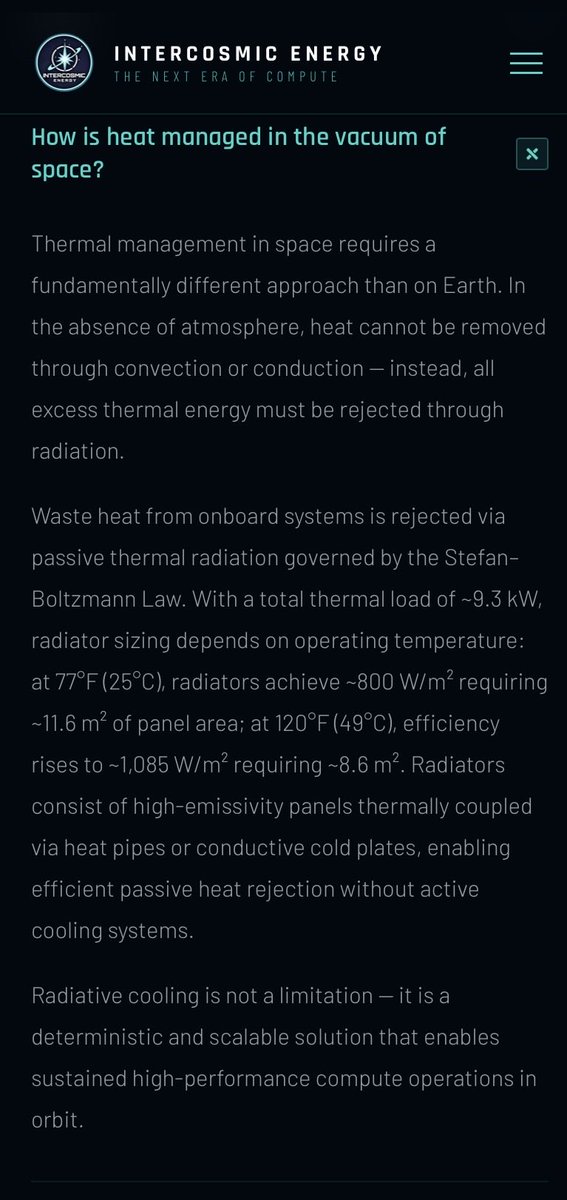
The company’s recent FCC filing for up to 1,000,000 orbital data center satellites, designed for continuous solar power generation and passive radiative cooling in vacuum, creates natural infrastructure overlap with high-density compute workloads.
Bitcoin mining, as an energy-intensive but verifiable computational task, aligns logically with such orbital assets, particularly given Starlink’s existing communications backbone.
This could represent a scalable path to expand holdings through operational integration rather than pure acquisition.
Post-IPO transparency on compute deployment will be particularly instructive.
🎯
Bitcoin mining in space is coming next. 🚀
As Starship drives the cost to orbit toward <$1,000/kg, an entirely new economic infrastructure becomes possible.
Massive solar arrays + continuous clean energy + the vacuum of space for perfect passive radiative cooling = hashpower that literally never sleeps, no land, no grid, no permissions.
In a multi-planetary civilization, Bitcoin’s borderless, decentralized, and censorship-resistant nature makes it the ideal interplanetary money, a neutral monetary layer connecting Earth, Mars, and beyond.
The long-term vision isn’t just mining in space. It’s establishing Bitcoin as the ultimate store of value and economic bedrock for humanity’s expansion across the stars.
@PeterDiamandis SpaceX will be the first to unlock real access to monetizing space, like discovering a brand new country, but one bigger than any continent on Earth.
This isn’t just another IPO. It’s the start of the space economy. 🚀
Dot-com era (early 2000s) had way less money sloshing around the system.
US M2 money supply: ~$4.7T in Jan 2000 vs ~$22.8T now (nearly 5x more liquidity).
Nominal GDP: ~$10.3T in 2000 vs ~$32T today (~3x larger economy).
S&P 500 market cap: roughly 5x bigger today.
Hyperscalers aren’t dot-com vaporware startups burning VC cash on hope. These are the most profitable companies in history with real revenue, real cash flow, and exploding demand for AI/cloud infrastructure that’s already being monetized.
Capex hitting 98-100% of operating cash flow looks scary in isolation but it’s happening in a financial system with massively more capital available than in 2000.
This isn’t the top. It’s the early innings of a multi-year buildout.
Scale matters. The ‘bubble’ comparison ignores how much bigger everything is now. Don’t get left behind! 🚀
@APompliano This is insanely spot on. 🎯
Converting energy into intelligence at massive scale is the ultimate flywheel.
Unlimited demand meets compounding capability, and the labs that master it print money for years, if not, decades.