The thing most people will never tell you about wealth is that most wealthy people hardly form attachments to most of their property. Everything is transient. It is that mindset that helps compounding.
A car is meant to be used and sold or kept for sale in the future if it is a supercar that appreciates. Houses are meant to be bought and sold or used as collateral for more leverage. Every asset serves a purpose and if they are not appreciating, they are disposed of.
After I sold a car last year, I noted how much it was in dollars and looked at how much it could have appreciated if I put that money in the US stock market, and I now want to sell every car or every asset that I am not utilizing fully.
An apartment I was offered for £85k in 2007 is now £450 today in Salford. It was a rent-to-buy deal but the problem I had then was moving money across borders. So, I put the money back into the business and lost everything. Rich people don't get too attached to one business as well. It is why they invest and move assets around.
Wealth management is a game of information and access. Keeping liquidity is not because of flexing or enjoyment but for the purposes of multiplication. This is why I cringe when I hear that stupid Nigerian term “Money na Water.” It shows that some people are devoid of ideas.
“Money no be water, money na bullet.” Load your weapon and aim wisely.
Breakfast, lunch, dinner. That schedule was invented for coal miners burning 4,800 calories a day. You burn about 2,200 at a desk.
The three-meal pattern took off in the 1850s, during the Industrial Revolution. Workdays ran twelve hours, and factory workers and miners needed a midday meal just to stay upright. Before then, most English people ate twice a day. Romans ate once. Lunch didn't even exist as a separate meal.
The average American walks 3,000 to 4,000 steps a day, about a mile and a half. Anything under 5,000 puts you in sedentary territory. A sedentary 35-year-old guy needs about 2,200 calories a day to hold his weight steady. A sedentary woman, around 1,800.
One chain-restaurant dinner runs 900 to 1,500 calories on its own. Researchers at the University of Toronto measured meals at 19 sit-down chains. Breakfasts averaged 1,226 calories, lunches 1,000, dinners 1,128. Do the math: 3,354 calories from main dishes alone. Throw in a soda and dessert and you clear 4,000, roughly what a coal miner used to eat in 1890.
US food supply per person has climbed 23% since 1970. Our step counts have gone the opposite direction. The World Health Organization says more than 1 in 4 adults globally miss even the bare-minimum physical activity level. And 40.3% of American adults are now obese, according to the CDC's latest national health survey. Up from 30.5% in 2000.
Three meals a day was built for people who swung pickaxes. The rest of us are borrowing their meal plan.
There's a physicist at Stanford named Safi Bahcall who modeled this exact principle and the math is wild.
He calls it "phase transitions in human networks." When you're stationary, your probability of a lucky event is limited to your existing surface area: the people you already know, the places you already go, the ideas you've already been exposed to. Your opportunity window is fixed.
When you move, your collision rate with new nodes in a network increases nonlinearly. Double your movement (new conversations, new cities, new projects) and your probability of a serendipitous encounter doesn't double. It roughly quadruples. Because each new node connects you to their entire network, not just to them.
Richard Wiseman ran a 10-year study at the University of Hertfordshire tracking self-described "lucky" and "unlucky" people. The single biggest differentiator wasn't IQ, education, or family money. Lucky people scored significantly higher on one trait: openness to experience. They talked to strangers more, varied their routines more, and said yes to invitations at nearly twice the rate.
The "unlucky" group followed the same routes, ate at the same restaurants, and talked to the same 5 people. Their networks were closed loops. No new inputs, no new collisions.
Luck isn't random. Luck is surface area. And surface area is a function of movement.
The lobster emoji is doing more work than most people realize. Lobsters grow by shedding their shell when it gets too tight. The growth requires a period of total vulnerability. No protection, no armor, soft body exposed to the ocean.
That's the cost of movement nobody posts about. You have to be uncomfortable first. The new shell only hardens after you've already moved.
The first week I arrived in Dublin, a woman at a Tesco checkout looked at me like I had asked her to explain the theory of relativity, and I realized I had said "please" the wrong way.
Not the wrong word. The wrong volume, the wrong timing, the wrong warmth — the whole social architecture of the sentence was off, and she scanned my tin of sardines with her eyes already somewhere else, and I stood there in my big coat from Kantamanto market holding my Revolut card and thinking, chale, I have arrived in a foreign country and I do not know how to speak anymore.
I had been a person in Accra. I want to be clear about this. I had been a whole, functioning, reasonably confident person — the kind who could negotiate a price at Timber Market, talk my way out of a go-slow jam on the Spintex Road, and explain macroeconomics to my mother's trader friends in terms she would accept. I had references. I had a reputation. I had a landlord who respected me, or at least feared my noise. And then I got on a plane and all of it stayed behind, sitting on the tarmac at Kotoka, waving.
Here, I had to re-earn everything. The woman at the immigration office who looked at my documents and said, "This address doesn't match," in a tone that had no question in it at all — I had to figure out that I was being given a chance to correct something, not being charged with a crime. The bus driver who closed the door in my face because I had pressed the stop button one second too late — I had to learn that this was not personal, which was somehow worse, because at least in Accra rudeness had the dignity of being directed at you specifically. The pharmacist who asked me to repeat myself three times and then turned to the person behind me — I stood at that counter and made the arithmetic: I could shrink, or I could say it again, slowly, looking directly at her, without apology in my face, which felt so unnatural it made my jaw tight for the rest of the afternoon.
The thing nobody tells you is that the confidence does not come back the same shape. You earn it back, yes, but in different currency.... smaller, harder coins. You learn which battles to enter and which rooms will cost you more than they are worth. You develop a patience that is not peace, and a quietness that is not submission, and you start to notice the exact moment someone decides to see you, and you store that moment somewhere careful, because you are going to need it later.
By the time I had been in Dublin eight months, the Tesco woman remembered my name.
I did not tell her mine.
A Jewish guy called Jacob finds himself in dire trouble.
His business has gone bust, and he’s in serious financial trouble. He’s so desperate that he decides to ask God for help.
He goes into the synagogue and begins to pray, “God, please help me, I’ve lost my business, and if I don’t get some money, I'm going to lose my house as well, please let me win the lotto”.
Lotto night comes, and somebody else wins it. Jacob goes back to the synagogue. “God, please let me win the lotto, I’ve lost my business, my house, and I'm going to lose my car as well”.
Lotto night comes, and Jacob still has no luck!! Back to the synagogue. “My God, why have you forsaken me?? I’ve lost my business, my house, my car, and my wife and children are starving. I don’t often ask you for help, and I have always been a good servant to you. Why won’t you just let me win the lotto this one time so I can get my life back in order???”
Suddenly, there is a blinding flash of light as the heavens open, and Jacob hears a voice:
“JACOB, MEET ME HALF WAY ON THIS ONE, BUY A TICKET!”
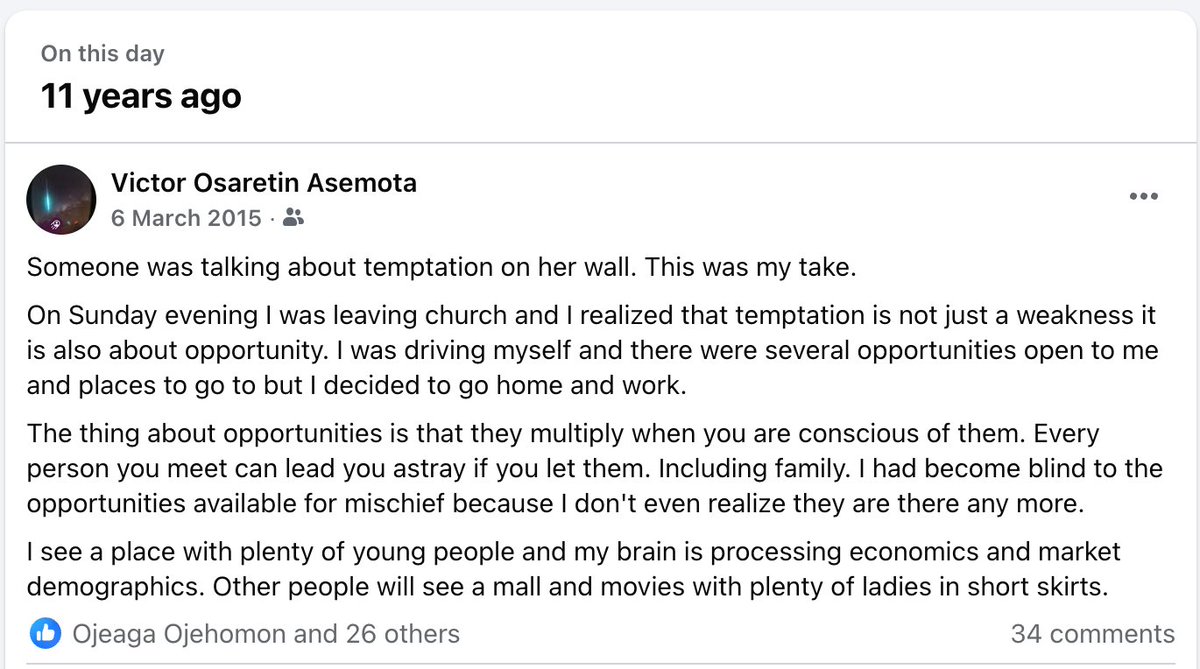
I always remember this joke when I am praying for something, and the answers come to me in prayer as action items. There are always opportunities to get out of problems and be great; we just have to learn to invert situations to see them.
@phveektordrayne I find it hard to believe this wasn't stated in their contract. Ordinarily, you get told this from the very beginning. It is just standard work policy, no need to slam the company.
If you work for a company that does “skip-level” meetings. Beware.
Skip-level meetings are where you meet with your boss’s boss.
Organizations promote this as a way to “hear from the front-lines” so that leaders can “really know what is going on, unfiltered.”
This is a trap. Don’t fall into it.
Like they warned us growing up, don’t let it be that it is from your mouth that they will hear that the teacher’s mother is dead.
Look, organizations already know what’s going on. And if they don’t, it’s on them.
Don’t use this as an opportunity to complain about your boss. Or throw him under the bus. Or whine about anything.
It will not end well.
So, what should you use your skip-level meetings to do?
First, and most important, use it to butter up your boss. Your number one job in your company is to make your boss look good. Know this and know peace and prosperity. Everything else is secondary in corporate America.
Use that meeting to tell of the wisdom, foresight and expertise of your boss. Praise his leadership skills and anything else you can say without appearing like you’re trying too much.
Word will get to your boss and you’ll be rewarded for it.
Second, use it to ask directly for favors. It can be anything from connecting you to a mentor to sponsoring you for a training or promotion. Make sure it’s something you have raised with your boss before so that he doesn’t feel offended that you went over his head.
I’ve seen too many careers ruined during skip-level meetings.
Learn to avoid the landmines so you don’t blow up your career before you even get started.