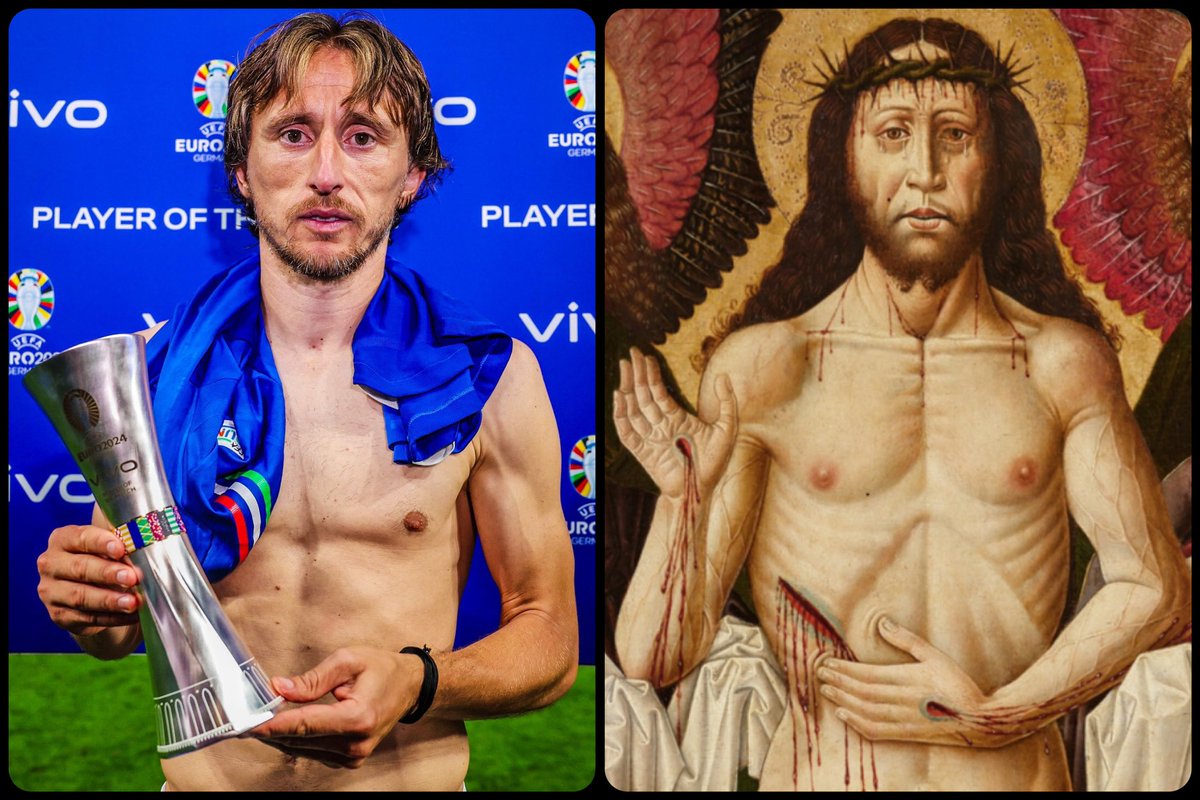
Nivel 1: Abriste los ojos en este mundial
Nivel 2: Abriste los ojos en Qatar
Nivel 3: Tuviste siempre los ojos abiertos. Sabes que se dopó con 18 años, ganó todo bajo Negreira, le organizaron 6 Copa Americas en 11 años, fue humillado una década en Champions, se retiró de la selección porque había perdido el debate y tuvo que venir Infantino a resucitar su carrera
Igual hay que admitir que equipo anfitrión beneficiado mediante la presión del gobierno fascista de turno es una de las más antiguas y respetadas traficiones mundialistas
🇪🇸🇵🇹 INSÓLITO: Bernardo Silva, fruto de la tensión del momento, casi agrede físicamente a Rodri, echándole en cara que España se quedó, de manera ilícita, con Papúa Nueva Guinea en el Tratado de Tordesillas.
Let's talk about Mexican football, about their World Cup, about Gilberto Mora and this new generation of talented midfielders, and about why I believe this match against England can give real hope for the future of Mexican football.
Mexico did a fantastic job at this World Cup. Four wins in a row against South Africa, South Korea, the Czech Republic and Ecuador, without conceding a single goal, before dominating England, one of the tournament favourites, for long periods and being brave enough to impose themselves.
Of course, hosting the World Cup and playing at altitude are significant advantages. But you don't reach this stage of a World Cup because of those factors alone.
I said it a few months ago: I felt Javier Aguirre and his coaching staff had found something. Mexico finally started to develop an identity. Before that, I struggled to understand what kind of team Mexico wanted to be. There wasn't a clear idea of how they wanted to play or what they wanted to represent on the pitch.
Aguirre realised he had an exceptional group of technical midfielders and that he needed to build around them. More importantly, he understood that Mexico had enough quality in midfield to dominate possession and look any national team in the eye. That's why he moved towards a 3-4-3 with a square midfield, allowing him to accommodate players like Erik Lira, Álvaro Fidalgo, Obed Vargas, Bryan Gutiérrez and Gilberto Mora. You can even add more names performing well in Liga MX, such as Marcel Ruiz, unfortunately injured, or Charly Rodríguez.
Mexico found its identity in that 3-4-3. The left winger, usually Julián Quiñones, played inside and enjoyed an outstanding World Cup in that role. Gallardo pushed high from left fullback, while the right back generally stayed deeper. This created a solid 3+2 rest defence that allowed Mexico to remain protected whenever possession was lost.
But the main reason I believe this system suited Mexico is because of the profiles they currently produce. Mexico lacks players who consistently threaten in behind or can punish opponents in transition with pace over long distances. One solution would have been to defend in a low 5-4-1 block and wait for transition opportunities. The problem is that if you don't have players capable of carrying those transitions, sooner or later your game plan collapses. It made a lot of sense for Mexico to be more dominant on the ball and, especially, to press opponents high from goal kicks and other restarts, something they had been doing well for a long time and that led to goals, such as the opener against South Africa.
Interestingly, Aguirre was actually more conservative during the group stage than he was against Ecuador and England. Against South Korea and the Czech Republic, Mexico often defended in a reactive 5-4-1. But against Ecuador and England, they pressed aggressively in a 4-4-2, enjoyed much more possession and controlled large parts of both matches.
There is one name that changed everything, Gilberto Mora.
At just 17 years old, he demanded the ball in front of more than 80,000 people at the Azteca Stadium and gave his teammates the confidence to play with courage. He showed Mexico that if you surround him with intelligent, technical players who can combine with him, this team can compete with anyone.
Suddenly, "Piojo" Alvarado started playing at a much higher level alongside Mora. Mexico began creating relationships, combining through quick one-twos, building wide triangles and, above all, generating dangerous crosses into the penalty area.
Alvarado would drift inside onto his stronger foot before delivering inswinging crosses towards Quiñones and Raúl Jiménez. It became one of the defining images of Mexico's tournament.
Alvarado cuts inside, everyone inside the Azteca rises to their feet, and Raúl Jiménez powers a header into the net. You could hang it in the Louvre.
Yes, we can argue that Mexico struggled in the final minutes against England and that Aguirre made a mistake by introducing too many strikers and relying almost exclusively on crosses. But this is also the same Javier Aguirre who produced two incredibly brave game plans, trusted young players and selected the best performers rather than simply choosing those playing in Europe. In fact, Mexico fielded more Liga MX players than European-based players.
I'm not sure whether this evolution towards a more courageous, possession-oriented style was entirely Aguirre's idea, whether it was driven by Gilberto Mora's emergence, by the players themselves, or by the Mexican public demanding a braver national team. Perhaps it was a combination of all those factors. Whatever the reason, Javier Aguirre will always do what he believes gives his team the best chance of competing.
Now it's time for the Mexican Football Federation to think about the future.
The players themselves are already giving you an identity. You simply need to embrace it.
Everything should start with Gilberto Mora (17) and building a structure that allows him to flourish. Alongside him you have Obed Vargas (20), Bryan Gutiérrez (23), Marcel Ruiz (25) and Erik Lira (26). There aren't many areas of the pitch where Mexico is producing this much talent.
You can even add more players who still need time but have potential: Elías Montiel (20), Iker Fimbres (21), Denzel García (22), Fidel Ambriz (23) and Jordan Carrillo (24). There are more than enough talented young midfielders to build an identity around.
The next step is surrounding them with players who fit that style. If Mexico wants to become a dominant possession team, they need centre-backs capable of defending far from goal, pressing aggressively, covering large spaces and who can contribute in possession.
They already have Johan Vásquez (27), an established European defender who is left-footed, a rare and valuable profile, and perfectly suited to defending high while contributing in build-up. Now Mexico needs to produce more centre-backs with similar characteristics. Diego Campillo (24) could become one of them, but the search shouldn't stop there.
At full-back, the future is promising. Rodrigo Huescas (22) and Mateo Chávez (22) are already playing for FC Copenhagen and AZ Alkmaar at a young age. Both possess the energy and technical quality to overlap, underlap and defend aggressively in open spaces. Neither is particularly dominant aerially, which is another reason why Mexico should aim to defend further away from their own penalty area.
In goal, "Tala" Rangel (26) has shown he can become the right goalkeeper if Mexico continues down a possession-oriented path.
On wide attacking positions, Mexico still needs to produce more wingers capable of consistently winning 1v1 situations. Alvarado (27) and Huerta (25) offer solutions, and Alvarado showed throughout this World Cup that he has the quality to hurt opponents whenever he receives to feet.
But Mexico also needs wide players who can attack depth, stretch defensive lines and create more space for the midfielders to operate between the lines. They need more pace. More players capable of threatening large spaces.
Up front, Santiago Giménez (25) can be a good option. But he still needs to stay healthy more often and reach his best level. Then there's "Hormiga" González (23). He may not receive as much attention, but he has intelligent movement inside the box, consistently scores goals, attacks depth well and contributes aggressively in the press. When so many of your midfielders want the ball to feet and are more technical than athletic, having a striker who constantly stretches the opposition, attacks space and presses with intensity becomes incredibly valuable.
Of course, players like Quiñones and Raúl Jiménez can continue contributing while Mexico gradually gives more responsibility to younger profiles and develops the next generation of strikers.
Ultimately, this World Cup has allowed Mexico and its supporters to dream again, but there is still plenty of work to do.
Mexico needs to invest more in coach education to produce better Mexican coaches, who will eventually develop better players in the academies.
The federation should also make it easier for young Mexican players to move abroad earlier, even if transfer fees are lower.
And finally, promotion and relegation must return.
Young players develop fastest when they compete under pressure. Few matches are more demanding than fighting against relegation or battling for promotion. Those experiences shape players who can later perform on the biggest stages, like a World Cup.
The encouraging part is that Mexico has started talking about football again. Apart from a few journalists unwilling to evolve, most people have praised the way this team competed. The catastrophism and negativity that have surrounded Mexican football for years are slowly disappearing.
Mexico is a genuine football country, one of the greatest in the world in that respect. Few stadiums roar like the Azteca. Few cities live football like Mexico City. Everywhere you go, people are talking about their national team.
Now it's time for Mexico and its federation to match that passion with a long-term vision.
The potential is there. This team has planted the seed.
¡PERO AQUÍ NO ES ASÍ! 🇲🇽🔥
Aquí estamos hechos diferente. Somos de nuestra esencia, somos de nuestra historia, somos de nuestra cultura, somos de nuestros antepasados… 🙌🥹🇲🇽
¡Aquí #SomosMéxico! 💚🤍❤️
Es increíble lo de los mexicanos creyendo que tienen una rivalidad histórica con Argentina cuando el argentino promedio lo único que identifica de ellos es el chavo y hasta ahí.
Y entonces un día vi a México caminar perfecto en una Copa del Mundo.
A los americanistas festejar las atajadas del Tala, a los chivahermanos aplaudirle a Erik Lira y a los cruzazulinos corear el nombre de Quiñones, y la vida empezó a sonar así:
Yo en lo personal agradezco mucho a la selección ecuatoriana que haya venido hasta el Azteca, con su “generación dorada” y sus tres “jugadores de clase mundial”, a recibir una clase de fútbol, un baño de humildad y a ratificar que son nuestros queridos clientes.
Eso sí: recomiendo salir con tiempo al aeropuerto mañana. Hay inundaciones y se hace un buen rato para el viaje a la altura de Quito, donde - según escuché incesantemente - habían aprendido a jugar en la altura.
@notanywher@SEBACFM@AntoniaBonaque Para ser mexicano no tienes que odiar a nadie y mucho menos a España. Que pobre concepto de identidad nacional tienes, si crees que tienes que odiar a alguien.
Condenó enérgicamente lo que se lee en redes sociales sobre no dejar dormir a Ecuador dándole serenata el día anterior al partido a las 23:00 en el Hotel Royal Pedregal. Interferir así con el descanso de los rivales no es algo deportivo.
Yo soy de Cristiano y Vinicius.
De los que fueron ninguneados desde que llegaron.
De los que tuvieron que hacer el doble que el resto para tener reconocimiento.
De los que lucharon contra todo y contra todos: Negreira, RFEF, FIFA…
Mientras, otros juegan con alfombra roja.