Neurocognitive Indices of Long COVID: Dysregulated Engagement of Inhibitory Control and Oscillatory Slowing
🚨Even after mild COVID, LongC0VID can leave a measurable brain signature.
Interesting small USA study that needs your attention:
➡️~6 months later, young, otherwise healthy adults with PASC reported more brain fog, anxiety, depression and sleep problems,
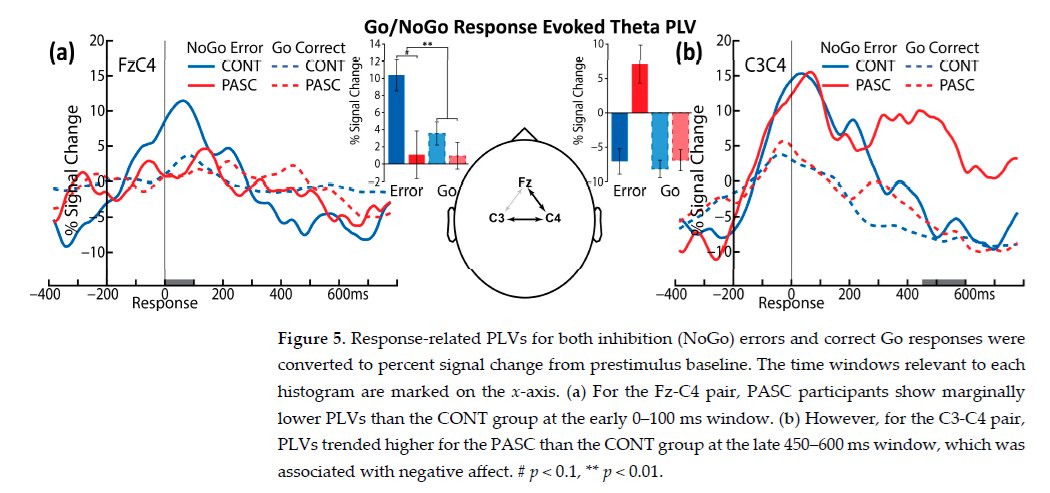
➡️On an inhibitory Go/NoGo task their performance looked intact, but EEG did not,
➡️Neural indices showed altered cognitive-control engagement on both correct and error trials, less efficient responding, and a trend toward dysregulated co-oscillatory synchrony during errors,
➡️Altered neural indices of inhibitory control marginally correlated with spontaneous oscillatory slowing, potentially suggesting shared basic mechanisms,
➡️“The overall pattern of PASC symptoms, altered neural activity during inhibitory control, and oscillatory slowing, is indicative of the core neural dysfunction characterizing PASC”.
‼️So, LongC0VID here is not symptoms without a signal. It is a core neural dysfunction that behavioral tests miss and EEG detects.
‼️In layman terms: After even a mild COVID infection, some people keep the fog, the bad sleep, and the low mood. Everyday tests may say nothing is wrong. The brain however can be working less efficiently, especially when it has to stop itself, stay on task, or recover from a mistake, and to be honest, I'm seeing a lot of this around me!
#AvoidSars2 #AvoidReinfections
https://t.co/VGKcyiHgnm
https://t.co/oTZ5wPdy6g
SARS-CoV-2 phenotypic trajectory and the Omicron Paradox. Discussion of the following pre-print and the complex intertwined pathways that have dictated phenotypic outcomes for SARS-CoV-2. This can be otherwise termed the pandemic to endemic trajectory: https://t.co/8lOKa22l9r