7,333€ to end day 3 / 14 🤯🤯
5 outbids today, 4 new entries
I might invest some of the extra money of the auction in https://t.co/XSw3N7lw5w and sponsor it myself ☠️☠️
we grew from zero to $50M ARR in <2 years, profitably
i've never publicly shared our tactics before
it's cost us over $5M to learn what I'm about to share
800-word long post on every growth hack that printed money for us
I'll cover:
1. Influencer Marketing
2. Performance Marketing vs Brand
3. User Testing
4. Dogfooding
0-10M was nearly 100% word of mouth and organic content
10-50M was still >50% word of mouth but influencer, affiliate, and referral made up the other half
But the foundation we set from 0-$10M is what allowed us to blaze past $50M
1. Influencer Marketing 101:
90% of your reach comes from <10% of content that goes viral. Your job: go broad with influencers and spend enough to find that 10% of content and formats that work. Virality is no accident - test and discover hooks, visuals, formats for each platform, understand why they work, and replicate 100x across your influencer roster.
Most startups get three things wrong:
1 - Too small budget
2 - Overly selective on creators and messaging
3 - Give up too early
Start with $10-20k/month, commit to 6 months minimum. This lets you experiment with many micro influencers and lets you test many concepts.
- List creator personas with audiences that care about your product. Be exhaustive. Influencer outreach is time-consuming. Work with a freelancer or agency if you don't have a team. DM me for recommendations.
- Offer base + viral bonus. For TikTok, have them start new accounts. New accounts can get as many views as established ones. But on new accounts creators are unburdened by their brand and can try any format.
- Test across all platforms (TikTok, IG, X, LinkedIn work for most B2B/prosumer apps).
- Track specific creators and hooks that outperform, not just channels.
- Add 'How did you hear about us' to onboarding. Calculate which channels drive leads vs just views.
- Compile every asset, video or hook that works into a guide. Once you have 20-30 winning formats, hire your top creators as consultants to train all other influencers on what angles go viral for you and why.
- Never write scripts - it becomes an ad no one watches.
Creators know their audience best.
2. Invest in brand before performance marketing
Most startups are not prepared to scale their spend because their brand and creative sucks. We had to go through an extremely expensive rebrand (both in terms of time and dollars spent) to land on something we loved. But it would have been much more expensive to skip this step.
Be relentless about testing a wide range of creatives. Whatever number of creatives you're thinking of testing, 10x it. Be bold. See what moves the needle (CAC payback, conversion rates, LTV and retention).
Once you see a particular use case resonating, build a whole funnel around it with symmetric messaging. You don’t want to confuse visitors by showing them an ad with one value prop and then drop them on to a landing page with a completely different message.
3. Get users to test prototypes before you ship.
This seems trivial, but saves you from the worst startup mistake - misdirected product development.
Most startups think experimentation is for mature companies improving their funnel by 1% through a/b testing. But Gamma's founding team is early Optimizely folks. Experimentation is in our DNA.
We ran extensive user testing on platforms like voicepanel and usertesting
a. Recruited random people who make slide decks for work. They have no skin in the game and won't lie to be nice.
b. Showed them prototypes with minimal instructions and let them spend a few minutes trying things out.
c. Asked them to think out loud. The words they use to navigate, their expectations, where they get confused is gold. Combining their voice + screen actions amplifies things 10x. You really feel the pain of poor UX and overcomplicated copy.
Did this for everything - landing pages, onboarding, new features, moonshot concepts.
Always test your biggest assumptions about what people will get or like. Identify major blind spots in your prototype stage, not at the end.
Ship once you have hours of testing proof that ordinary people find it easy and useful.
4. Dogfood the hell out of your product
Either you build something that's 100x better than alternatives, or you build something else. Dogfooding makes it painfully obvious if your product isn't a 100x better.
Storytime: When we started Gamma, we had two competing ideas -
Idea 1: a virtual office to capture in-person magic
Idea 2: reimagining PowerPoint from the ground up (This became Gamma)
After 6 months of building and dogfooding both of them in parallel, we had a clear winner.
It wasn't about metrics or hard data.
With a virtual office, we were always competing against IRL and could never replace the magic of being together in person.
With the reimagined PowerPoint, we could imagine a product 100x better than the alternative.
Any startup can learn from our playbook.
I really hope they do.
it’s interesting how posting for designers versus for clients has a really odd way of yielding you way more clients.
the sooner you realize this, the better.
Crazy idea but I have to get it out of my head: share your MVP idea in the comments, and I’ll build them one by one for free so you can test and validate too.
9 This is my journey to mastery. I've finally decided to live it in public, so that fellow mavens can find me.
You’re welcome to witness, and maybe walk beside me.
#maven_musings
Not until I discovered the ask ai feature, well I just pasted the code file and just like an expert who is trained on the doc, the ai pointed out the error and boom 🤯
This is no longer an option, it's gonna be required for every doc page.
Finally posting this like I promised
This is for people that are interested in events that are happening in the tech and design space.
If you’re hosting a tech or design event, you can post this on the platform.
Oh, and I added a twist to this.
1/3
https://t.co/1GxBCjcMoD
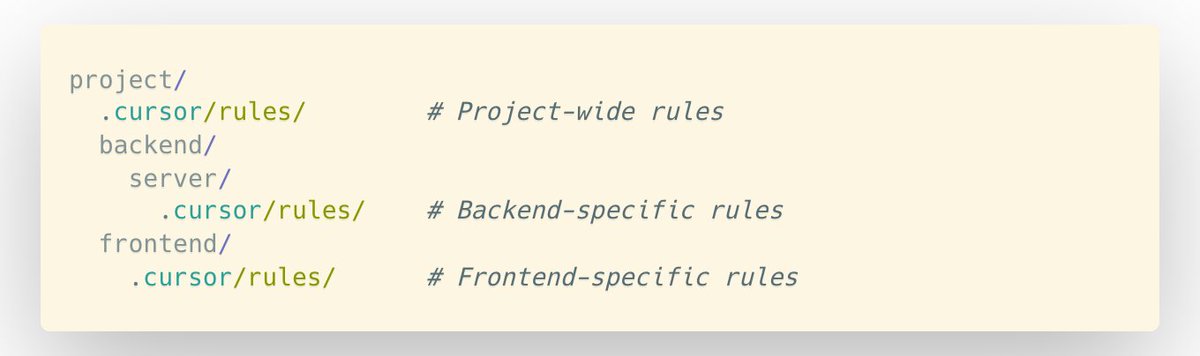
reminder that you can have nested .cursor/rules within your project. they will be considered (or loaded, depending on type) when files in their directory are referenced