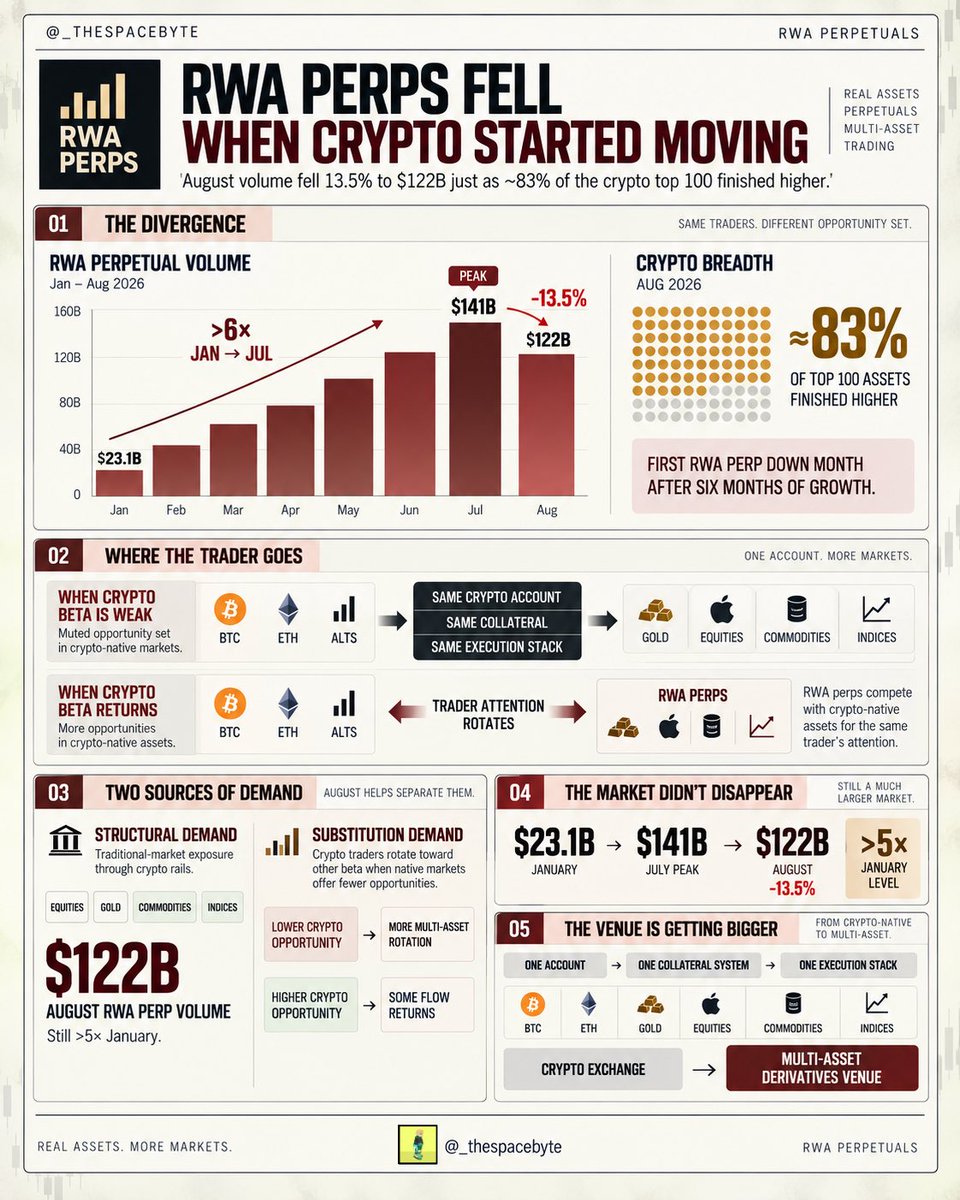
RWA perpetual volume fell 13.5% to $122B in August, ending six consecutive months of growth.
That alone isn’t especially interesting.
The timing is.
August was also crypto’s broadest rally of 2026, with roughly 83% of the top 100 assets finishing higher.
So the first down month for RWA perps arrived exactly when crypto-native assets became much more attractive to trade again.
That suggests part of the category’s growth wasn’t only structural adoption.
It was substitution.
…
— Crypto Traders Needed More Beta
RWA perp volume started the year around $23.1B in January.
By July, it had reached $141B.
That’s more than 6x growth in six months.
Over the same period, perp venues expanded aggressively into:
• equities
• commodities
• indices
• precious metals
This gave crypto-native traders access to traditional-market beta without changing venues, collateral systems or execution workflows.
The product wasn’t simply “tokenized TradFi.”
It was a way to keep traders active when crypto itself lacked enough movement.
That distinction carries weight.
A trader using Hyperliquid or Binance doesn’t necessarily care whether the opportunity is $BTC, NVDA or gold.
They care about liquidity, volatility and execution.
RWA perps expanded the opportunity set without forcing that trader to leave crypto rails.
…
— August Exposed the Demand Mix
Then crypto started moving.
$BTC gained sharply.
$ETH outperformed.
Breadth expanded across the top 100.
And RWA perp volume fell from $141B to $122B.
That’s the first clean evidence that some RWA perp demand was substitutional.
When crypto-native volatility was weak, traders moved toward equities, commodities and macro products.
When crypto offered broader directional opportunities again, part of that flow returned.
So RWA perps aren’t only competing with CME, brokers or traditional derivatives venues.
They’re also competing with crypto assets for trader attention.
…
— But $122B Is Still a Large Market
The decline doesn’t invalidate the category.
August volume was still more than 5x January levels.
That tells us the market kept a large amount of activity even after crypto-native beta returned.
So the right framework isn’t:
RWA perps are growing
or
RWA perps are fading
It’s:
structural demand + substitution demand
Structural demand comes from traders who specifically want stocks, commodities and macro assets through crypto rails.
Substitution demand comes from crypto traders rotating into those assets when native markets are less attractive.
August separated those two demand sources for the first time this year.
…
— The Business Model Is Bigger Than Tokenization
This is the part I find more important.
Perp venues are gradually becoming multi-asset exchanges.
Once the same account can trade $BTC, $ETH, gold, equities and indices with the same collateral and execution stack, the venue is no longer competing only inside crypto.
It’s competing for the trader’s entire derivatives wallet.
RWA perps therefore don’t need crypto-native assets to stay boring forever.
They only need traders to prefer one unified venue over fragmenting their capital across multiple platforms.
That’s already a much larger market than tokenized assets alone.
…
— My Take
August showed that part of RWA perp growth was driven by crypto’s lack of movement.
But it also showed something more important.
Even after crypto produced its broadest rally of the year, RWA perp volume still held at $122B.
So the category has already moved beyond a temporary boredom trade.
The durable advantage is distribution.
Crypto exchanges are turning into multi-asset derivatives venues, and RWA perps are becoming another product inside the same liquidity network.
The trade isn’t “RWAs versus crypto.”
It’s who owns the account traders use for both.
Hyperliquid is still the largest perp DEX.
But the market underneath it has become much bigger than the leaderboard suggests.
Sept. 7 perp volume:
• @HyperliquidX: $8.89B
• @Aster_DEX: $3.51B
• @tradexyz: $2.75B
• @Lighter_xyz: $1.77B
• @OfficialApeXdex: $1.468B
• @edgeX_exchange : $1.466B
Total tracked market: $26.61B
Now group the data differently.
Hyperliquid processed 33.4% of total volume.
The five venues directly below it processed $10.096B, or 41.2%.
Combined, the top six controlled roughly 74.6% of all tracked perp DEX volume.
That’s the more revealing market structure.
Hyperliquid remains the largest individual liquidity venue.
But there is now a substantial second tier:
Aster + tradeXYZ: $6.26B
ApeX + edgeX + Lighter: $4.70B
Neither group is small anymore.
And importantly, the volume isn’t consolidating around a single challenger.
It’s being distributed across several exchanges simultaneously.
So I wouldn’t describe the perp DEX market as Hyperliquid versus everyone else anymore.
The data describes something more mature:
one clear leader, two large challengers, three billion-dollar venues.
Hyperliquid still leads the market.
But perp liquidity is no longer concentrated enough for one leaderboard position to describe the entire sector.
Lending might be one of the cleaner rotations happening rn and nobody really talks about it.
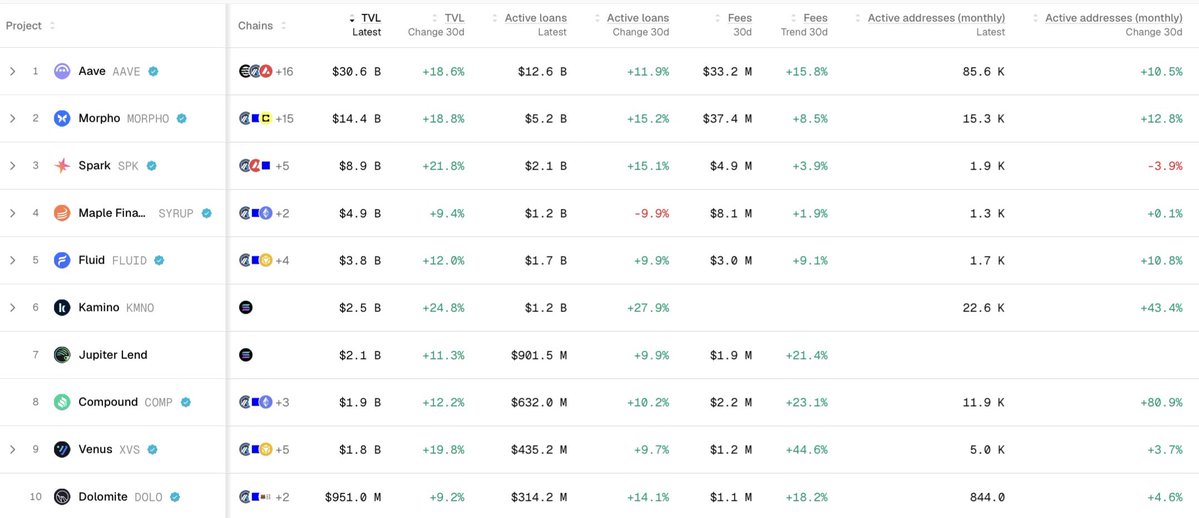
Active loans:
• Aave $12.6B +11.9%
• Morpho $5.2B +15.2%
• Spark $2.1B +15.1%
• Fluid $1.7B +9.9%
• Maple $1.2B -9.9%
• Kamino $1.2B +27.9%
• Jupiter $902M +9.9%
@aave obviously still owns the category on size.
But that’s not really the part I’d focus on.
@Morpho loans are growing faster off a $5B base.
@kamino just did +28% in a month.
@0xfluid is quietly at $1.7B now.
And even Jupiter Lend is already pushing $1B.
Feels like lending went from “Aave and everyone else” to a bunch of venues actually finding their own flow.
The crypto market is starting to look different.
Bitcoin is holding around $80K, while nearly $1B flowed into spot BTC ETFs last week.
But underneath that, money is starting to move into DeFi, DEXs and higher-beta assets again.
That shift is what I’m watching now.
Bitcoin ETFs just recorded $730.9M of net inflows in one day.
Normally, I’d read that as another institutional accumulation headline.
But there’s a contradiction worth looking at:
> 10Y Treasury: 4.8%
> 30Y Treasury: 5.2%
> Bitcoin: 0% cash yield
Institutions can earn close to 5% from U.S. government debt.
Yet they’re still allocating hundreds of millions to BTC.
Why?
…
1/ The ETF demand is concentrated
On September 3:
• Total BTC ETF inflows: $730.9M
• BlackRock IBIT: $454M
• ARKB: $138M
IBIT alone captured 62% of the day’s inflows.
And August had already produced roughly $3.5B in net BTC ETF inflows.
This isn’t just retail buying the dip.
The institutional wrapper is absorbing meaningful capital.
…
2/ But the hurdle rate is much higher now
Consider a $100M allocation.
Put it into 10Y Treasuries at 4.8%:
→ $4.8M annual nominal income
Put it into Bitcoin:
→ $0 cash yield
Every $100M moved into BTC therefore gives up almost $5M/year in nominal Treasury income before accounting for Bitcoin’s higher volatility.
That’s very different from 2020-21, when rates were near zero.
Yet BTC demand is still showing up.
3/ Interestingly, investors aren’t abandoning bonds either
Bond ETFs attracted roughly $55B in August, while money-market funds took in another $46B during the week ending September 2.
So this isn’t:
Treasuries → BTC.
It’s:
Treasuries = income + capital preservation
BTC = scarcity + asymmetric upside
Institutions can own both for completely different reasons.
And that may be the more important development.
Bitcoin doesn’t need to replace Treasuries.
It only needs to justify a permanent allocation beside them.
…
4/ There’s still a major caveat
BTC remains sensitive to rates.
August payrolls came in at 162K vs 56K expected, pushing Treasury yields higher and increasing expectations for another Fed hike.
BTC subsequently fell back below $80K.
So one $731M ETF day doesn’t prove Bitcoin has escaped the macro cycle.
The real test is what happens next.
If Treasury yields stay around 5% and ETF demand disappears, BTC remains heavily dependent on easier financial conditions.
But if yields remain elevated and ETF accumulation continues, the interpretation changes.
…
My Take
The $730.9M isn’t the most important number here.
4.8% is.
That’s roughly what institutions can earn from 10Y Treasuries while taking dramatically less risk.
And they’re still buying Bitcoin.
If BTC can earn a durable institutional allocation while competing against 5% government debt, imagine the relative setup when that risk-free hurdle eventually comes down.
Stay Bullish Chad.
Bitcoin just gave us an interesting divergence.
$BTC corrected 5.82% from its August 28 local high.
Normally, I’d look for signs that larger holders were using the weakness to exit.
Instead, whales accumulated 6,765 $BTC during the pullback.
That’s $521M bought while price was falling.
Then institutional flows joined them.
U.S. spot Bitcoin ETFs recorded $730.9M of net inflows yesterday, their largest single-day inflow since January 14.
BlackRock alone took in $454M.
So during this correction we had:
• $BTC price: -5.82%
• Whale holdings: +6,765 BTC
• ETF flows: +$730.9M
That’s a very different setup from broad distribution.
Price weakened, but larger pools of capital were absorbing supply underneath it.
$BTC has since recovered above $80K.
For me, the important part isn’t that whales “bought the dip.”
It’s that both onchain accumulation and ETF demand strengthened around the same period of price weakness.
That makes this correction look much more like absorption than capitulation.
I found something weird in @CantonNetwork’s numbers.
It has only ~$8.35M in DeFi TVL.
Yet over the last 30 days it generated:
• $49M in network fees
• $47.3M in holder revenue
That’s more holder revenue than @trondao , @ethereum and @solana.
Only Hyperliquid is clearly ahead.
Normally, I’d expect numbers like this to come from a massive trading economy.
But Canton did only $105M in 7D DEX volume and $489M in perps.
So where are the fees coming from?
The answer is Canton’s network design.
Users pay for synchronizer traffic, holding and other network operations in CC. Those fees are burned rather than simply transferred to validators.
This means Canton doesn’t need billions in retail DEX volume for CC demand.
Its bet is institutional financial activity:
• tokenized securities
• repo
• collateral
• payments
• settlement
And the institutional footprint is already substantial.
Broadridge’s DLR processes trillions in monthly repo volume. DTCC is developing tokenization infrastructure for DTC-custodied assets. JPMorgan is bringing JPMD to Canton.
But here’s the number I find more important:
• 42.35B CC minted since genesis
• 5.01B burned
Canton is still inflationary.
What’s changing is the direction.
The weekly burn/mint ratio has reportedly moved from 0.16 in January to 0.72.
At 1.0, network usage would be burning CC as quickly as incentives create it.
That’s when the Canton thesis gets much more interesting.
Not because it becomes another high-TVL DeFi chain.
But because institutional financial activity starts paying for the network at a rate that can offset its own issuance.
Canton’s most important metric might not be TVL at all.
It’s burn versus mint.
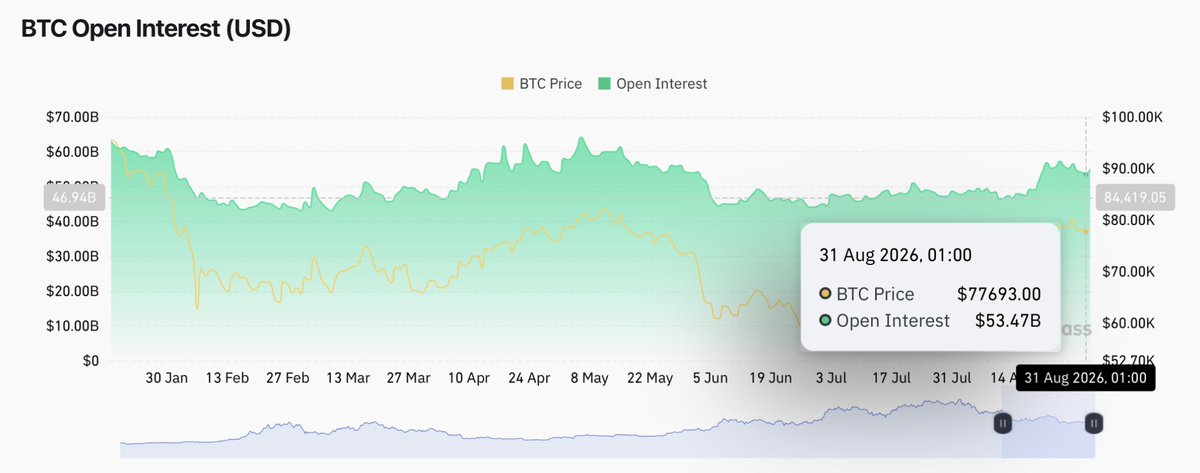
$BTC OI has been flushed pretty hard since Aug 21.
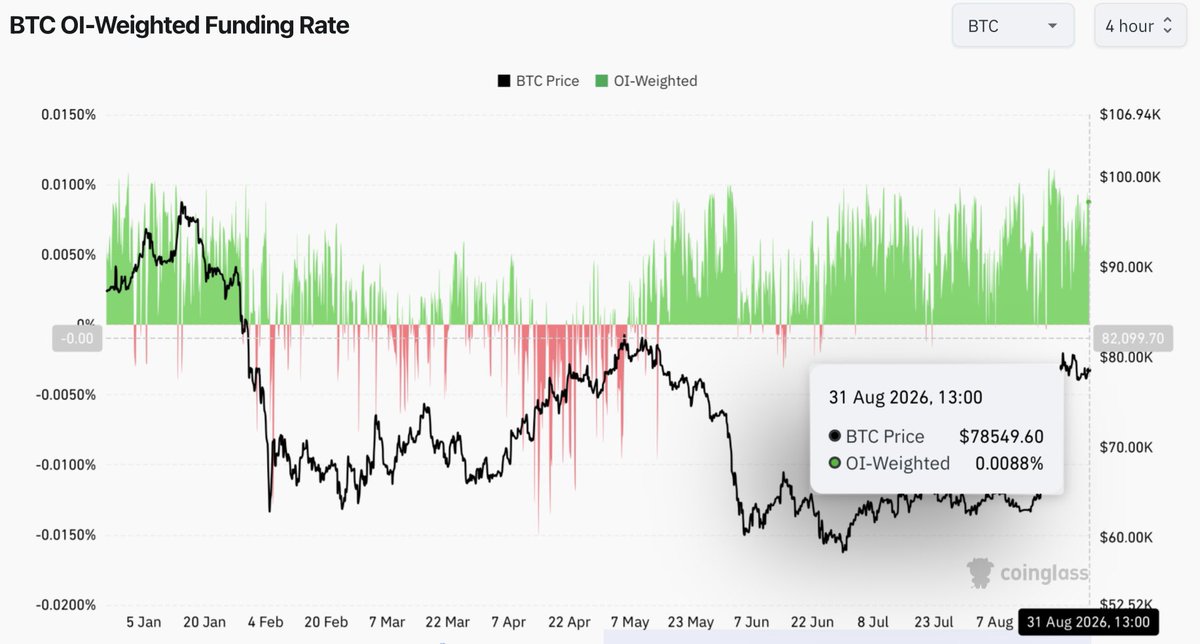
Funding hasn’t.
That’s an odd combination.
You’d normally expect funding to reset alongside leverage after a move like this.
Instead, the remaining positioning is still skewed toward longs.
Which means the market has less leverage overall, but the leverage that remains is still paying to stay long.
That’s a pretty clean setup for another squeeze if OI starts coming back before funding normalizes.
And if $BTC loses the nearby liquidation clusters while dominance is weakening, the downside gets even more reflexive.
The mistake here is looking at the OI reset and assuming leverage is gone.
It’s not.
The leverage got smaller. The bias didn’t.
I’ve been looking into QIE lately and there’s actually a lot happening around the ecosystem.
QBots is already live, bringing automated crypto trading to Binance and Bybit, with a 7-day free trial.
https://t.co/AShaSfkJNw
And now QIE’s latest hackathon is underway.
$17K in prizes, Solidity development, and more importantly projects are expected to actually launch on QIE Mainnet and prove they can attract real users.
https://t.co/TKD5suI23g
That’s what caught my attention.
It’s one thing to have a blockchain.
It’s another thing to see developers building, products going live, and new applications starting to form around the network.
The market seems to be picking up on it too…. QIE has gained more than 1,000% over the past year.
Still early, but there’s clearly something being built here.
Definitely one worth keeping on the radar.
I’m always on the lookout for high-quality, low-maintenance yield.
And after all the exploits and protocol shutdowns in 2026, I became even pickier about where I park my stables.
Some DeFi yield setups are closer to my preference, though, like the one from @Mantle_Official's Grove vault. Btw, the same vault was previously available on Bybit, and now it's also onchain.
I personally prefer farming onchain yield either way.
This one in particular is non-custodial, doesn’t use leverage, and the rewards come from separate sources.
Let me guide you through the process ↓
1/ Deposit USDC
• Go to @Fluxion_network's platform
• Open the "Earn" tab
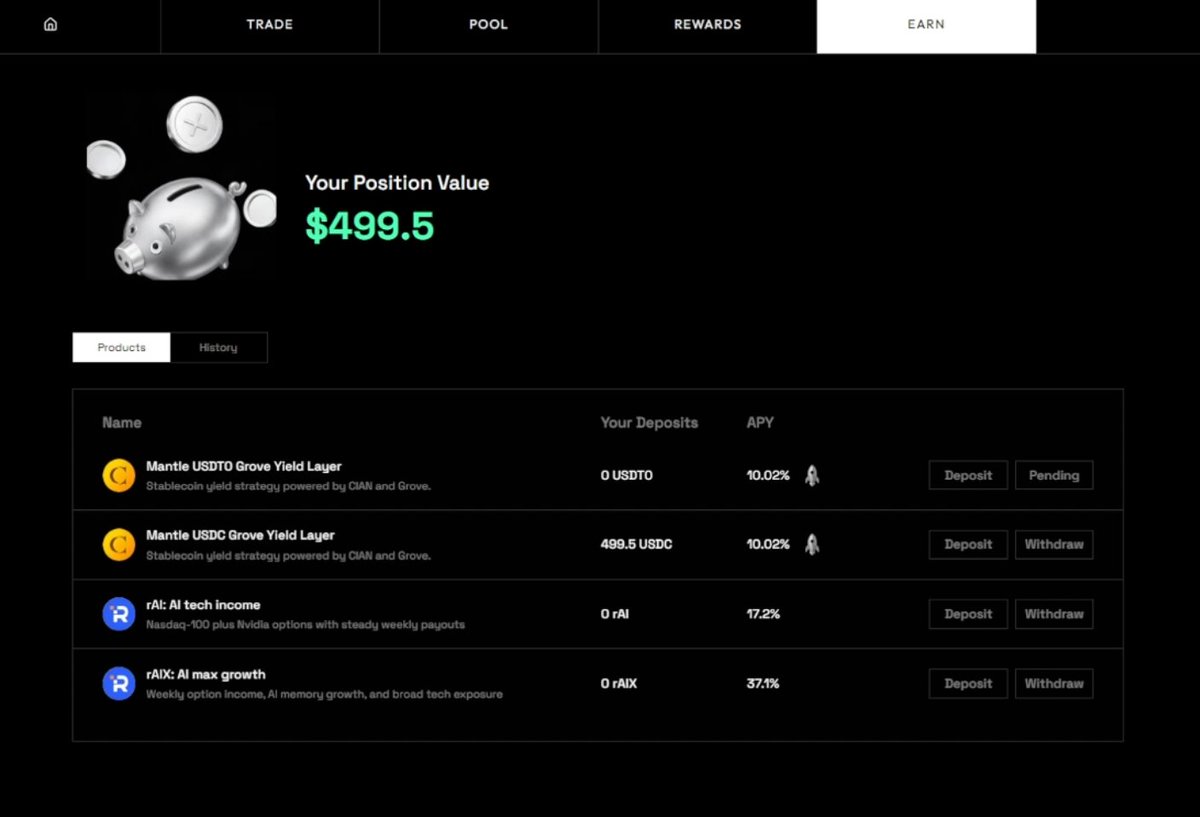
• Choose the Mantle USDC Grove Yield Layer vault
• Deposit a USDC amount higher than $500
There’s nothing else to manage after that. @CIAN_protocol handles the underlying strategy inside the vault.
2/ Track the yield
Once deposited, your position appears directly on Fluxion.
There are three separate components:
• Native yield from Sky Savings (~3.5%)
• Up to ~6.5% APR in @grovedotfinance incentives
• @Fluxion_network points
The native yield shows through the vault’s share price, which updates every three days. So your balance won’t visibly increase every block as it does in some other DeFi products.
3/ Claim GROVE rewards
GROVE incentives are separate from the native Sky yield.
You can check and claim them through Merkl directly from the Fluxion interface (the "Rewards" tab), while Fluxion points accrue separately.
The main thing here is I can track the sustainable yield and the temporary incentives separately. I actually prefer this structure.
4/ Withdraw
If you want to exit the strategy, you can submit a withdrawal request from the same interface.
Grove processes withdrawals from the underlying strategy within roughly 3-5 days, and you can only have one request per asset active at a time.
5/ Conclusion
For me, the main difference to other yield products is the maintenance burden. I don’t need to monitor borrow rates, health factors, or expiries like I would with more active DeFi strategies.
Compared with looping on @Morpho or managing PT/YT positions on @pendle_fi, this requires far less maintenance.
I already have so much to keep track of. I don’t need my stablecoin yield to become another unnecessary hassle.
At this point, I’m optimizing for peace of mind as much as APY.
For the record, I'm a long-term $MNT holder and Mantle supporter, just couldn't ignore a yield opportunity so juicy.