When people hear “over-collateralized” they assume safety.
@falconfinance's $USDf, for example, runs at 108–116% collateralization. On paper, it sounds airtight.
But ratios don’t tell full story.
What matters isn’t just size of collateral, but what "type" backs the stablecoin:🧵
Why are some DeFi protocols pulling ahead while others struggle to maintain momentum?
The answer may have less to do with product quality than people think.
Look at the market today:
● @HyperliquidX didn’t just build a perpetuals exchange. It became a destination where traders spend their time.
● @JupiterExchange became more than an aggregator. It’s now one of the primary gateways into the Solana ecosystem.
● @pendle_fi didn’t create yield. It transformed yield into a tradable asset class and embedded itself across DeFi.
● @ethena_labs growth wasn’t driven by APY alone. Distribution through exchanges, wallets, and integrations accelerated adoption.
A pattern is emerging.
Product attracts users.
Distribution keeps them coming.
In previous cycles, liquidity was the moat.
This cycle, distribution is becoming the moat.
The protocols that own the user journey are quietly pulling further ahead.
Tech alone is no longer enough.
The crypto and AI landscapes are evolving at breakneck speed, moving beyond hype into deeper questions of architecture, adoption, and sustainable value creation.
My favorite reads this week cut through the noise with sharp insights.
From reimagining crypto cards, to the critical role of privacy in institutional DeFi, the limitations of prompt-only AI thinking, and how autonomous agents may reshape value capture entirely.
Here’s a recap of my top 10 articles of the week.
—
@bjnpck argues that most crypto cards today are competing on distribution rather than innovation.
He outlines what the ideal product should look like: self-custody, global access, zero FX fees, native DeFi yield, privacy protections, and crypto-backed credit lines.
The biggest opportunity lies in deeper DeFi integration such as crypto cards allowing users to spend directly from DeFi positions, borrow against onchain collateral, and access crypto-native credit.
https://t.co/SIb2vg1xl9
—
@Defi_Warhol explains that privacy is the missing layer preventing institutional capital from fully embracing DeFi.
Using @iEx_ec’s newly launched Nox protocol as a case study, he explores how programmable privacy allows financial data to remain confidential while still enabling compliance, audits, and onchain composability.
As institutional products move onchain, the next phase of adoption may be driven by private infrastructure, without sacrificing the benefits of public blockchains.
https://t.co/JJ1LIOh9O8
—
While AI adoption is accelerating, most of the value is accruing to a small number of centralized AI providers.
Using AI security as an example, @0xJeff highlights how decentralized networks like @bittensor can coordinate global talent, fund open-source contributors, and address vulnerabilities that traditional systems struggle to fix.
As AI becomes increasingly embedded in everyday workflows, decentralized AI may emerge as an alternative path for ownership, coordination, and value capture.
https://t.co/wLb6QdJSOI
—
@neuralunlock shares a VC’s perspective on fundraising, arguing that investors back momentum, not pitch decks.
From building prototypes and identifying defensible moats to crafting compelling founder stories, the guide emphasizes that strong execution, clear traction, and the ability to attract talent matter far more than networking.
The bottomline is that fundraising is not the goal. It’s a tool to extend runway, accelerate growth, and buy time to build something customers truly want.
https://t.co/p5cOTVxczn
—
@defileo argues that the biggest advantage in the AI era is not access to models, but the ability to communicate effectively with them.
Through 25 practical prompting frameworks, he shows how context, constraints, and clear success criteria produce better outcomes than vague requests.
As AI becomes embedded across work and daily life, prompting may evolve from a niche skill into a core form of digital literacy.
https://t.co/Q1dwnGxcfz
—
@TheDeFiPlug explains that crypto neobanks are no longer converging on a single product category, but splitting into distinct layers of a new financial stack.
From self-custody wallets and stablecoin rails to crypto credit, yield-bearing accounts, and payroll systems, each segment is evolving into its own infrastructure layer rather than competing for the same use case.
The broader shift points to an emerging parallel financial system built around programmable money, stablecoins, and self-custody architecture.
https://t.co/IqXFsqwF02
—
@hooeem explains that prompt engineering is still relevant, but prompt-only thinking is outdated.
Using a full AI engineering framework, he breaks down how to move from casual prompting to building reliable AI systems by combining specificity, roles, examples, reasoning control, output constraints, retrieval, tools, workflows, and evaluation layers.
The focus is moving from “what prompt should I use?” to “what system ensures consistent, high-quality outputs?”
https://t.co/4WlICDnDQ1
—
Agents break existing crypto value capture models because the “user” is now software, not humans, removing UX, branding, and loyalty as moats.
@jonah_b argues this weakens both Fat Protocol and Fat App theses, since agents can route directly to APIs and switch venues instantly.
As agents grow, value may shift to headless protocols, apps, or new models, and the big question becomes what makes agents consistently choose one route over others.
https://t.co/U1DoIRJFFL
—
@blendino explains that crypto’s next adoption bottleneck is not financial infrastructure, but the absence of cultural assets that can scale beyond trading-native users.
Using a breakdown of institutional finance, consumer finance, and emerging cultural crypto experiments, he explores how most current apps still revolve around financial assets rather than cultural relevance.
As crypto evolves, adoption may depend less on financial innovation and more on cultural assets that turn attention and identity into onchain value.
https://t.co/OSYSyNG7RP
—
@DamiDefi explains that real AI leverage comes from using a layered stack, not a single tool for everything.
He breaks down a system where Claude handles reasoning, Obsidian stores memory, Hermes runs automation, Kimi K2.6 handles large-scale coding, and Cursor executes live code.
As AI matures, competitive advantage will shift from prompting skill alone to designing integrated systems where each tool plays a distinct role in the workflow.
https://t.co/txJe7qLHvK
—
That’s all for this week. Stick around for more insights next week.
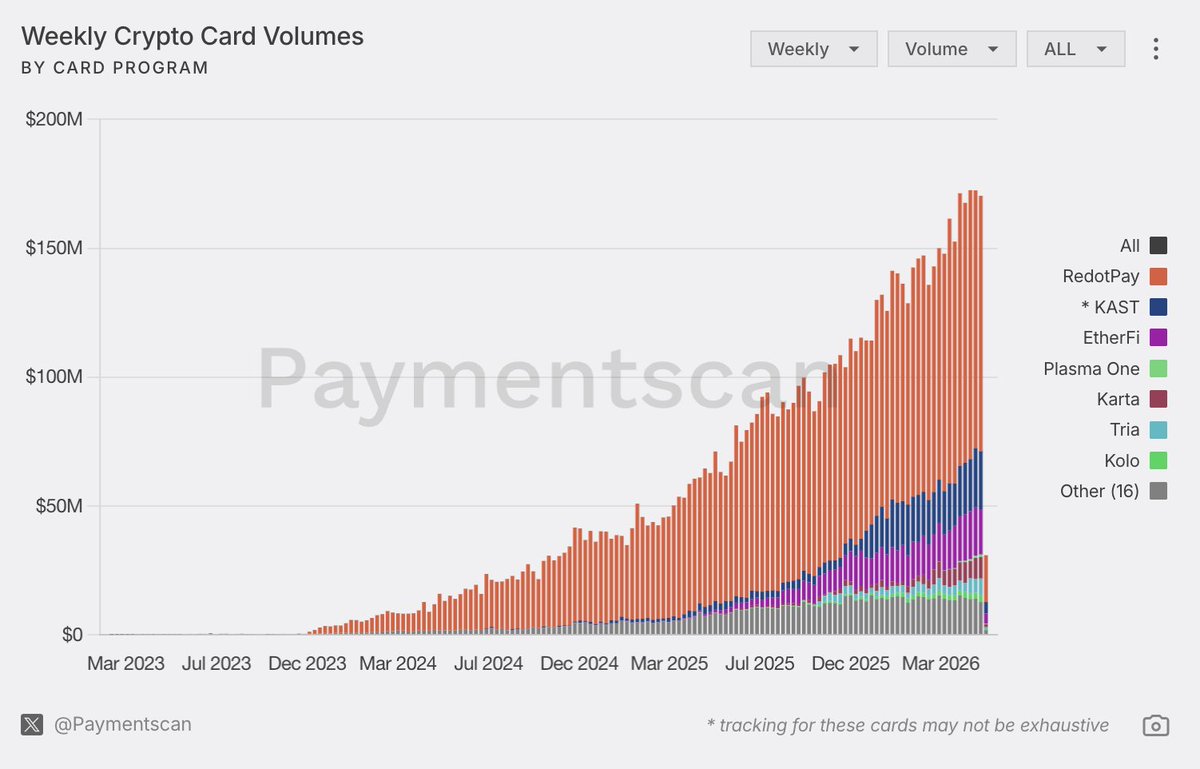
Crypto Cards Weekly Digest: May 25-31
Volume:
RedotPay: $99.12 million
KAST: $22.49 million
EtherFi: $17.57 million
Karta: $8.35 million
Tria: $6.28 million
Kolo: $2.84 million
Plasma One: $963.4K
Other: 1$2.74 million
Total: 170.4 million (-0.5% WoW)
Transactions:
EtherFi: 224,751
RedotPay: 124,417
Bitget Wallet: 103,251
Gnosis: 49,674
Safepal: 40,849
BFinance: 32,024
Plasma One: 5,832
Other: 104,205
Total: 685,003 (+15.8% WoW)
Users:
RedotPay: 70,449
EtherFi: 22,151
Bitget Wallet: 16,096
BFinance: 9,372
KAST: 8,103
Tria: 6,989
Plasma One: 1,949
Other: 26,444
Total: 161,553 (+7.7% WoW)
Interesting stats:
The volume stayed near ATH levels, barely down from $171.3 million to $170.4 million.
Transactions had a huge rebound, jumping from 591,722 to 685,003, an almost record-breaking jump.
@ether_fi hit another transaction ATH with 224,751 weekly transactions.