If an Indian startup/defense firm wants to build rocket engines/satellite parts/surgical implants/advanced drone components, they need sub-micron precision metal parts made from heavy-duty alloys like Titanium & Inconel.
Historically, the ultra-precise 5-axis CNC machines required to carve these complex 3D parts had to be imported from countries like Germany/Japan/Switzerland at astronomical costs. To make matters worse, foreign suppliers face tight export controls on high-precision machining tech due to its dual-use potential in defense/missiles.
India had the engineering talent to design hardware, but was held back by a reliance on imported tooling & machining infrastructure.
A not so known startup Ethereal Machines is doing genuinely game-changing work for Indian deeptech & manufacturing, operating in a sector that rarely gets flashy headline attention compared to consumer tech.
Founded by Kaushik Mudda & Navin Jain out of RVCE in BLR, they hit on a fundamental bottleneck that was quietly crippling India’s hardware, aerospace & defense ecosystem.
Instead of just buying machines, Ethereal built their own multi-axis CNC machines from the ground up in India including their proprietary hardware, mechanics & complex CNC controller software. 🙏🙏
They built flagship proprietary machines like Halo, Aura & Nimbus that deliver sub 10 micron precision allowing intricate metal geometries to be carved in a single setup w/o manually repositioning the raw block.
Their early breakthrough was combining 3D printing (adding material) & multi-axis CNC milling (carving material away) into a single machine platform.
Instead of just selling machines, they run a massive 50K+ sq ft Smart Factory in Peenya, BLR operating 24/7. Startups in spacetech, drone tech, semiconductor equipment & medical devices can upload CAD designs & get aerospace-grade precision components delivered in days instead of months, cutting customer lead times by ~40%.
They became the 1st Indian company to win a CES "Best of Innovation" Award in Las Vegas for their hybrid manufacturing tech.
By controlling both the hardware & the software behind multi-axis machining, they give India's spacetech & defense ecosystem a local manufacturing fallback that cannot be disrupted by global supply chain shocks/export bans.
Top-tier deeptech investors like Peak XV Partners, Blume Ventures & Avataar Ventures backed them with major Series A & B funding rounds to set up a massive 300K sq. ft. mega-factory outside BLR.
Most people think of "Indian tech" as SaaS apps/fintech/q-com, Ethereal Machines is doing the heavy, unglamorous lifting, building the physical machine tools required to manufacture the rockets, drones, medical implants & chips of tomorrow right inside India. 🙏🙏
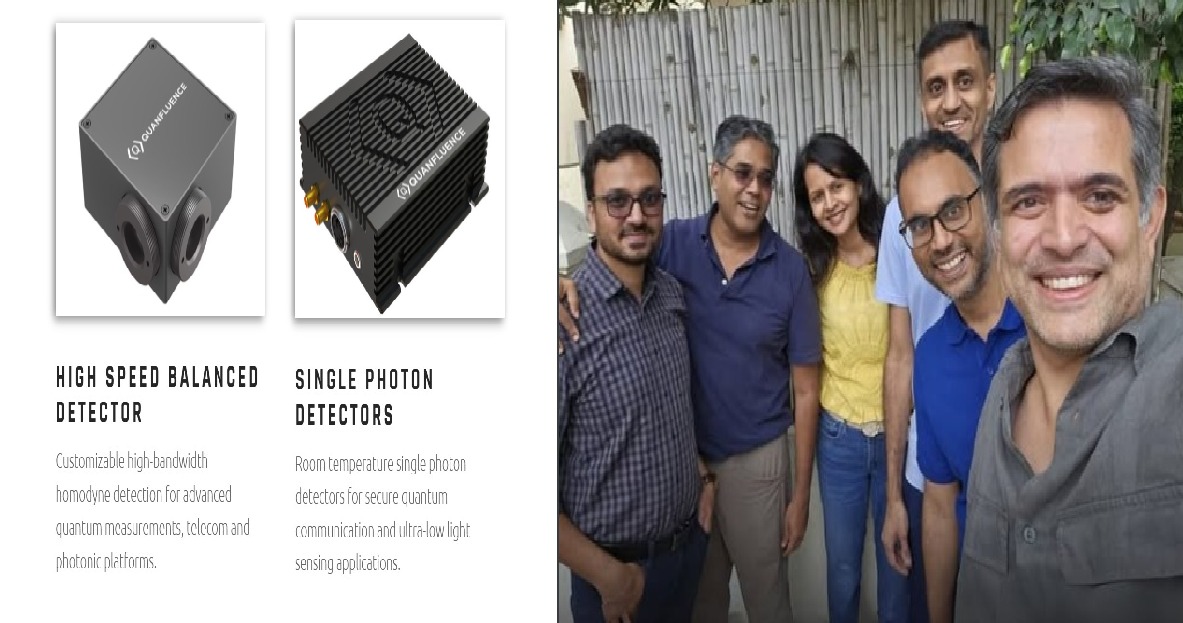
Google's quantum computer needs to be cooled to -273°C, colder than outer space. Quanfluence's quantum computer works at room temperature, was built in Bengaluru, and already has eight paying customers. That is not a small distinction. It is the entire bet.
Behind Quanfluence is a founding team that took an unusual route to quantum. Sujoy Chakravarty, Ravi Mehta, and Biman Chattopadhyay spent more than a decade together at Texas Instruments, building careers in chip design and semiconductor engineering. In 2012, they left to co-found Silicon and Beyond, a high-speed semiconductor IP company. In 2018, they sold it to Synopsys, one of the world's largest electronic design automation firms.
Most people who exit a semiconductor company return to industry. These three went into a library.
For six months after the Synopsys exit, the trio studied every quantum computing approach available. Superconducting qubits, the approach used by Google and IBM, require cooling to near absolute zero, infrastructure India has almost no base for. Ion traps demand extreme vacuums. Photonics, by contrast, uses laser light as the computational medium, operates at room temperature, and relies on telecom-grade components that India's manufacturing ecosystem already produces. The decision was clear.
They brought in two academic co-founders who had been working at precisely this intersection. Prof. Anil Prabhakar at IIT Madras had already been researching the Optical Ising Machine concept that would become Quanfluence's core product. Prof. Sandeep Goyal at IISER Mohali provides the quantum information theory that underpins the platform. Aditi Vaidya, ex-Arista Networks product manager, joined as CPO to complete the founding team of six.
The technology is a photonic quantum computer that does not use single photons as qubits, as competitors like PsiQuantum do. Instead, it uses the electric field of a collection of photons, which is more reliable to generate and fundamentally more scalable. Their Optical Ising Machine currently handles 128 interconnected variables, with a next-generation version targeting millions of permutations in development. Eight companies pay roughly $2,000 per month to use it on cloud. Revenue in 2024: $400,000. Seed funding raised: $2 million.
Quanfluence is one of only two companies in India building commercial quantum computers.
Three chip designers who sold their semiconductor company to a global EDA giant came back with one question nobody expected: can India build a quantum computer the world will pay for?
The answer, so far, is yes.
In Rajya Sabha today, Govt declared that between Apr 2025 to June 2026, they procured ethanol for E20 at an avg price of ₹70.27/L
Crude oil price is ₹45.31/L!
Did we get scammed? 😭🙏
The numbers are in: 1.7B+ global viewers tuned in to @YouTube to watch World Cup-related videos during the tournament. ⚽️ It was our most viewed World Cup ever on YouTube, bringing lifetime views of related content to over 200B!
Billionaire industrialist Bill Koch sold his roughly 52-acre Aspen compound for $33.515 million at auction, a steep discount from its peak asking price of $125 million in 2025. 🔗 https://t.co/DB91Wl74oz
A rate limiter allows 100 requests per minute.
At 11:59:59 a user sends 100.
At 12:00:01 they send 100 more.
200 requests in 2 seconds and the limiter says that's fine.
Where's the bug, and is it even a bug?