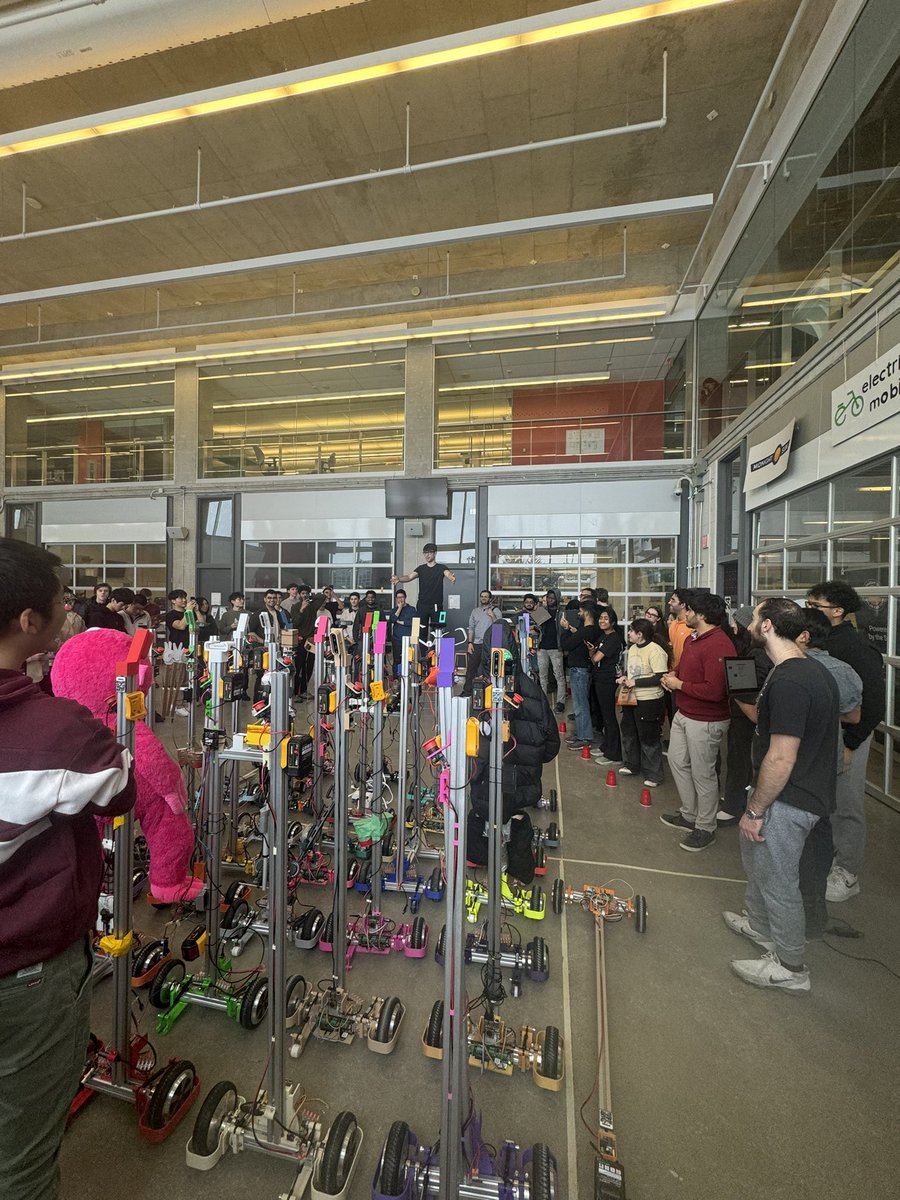
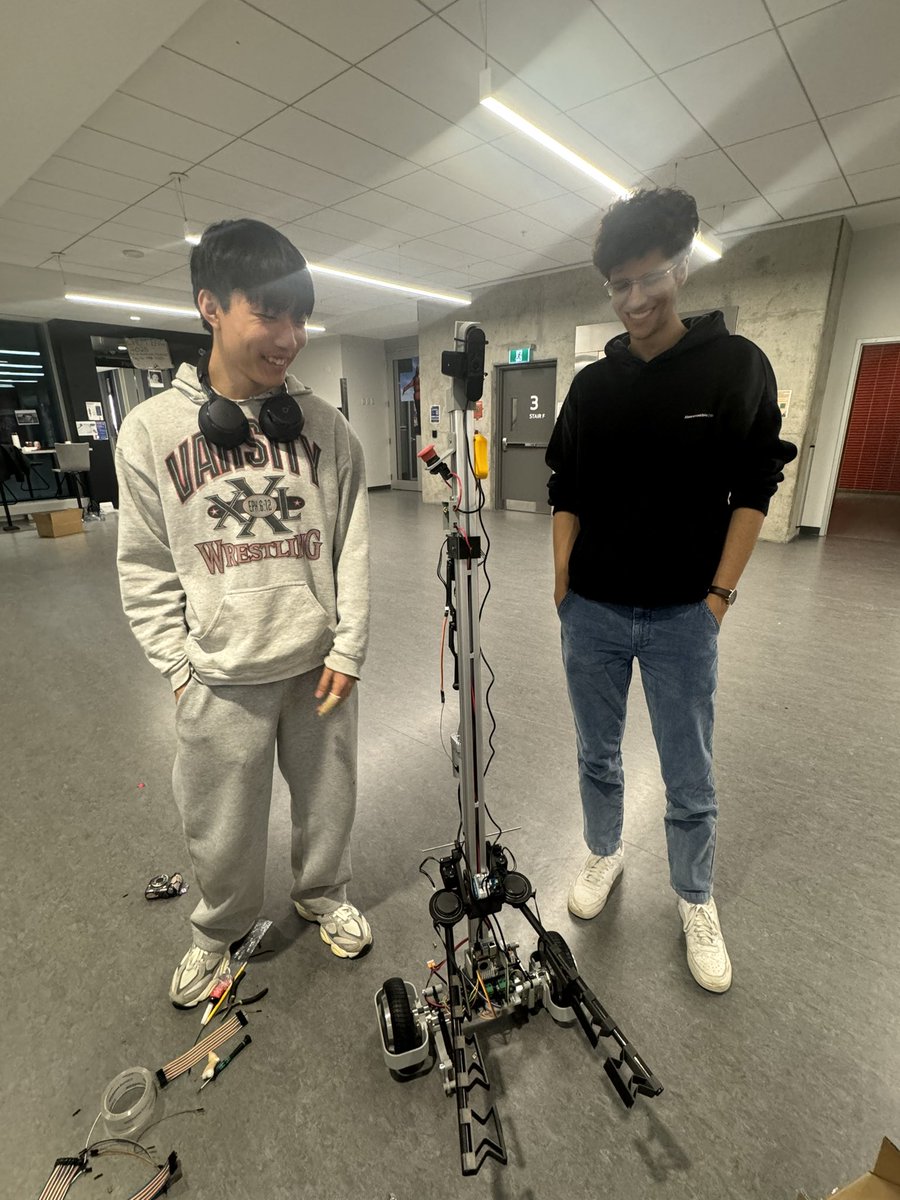
Over last weekend, my friends & I worked on building a bracket bot from scratch. We used 3D printed grippers with flexures to grip a box, an arm that extrude to press an elevator button. To recognize images of the elevator, Roboflow helps trains the bot to recognize the elevator.
New work with @nvidia: evaluating robot policies entirely inside a world model. The policy acts, the model imagines the consequences, and the imagined evals predict real-world results. 🧵
real vs world-model rollout side by side📷
Introducing NEO’s 25 Degrees of Freedom, tendon-driven hands — nearing or surpassing human-level dexterity, strength, speed, and reliability.
For seventy years, robotics worked around the hand problem. The humanoid bet is the reverse: it lives or dies at the fingertips.
This is WILD!
1X just gave AI the most human hands ever built on a robot and they call it exactly what it is, an API to the physical world (Save this).
NEO's hands have 22 degrees of freedom per hand, 44 total across both, with fingers that move at 8 meters per second.
For context, human hands have 27 degrees of freedom while NEO is operating at roughly 80% of human hand dexterity and the gap is closing fast.
The hands are IP68 waterproof, driven by 1X's patented tendon drive actuation system, using the highest-torque density motors on earth to create movements that are soft, safe, and compliant around humans.
There are no exposed gears, no pinch points, and the entire hand closes like a human hand not like a mechanical gripper.
Now here is why the API to the physical world framing is exactly right.
Every piece of software ever written can only interact with the digital world.
It can process information, generate outputs, and talk to other software. But it cannot pick up a glass of water, fold a shirt, assemble a circuit board, or perform surgery.
NEO's hands are the hardware layer that finally lets AI reach through the screen and act in the physical world.
The use cases become obvious once you understand the dexterity involved.
In the home, NEO is already folding laundry, organizing shelves, carrying groceries, and opening doors.
Through 1X's Expert Mode, a remote human guides it through an unfamiliar task once and NEO remembers it permanently.
In industrial settings, hands with this level of precision can handle circuit board installation, pharmaceutical packaging, quality inspection, and electronics manufacturing, the exact jobs that are simultaneously the hardest and most valuable to automate.
In healthcare, hands this precise open the door to patient handling, medication administration, sterilization protocols and eventually surgical assistance, tasks considered impossible for robots until now because of the dexterity and safety requirements involved.
The future is bright!
Today @MeckaAI is announcing $60M in funding to become the data and deployment layer for physical AI
This raise will allow us to scale our data infrastructure, invest into new verticals, and deploy robots into the real world
1/ 🧠Humans are the best robot data source!
2/ 👓Human egocentric video is rich in quantity, but poor in quality.
3/ Beyond scaling data, smarter representation and architecture matter just as much.
4/ Want an open-source framework to train your own learn-from-human-data robot policy?
🚀We introduce HumanEgo: Zero-Shot Robot Learning
from Minutes of Human Egocentric Videos⬇️
✦ Zero-Shot Human-to-Robot Transfer
✦ Robot-Data-Free
✦ Just 30 min of data per task
✦ Collect by Anyone, Anytime, Anywhere
✦ Deploy on Any Robot, Any Camera, Any Environment
✦ Open-Source & Easy-to-Implement
Let's squeeze every bit of signal out of human data!
🌐 Website: https://t.co/JfsW8x6wtq
📄 Paper: https://t.co/tsaIiatmNi
💻 Code: https://t.co/jZjghCcjh2
📹 Video: https://t.co/QWmJmQ9GgQ
🧵 1/n
We just wrapped what began as an 8-hour challenge - and it ran for 200 hours without a failure
Shoutout to the team for the hardcore engineering behind F.03 and the robust Helix models powering it
Hugging Face just released LeRobot Humanoid
An open-source, low-cost (~$2.5k), 3D-printed humanoid built for robot learning and not just demos.
What’s cool is it’s a full stack release:
• hardware + CAD
• runtime & calibration
• sim environments
• identification tools
• training zoo for locomotion
Designed so anyone can build, break, repair, simulate, and train on a real humanoid.
This is WILD!
MIT just solved one of the hardest unsolved problems in robotics (Save this).
For decades, the fundamental problem with soft robots and wearable exoskeletons has not been compute or AI, it has been actuation.
The moment you try to give a soft robot meaningful strength, you run into the same wall every engineer has hit since the field began, fluid-driven systems require external pumps, hydraulic reservoirs, and heavy infrastructure that makes the entire thing impractical to wear or embed into fabric.
MIT's new Electrofluidic Fiber Muscles solve that problem by eliminating external infrastructure entirely.
The key insight is electrohydrodynamic pumping using electric fields to generate pressure directly from electricity, with no moving parts, no motors, and no external fluid reservoir.
The fibers are less than 2 millimeters thick, can be woven into fabric like ordinary textile, and operate in complete silence because nothing physically moves inside them, it is just ions propelling fluid through a closed circuit.
The performance numbers published in Science Robotics are not conceptual, they are empirical results from actual hardware.
These fibers achieve a power density of 50 watts per kilogram, matching skeletal muscle, with a contraction strain of 20% and a response time of 0.3 seconds.
A single bundled configuration lifted 4 kilograms, 200 times its own weight while a separate configuration drove a robotic arm through a 40-degree bend compliant enough to safely complete a human handshake.
Another configuration launched objects in under 100 milliseconds, which is faster than a human flinch reflex.
The design mirrors biological muscle architecture in a way that prior artificial muscle approaches never achieved.
The fibers are organized into antagonistic pairs, one contracts while the other extends, exactly like biceps and triceps and because the system runs in a closed loop, the relaxing fiber serves as the fluid reservoir for the contracting one, which is what allows the whole system to operate untethered with no external tank.
The applications are not hypothetical but rather are the exact use cases the industry has been waiting years for the hardware to catch up to.
Exoskeletons for physical labor, prosthetic limbs that move with the natural compliance of biological tissue, assistive garments for patients with motor disorders, and soft robots capable of safe physical contact with humans are all immediately unlocked by a muscle technology that is silent, lightweight, and weavable into clothing.
The deeper significance is what this technology does when it meets the AI robotics wave that is already underway.
Every major humanoid robot program, Figure, 1X, Boston Dynamics, Tesla Optimus is currently bottlenecked by the same hardware limitations these fibers address, actuators that are too rigid, too loud, too heavy, or too dependent on infrastructure to operate naturally alongside humans.
Electrofluidic fiber muscles do not just solve a materials science problem but rather they remove one of the last physical barriers between robots that live in labs and robots that live in the world.