One of my favourite things to do in the morning is to play a rapid game of chess. My performance in that game is a good indicator of how ready I am for analytical tasks in that day.
Incidentally today does not seem to be a great day 😅
I’ve been playing Order of the Sinking Star since release and enjoyed it a lot. It is amazing how you turned a graph path finding problem into such an addictive game. I’ll be going “backwards” and try The Witness after I finish this one.
Order of the Sinking Star has been out for a week now, so I decided to run some stats on Steam where it's easy.
The Witness was our previous game that was very successful when launched 10 years ago. Order has sold 45% more units on Steam in its first week than Witness did.
Order is 25% cheaper (Witness was $40, Order is $30 with some bundle discounts, and there's been some inflation), so you would expect more units at the lower price. But regardless, it looks at least as financially successful as the Witness was, maybe a little more eventually, depending on how the tail goes.
Thanks everyone for supporting the game, and I'm glad you are enjoying it!
There have been some conversations over the last couple of days on what kind of cryptography is going to be hit first from AI improvements. I don't know enough about lattices and other PKC hardness assumptions, so here's my two cents as a symmetric-key cryptographer with above average experience in hash functions (both traditional and algebraic) >>
I've published two blogposts on hash-based post-quantum signature schemes and described the NIST XMSS scheme. Since it is a stateful scheme, it should be used with extreme care not to reuse the state. My future posts will describe a stateless alternative.
Links in the comment.
A good source for #2 is PR/Issues (and discord help req). I checked issues and suggest the following:
- Intentionally break the update randomly midway and try to resume
- nvidia black screen: driver ahead or behind
- Shell issues: ensure exactly one shell exists after update
1/n
Omarchy QA update
There are two things that are very hard about building a QA agent harness.
1. How to go fast in the day and age of agents (which are very very slow)
2. What is correct? What do we even test?
The first one is less exciting but the second one has been this last weeks challenge.
When I originally started this, to have a basic agent crawl the desktop in QEMU was about ~15 minutes to open the lock screen and then type in password and confirm that we are back on the desktop
Then a few changes I was down to ~5 for median. That sucks.
With more changes and now a custom harness I am down to ~2 minutes.
That still sucks.
So for the last week I have been experimenting with using Clef (cloudflare's jev, it has image capabilities, which is what i needed) and I am hoping to get this number down from 2 minutes to 30 seconds for
* logging in
* system menu
* lock screen
* password
* back to desktop
* confirm i am done.
If I can get this then I can officially move to step 2, which... well I am not stoked about step 2 and may need some help. So if you are interested in helping, let me know.
- lockscreen and monitor setup (external monitor, dual monitor, mouse, trackpad, bluetooth connectivity, lid close, ...)
- Audio issues after update! Hard to test though. Maybe another physical machine actually listening to audio??
2/n
I wasn’t going to comment since this is a really bad take IMO, but since it’s taken off I feel the need to. To my understanding, there is no evidence whatsoever pointing to a break of decades old hardness assumptions like elliptic curve cryptography. 1/n
@GarbledCircus@TomerAshur Seems like a good use case for AI to take care of tedious details that have a clear verification structure and that humans don’t want to/should not spend time doing.
Wow!!! Real RSA-1024 signature forgery. Interestingly, it doesn’t break the key but uses a different approach by Joux et al. that was known but pretty much ignored. https://t.co/Cdvt3LuzV0
Canada just announced its new National Council on Artificial Intelligence.
I'm not one to carry water for the government but take a look at the people around the table:
• @professor_ajay — U of T professor; founder of Creative Destruction Lab and NextAI.
• @Yoshua_Bengio — Turing Award winner; pioneer of deep learning; founder of Mila.
• @FidlerSanja — co-founder & CEO of Veeda AI; former VP of AI Research at NVIDIA; co-founder of Vector Institute.
• @JohnGrisham — President & CEO of CPP Investments.
• @ghadfield — Johns Hopkins professor specializing in AI alignment, governance and law.
• @JordanJacobs10 — co-founder of Radical Ventures, Vector Institute and Layer 6 AI, which was acquired by TD.
• EricLamarre — MIT lecturer; former head of McKinsey Technology & AI in North America; co-author of Rewired.
• @vpisano_mila — President & CEO of Mila, one of the world’s major AI research institutes.
• Senator @tompitfield — founder of Data Sciences; technology entrepreneur and former Principal Secretary to PM Carney.
• Jody Thomas — former National Security and Intelligence Advisor to the Prime Minister and former Deputy Minister of National Defence.
• Louis Vachon — former CEO of National Bank; now Operating Partner at J.C. Flowers.
• Michelle @zatlyn — co-founder & President of Cloudflare.
• Patrick Pichette — former Google CFO; now CEO of Digital Transformation Canada.
That is a very high concentration of experience across frontier AI research, commercialization, capital, financial services, technology infrastructure, government and national security.
Great to see them all stepping up for Canada.
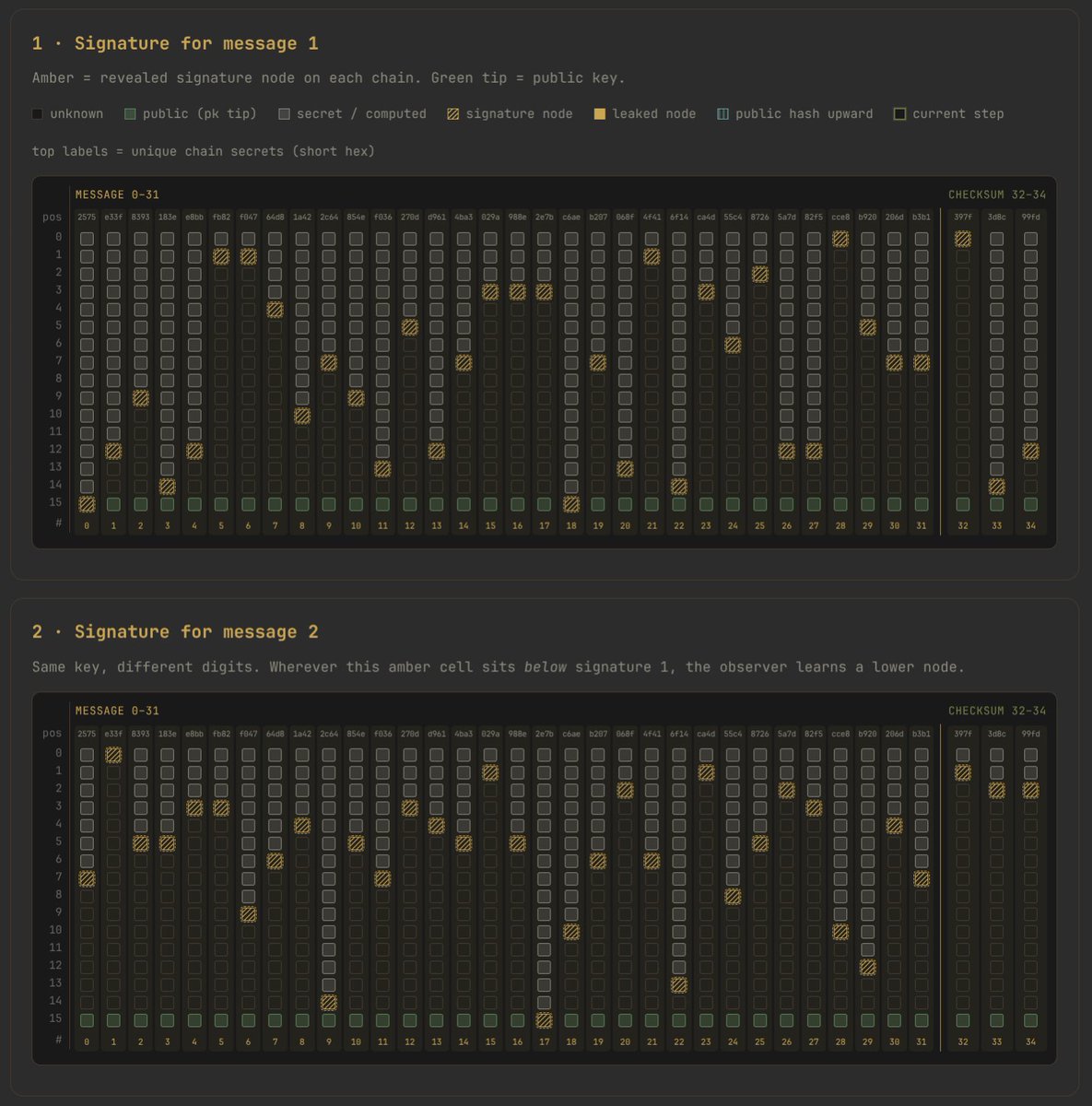
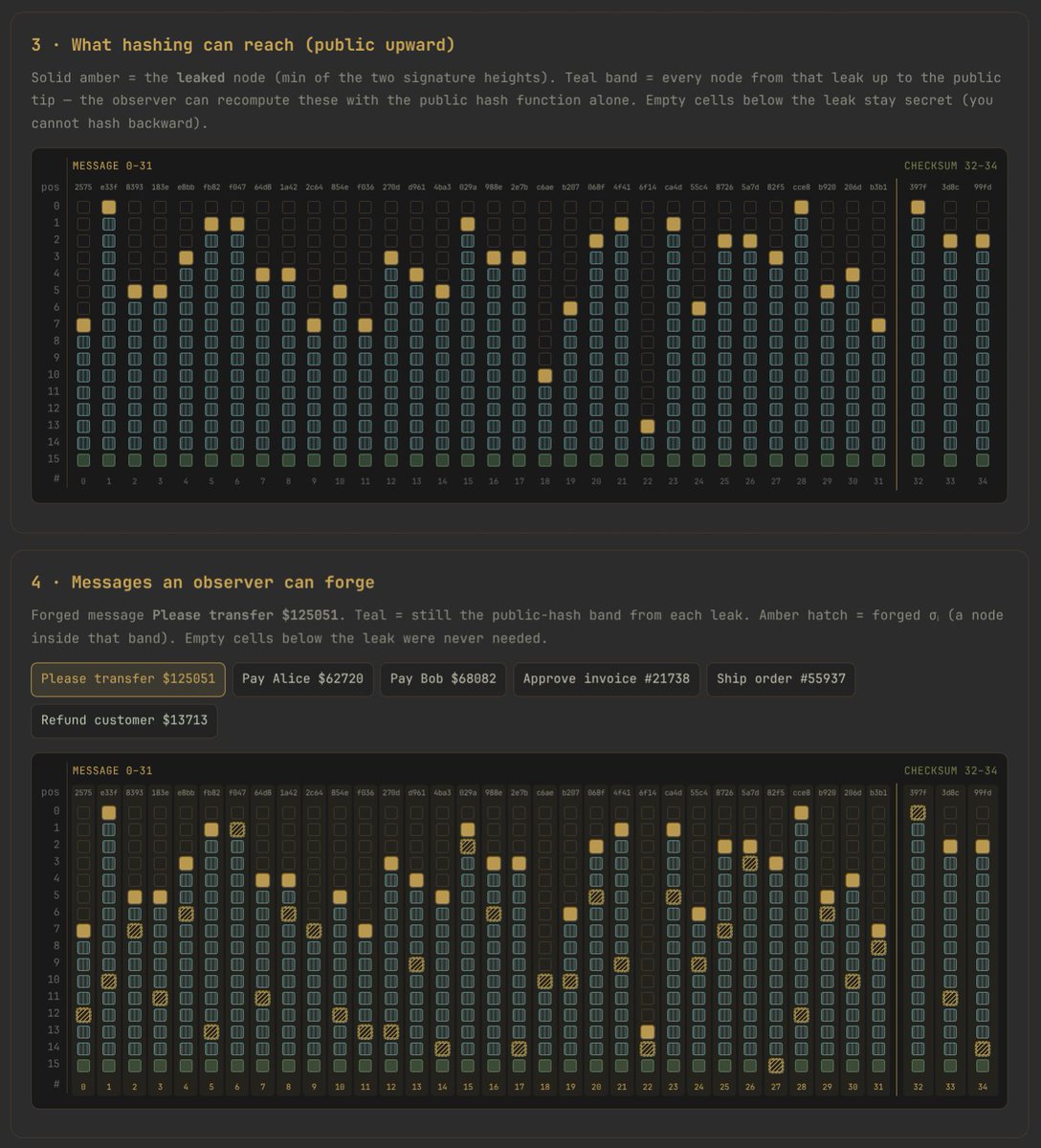
One-time signatures break if you sign two messages with the same key: the two WOTS signatures leak enough of each hash chain that an observer can forge others.
https://t.co/DTK4GeLpGV
One-time signatures break if you sign two messages with the same key: the two WOTS signatures leak enough of each hash chain that an observer can forge others.
https://t.co/DTK4GeLpGV
If you've heard of post-quantum one-time signatures like WOTS but never seen one work: I built a visualizer that signs a real message and walks you through it, step by step.
https://t.co/NtH9rxCqXE
Hey @alinush, I created one for you. You can either use the google chrome plugin (https://t.co/NdB1Mp4qf8) or the open-source github code (https://t.co/hDWyesif3V).
You can just make things! I just built a chess game analyzer for @OmarchyLinux . Following @dhh 's advice this is mainly for me to improve my game. I love the minimal and keyboard driven TUI and wanted to share how it works.
https://t.co/3tYsXg9xCu
The foundation is not just for the Oligarchy and the Corporate Patrons. It’s for everyone. Anyone who can get behind beautiful, fun & agentic Linux. So as of today, patronage is now open to everyone. There are four tiers: $16, $256, $2,048, and $8,192. https://t.co/2KtzRTztS9
The foundation is not just for the Oligarchy and the Corporate Patrons. It’s for everyone. Anyone who can get behind beautiful, fun & agentic Linux. So as of today, patronage is now open to everyone. There are four tiers: $16, $256, $2,048, and $8,192. https://t.co/2KtzRTztS9