Hey everyone,
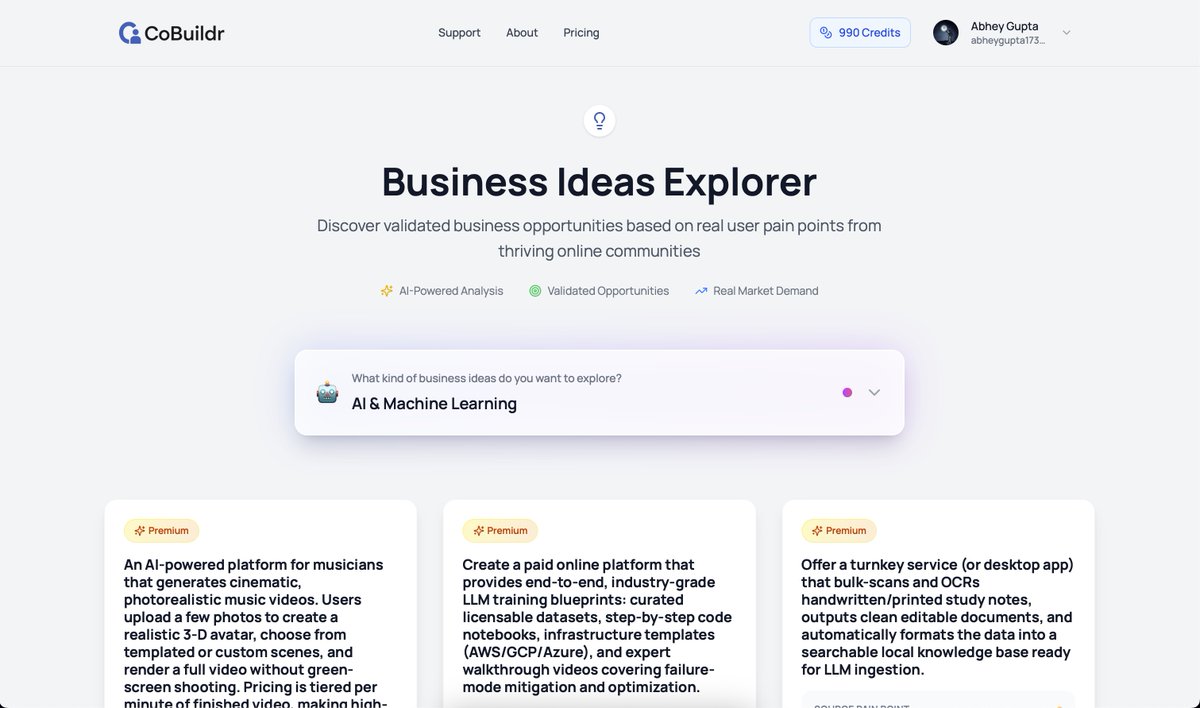
If you are looking for building something, but aren't sure of what to build, I made an AI agent that scans the internet for real user frustrations and uncovers potential market gaps - complete with source links.
Already have something in mind? There’s a comprehensive validation flow to help you test if it’s worth building.
check it out : https://t.co/6cUDytaV0o
Most people don’t realize this:
You get 1,500 free daily requests to Gemma 4 31B on @GoogleAIStudio.
That’s plenty of free inference (imo).
And you can route it into @NousResearch Hermes Agent via Vercel’s AI Gateway:
1. Create an API key on Google AI Studio
2. Add it under BYOK (Google) in Vercel AI Gateway
3. Create a Vercel Gateway API key
4. In Hermes → select “Vercel AI Gateway” + your Google model
Now all your Google model requests route through your free AI Studio quota.
Basically: free 31B model access inside your agent stack.
(Tradeoff: not as private as running locally)
You need to write more.
Without AI. Without templates. Without knowing what you're writing about. Just you, an idea, and enough time to do the difficult cognitive work necessary to reach true understanding. If you don't, your ability to think will drastically decline.
One thing that feels increasingly clear with coding agents:
code is getting cheaper faster than supervision.
You can already spin up more agent work than you can realistically review well.
So the next UX win is probably not more parallelism.
It’s better delegation, faster verification, and much lower context-switching cost for the human in the loop.
This has started to feel like the right mental model.
Coding agents are great pair programmers.
They feel much worse as fully independent teammates.
Once you run too many in parallel, the bottleneck becomes review bandwidth, context switching, and validation discipline more than code generation itself.
This is very real in agentic workflows.
A lot of clever scaffolding starts life as a workaround for a model weakness, then quietly becomes the new bottleneck after the models improve, and the hard part is not just inventing new layers, its having the evals and discipline to know when to delete them.
Fixed a Discord startup bug in Hermes Agent and opened a PR.
If DISCORD_ALLOWED_USERS was numeric-only, Hermes still requested the privileged Members intent unnecessarily, which could leave the bot offline. Also fixed token-lock cleanup on failed startup.
PR: https://t.co/Z9apzcKQJI
cc @NousResearch
I don’t think “read every line” scales, but neither does blind trust.
The workable pattern is layered verification: strong plans, sandboxed execution, automated tests/evals, and human review concentrated on high-risk diffs and integration boundaries.
The bottleneck is designing the review stack, not pretending raw output is safe by default.
@ScottWu46 One underrated agent workflow is always-on review, not just autonomous codegen.
A constrained reviewer that watches diffs, dependencies, and weird changes in the background may create more immediate value than another “build an app from a prompt” demo.
The interesting shift isn’t just “AI agents replace services”
It’s that some service businesses with clear workflows are starting to become software like.
But the bottleneck still looks less like raw model capability and more like reliability, approvals, and integration depth.
That’s the part that will decide what actually works.