Roboticists have been working hard to add memory to “goldfish” imitation learning policies. But do we understand how context length impacts state-of-the-art imitation learning methods?
We provide an in-depth analysis of long-context Diffusion Policies to study this
🧵(1/7)
@likeavass@RussTedrake Agreed that long execution horizons are compensating for expert non-Markovianity wrt policy input. Important: results specifically focus on open-loop “execution”. Chunked prediction could still have benefits (clarifying as MPC thinking focuses on planning horizon as well)
@roblee_rl@michzeng_ Great idea. It’ll require careful experimentation to try, especially because I have heard of concerns that the policies can overfit to proprioception history (and learn to ignore RGB conditioning). We haven’t tried it here; certainly curious about it
Action chunking — especially executing long action sequences open-loop — is widely used in imitation learning for robotic manipulation. Why is it so effective and do we really need it? We find a key reason:
Long open-loop execution helps short-context policies imitate non-Markovian experts.
With this insight, we show how to move beyond open-loop execution: extending policy context restores reactivity while achieving even higher task performance.
🧵(1/5)
Behavior cloning’s success has been accompanied by design choices we don’t understand well. Action chunking with open-loop execution is one of them.
We provide a key reason why open-loop execution seems important: it helps short-context policies imitate non-Markovian experts.
Important practical takeaway: focusing on increasing relatively recent context length can help restore reactivity.
Congratulations @michzeng_ for leading this insightful work.
Action chunking — especially executing long action sequences open-loop — is widely used in imitation learning for robotic manipulation. Why is it so effective and do we really need it? We find a key reason:
Long open-loop execution helps short-context policies imitate non-Markovian experts.
With this insight, we show how to move beyond open-loop execution: extending policy context restores reactivity while achieving even higher task performance.
🧵(1/5)
Good point. In our paper we use “DiT��� as a shorthand for diffusion transformer baseline from the original DP work (w/ cross-attn conditioning). It has been used in other long context DP learning works: https://t.co/8jawRMTWcw. So using it allowed us to compare. Agreed that we need more policy architecture evaluations as a community.
Roboticists have been working hard to add memory to “goldfish” imitation learning policies. But do we understand how context length impacts state-of-the-art imitation learning methods?
We provide an in-depth analysis of long-context Diffusion Policies to study this
🧵(1/7)
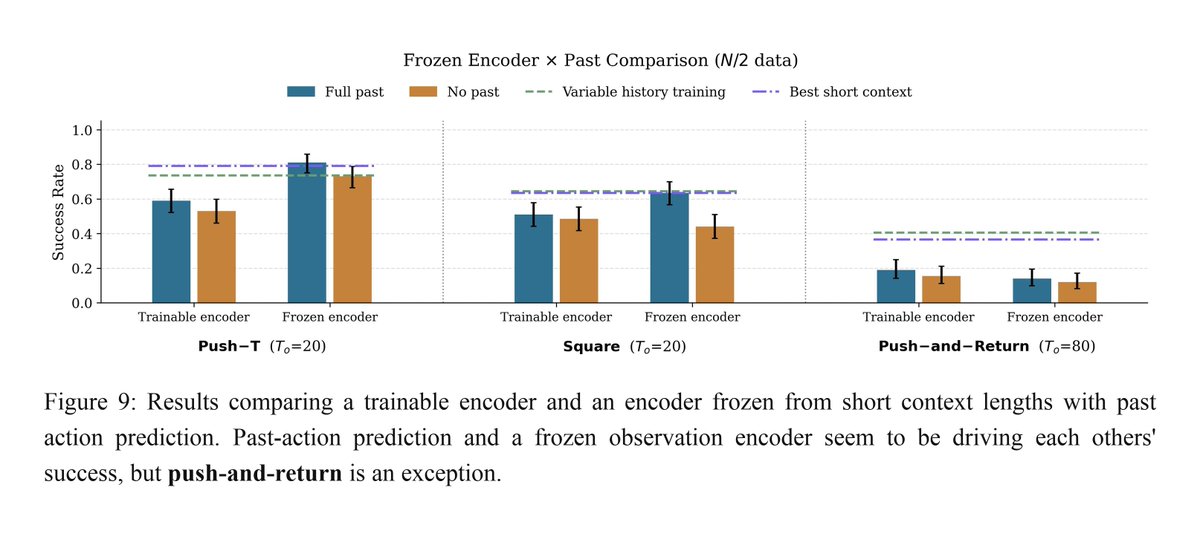
We find that long-context policies can be especially sensitive to vision encoder training - comparing against methods from prior works, we find that freezing the vision encoder can help us succeed in many cases with "past-token prediction", but there are examples where this fails.
🧵(6/7)
🤖 We introduce Ambient Diffusion Policy, a simple and principled method for training policies with suboptimal data in robotics.
Suboptimal data is everywhere in robotics…
❌ Data filtering is wasteful
❌ Co-training learns both good and bad features
✅ Ambient Diffusion Policy selectively learns useful features via noise-dependent data usage
👇🧵(1/5)
Happy to announce that we’ll be presenting our work on sim-and-real cotraining at IROS 2025!
Check out our latest arXiv version - we’ve added new experiments for 2 alternative co-training formulations and addressed some FAQs
📄 https://t.co/ezpVyOOfpG
🌐 https://t.co/jW05A7uwBU
Exciting results that will help us understand and design effective co-training methods in robot imitation learning. Grateful to have worked with brilliant collaborators!
Learning from both sim+real data could scale robot imitation learning. But what are the scaling laws & principles of sim+real cotraining?
We study this in the first focused analysis of sim+real cotraining spanning 250+ policies & 40k+ evals https://t.co/hMc56Hj2K9 (1/6)