@imgamunu@jmanofficial1@lonixs_@thrtysvnth No, Merc just didn’t pit because doing the same as the car ahead had no benefit. If Lewis didn’t pit, best believe George was gonna pit. The person behind always has the luxury of taking risk and coming out looking smart.
@Joshuakintayo@DarktureRocks@sebastianbaughh@Pennys310865@FER44Rl You can’t say George didn’t pit” if the only reason that happened was cos Lewis pitted. Atimes if there is no risk for position behind, drivers just do the opposite of the guy they are chasing. If Lewis didn’t pit, there is no way George doesn’t pit too
@cloverleaf_pt@cotsios_h@FER44Rl I just wonder how all 19 remaining cars crossed the finish line less than 10s from P1. Almost as if a safety car neutralizes any gap you had. Even if GR was 50s away from Lewis, as long as no one jumps him by not putting, the safety car would put him right behind Lewis
@fwmarqix Imagine the outcry if there was an error due to “communication”. It would now turn to “why didn’t he directly and explicitly say what he needed the team to do”
@TenmanNoble1 $200bn is Nigeria’s national budget for multiple years to put in context so I don’t see how someone can steal that much if Nigeria borrows to fund the national budget
@AnyanwuMalachy@AkanPatrick1@Its_Invictus1@IamaExcellency My common sense would have me sending extra money to someone if I suddenly needed something extra especially if said person is probably in a low paying position. But then that’s just my personal opinion.
The Real “Villain” of the Publication Process: The Editor
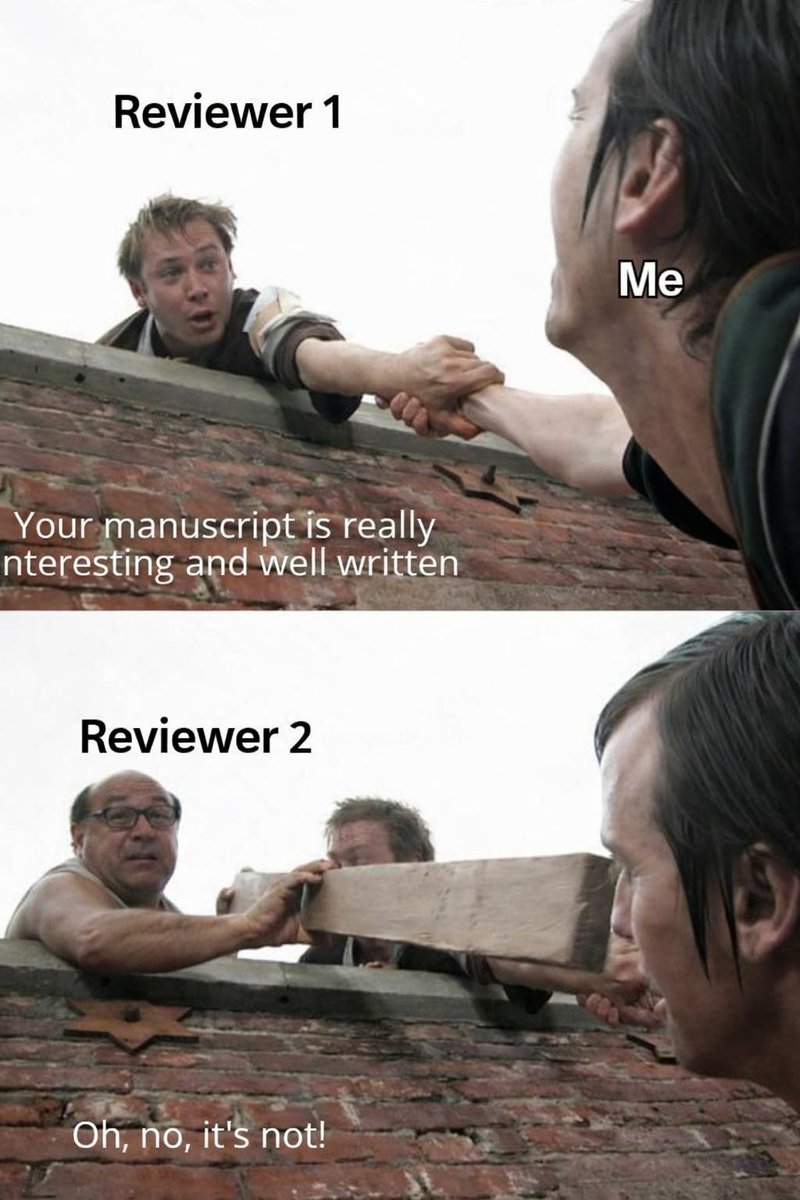
I also love “Reviewer 2” jokes. They are genuinely funny and often reflect reality. However, I think they are somewhat misleading: they make us believe that the main problematic actor in the publication process is the reviewers.
In reality, the person who ultimately decides how the publication process unfolds is the editor. Whether the process becomes smooth or painful is determined, more often than not, not by the reviewers, but by the editor.
My PhD advisor used to say something quite often:
“The publication process is not only about how good your paper is, but also about whether you happen to get the right reviewers. In academic publishing, luck plays a significant role.”
However, if there is something even more important than getting the right reviewers, it is having a good editor. Because the only way to overcome a bad editor is to have an almost flawless manuscript accompanied by completely positive reviewer reports — and the probability of that happening is fairly low.
It is actually quite common for one out of three reviewers to be toxic, make comments that reveal a lack of understanding of the topic, or leave you wondering, “Why is this person even here?” The job of a good editor is to filter out such comments, assess the quality of the reviews, and manage the process in a balanced way.
For example, in one of my papers, we simply could not satisfy one of the reviewers. Every revision we made was met with a new objection. However, the editor recognized that the reviewer’s approach had gone beyond reasonable limits and chose not to treat those comments as decisive, ultimately allowing our paper to be published. That is exactly what a good editor does.
Let me also talk a bit about bad experiences.
I once submitted a paper to the IEEE journal IEEE Internet of Things Journal, one of the most prestigious journals in its field. Only two reviewers were assigned. One reviewer provided highly positive feedback, while the other submitted a negative evaluation. Moreover, the negative review was extremely superficial, and its main argument was simply that the paper was “not novel.”
The editor rejected the paper solely on the basis of that single negative opinion.
I responded to the editor by explaining that this approach was not sound and that we should at least have been given an opportunity to defend ourselves. After all, demonstrating that a study is “not novel” is actually quite straightforward: you simply present a similar publication, and the discussion is over. Therefore, I argued that assigning at least a third reviewer would have been the more appropriate course of action. Initially, the editor refused.
At that point, I sent a rather strongly worded email to the editor-in-chief. After a long exchange of correspondence, the editor formally apologized and agreed to assign a third reviewer. However, by then I no longer believed the process would proceed fairly, so I chose to withdraw the paper. The same study was later published quite quickly in the Elsevier journal Internet of Things.
Another bad experience involved IEEE Transactions on Dependable and Secure Computing. The first response to the paper I submitted there arrived exactly one year and nineteen days later — and it was a rejection.
The rejection itself was not the main issue; after all, there is no rule that every paper must be accepted. However, keeping a highly current study waiting for more than a year is a serious problem. Moreover, because the literature review became outdated during that period, I had to make substantial revisions before I could submit the paper elsewhere. The work was later published in the Elsevier journal Computer Networks.
There was also another issue during this process: the preprint version of the paper received 15 citations, 9 of which were indexed in Web of Science. However, because the study had not yet been formally published through peer review, I could not effectively use those citations for academic performance evaluations. In other words, a poorly managed editorial process can lead not only to a loss of time, but also to direct academic harm.
In short, what I am trying to say is this: “Reviewer 2” is, to some extent, a notorious scapegoat in the story. The true determining actor in the publication process is the editor. Because a good editor can compensate for a bad reviewer. But compensating for a bad editor is, most of the time, impossible.
@BBeutah@Kevyncozic@WelBeast A team that goes into the last 2 games with the title up for grabs cannot have 1,2,3 in best players list. For you to have the 3 best players in the league, you should have probably won the league in March or something
@SamuelGodbless@AskMichaelTaiwo Even here in the US, the BGS is highest CGPA. The student B can be awarded something else like service award or whatever they want to call it. But the BGS is simply the best CGPA since that is an actual objective measure of what someone did. Everything else is subjective
@RomelloTu11@MOVIESWORLD67 For some reason I never realized that the Ashley look at me from all the dance videos are from this scene. Just rewatching it now and I am like wait a min. This is the exact same voice they always use 😂