Fin de otra etapa formativa. Ahí va mi pequeño granito de arena!
PET en Fisio-Onco-Pulmón. Arranca un proyecto personal y profesional nuevo! Gracias @aicuesta hacer todo esto posible. Estoy seguro que esto no acaba aquí, seguiremos esparciendo estas pequeñas semillas
El primer programa de ejercicio terapéutico dirigido a pacientes con cáncer colorrectal que se encuentran bajo tratamiento de quimioterapia, será llevado a cabo, en Salamanca, por fisioterapeutas especializados.
https://t.co/bdu9gli6SY
@juanlusanchez94@carlsMartin89
Lo difícil es compartir los fracasos, los pacientes que no salen, los severos, los crónicos con enfermedades degenerativas.
Ahí también somos útiles, pero no tan vistosos.
@MiguelAsen@VRodeiro Añade a un 5 a tu listado: 5) si nosotros desterramos el ejercicio, otros lo cogerán. Y esto, que está redactado en futuro simple, es ya un triste presente.
La conciencia existe, aunque no tengamos ni idea de cómo surge, y nos permite analizar y modificar hábitos cognitivos, impacto emocional y sesgos de atención, motivarnos, imaginar, actuar de otra manera. Hay que aprovechar ese espacio para conseguir objetivos.
Los pacientes no catastrofizan porque son catastrofizadores, sino porque han recibido una instrucción alarmista, catastrofizadora. El decatastrofizador que los decatastrofice buen decatastrofizador será.
Por mucho que sepas de ejercicio, el manejo clínico, la anamnesis, la modificación de síntomas, la educación, el comportamiento e historia natural de la patología, el pronóstico, el seguimiento y reevaluación, entre otras cuestiones, son SANITARIAS.
Busting 3 common “muscle myths” with exercise training:
https://t.co/KgS7Kpjaeo
1/ Go big or go home
Many believe lifting heavy weights are mandatory for building muscle.
But - muscle growth is possible with a variety of loads and repetition ranges:
https://t.co/G52PYHeBYa
So - a fear of heavy weights needn’t limit any ‘gains’.
2/ Stopping exercise means starting again from scratch
It’s true that if we stop resistance training, we lose muscle.
But if we resume training, muscle growth may occur faster than if we were previously untrained.
This “muscle memory” may be explained by various factors (e.g., satellite cells, epigenetic changes) linked to the initial training period:
https://t.co/0bGptQA6Pn
This means training may prepare us to respond better in future.
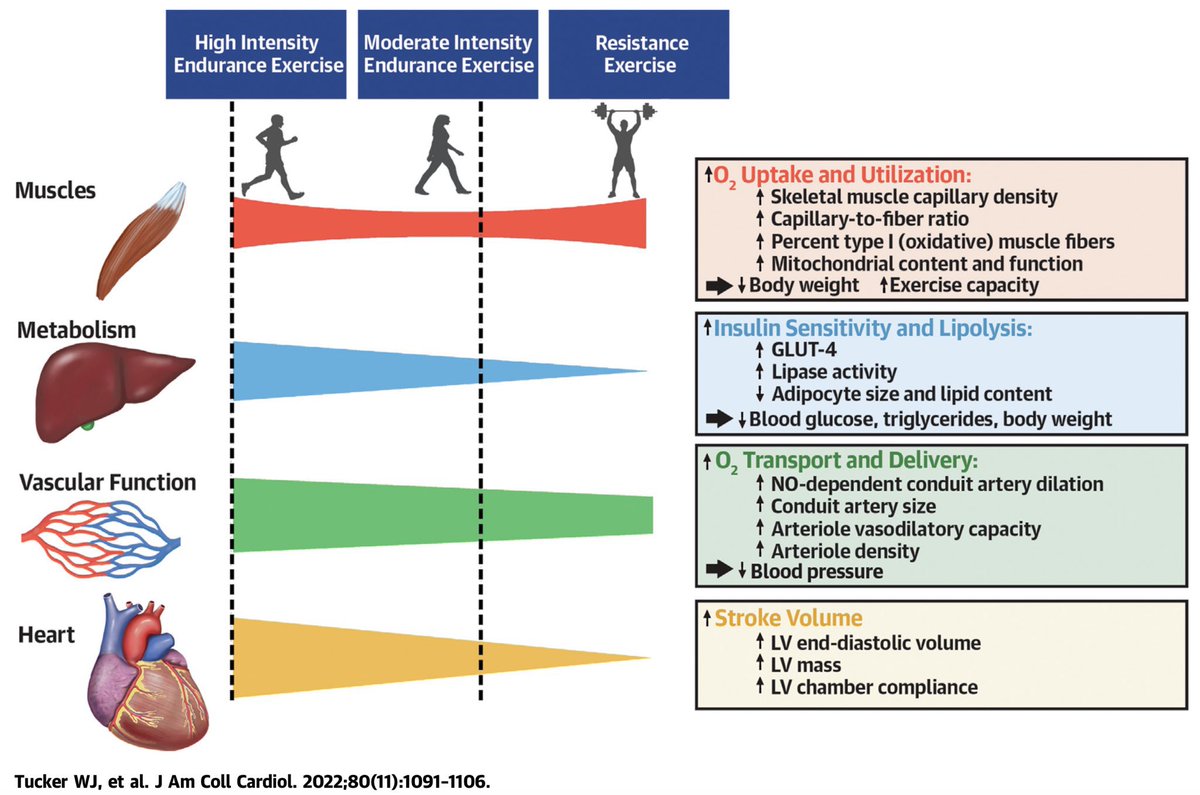
3/ Muscle fibre types can’t shift with training
Muscle fibre types differ in terms of their speed of contraction and metabolism (type I - slow/oxidative and type II - fast/glycolytic).
Human quadriceps muscles may be comprised of ~40% ‘slow’, ~40% ‘fast’, and ~20% ‘mixed fast/slow’ fibres.
It was traditionally believed muscle fibre types are genetically pre-determined and can’t shift with training.
But this may not be the case.
As an example, identical twins with 30 years of divergent exercise habits showed vastly different muscle fibre type profiles, with the endurance-trained twin having 55% more type I (slow) fibres:
https://t.co/zh8JkxQ10v
The potential ability to shift fibre proportions with training may have important implications for health and performance.
Great article from @DrJimmyBagley@DrAndyGalpin & @KevinMurachPhD
https://t.co/KgS7Kpjaeo
Si tens entre 18 i 30 anys, anar a teatre o a concerts et podrà costar, com a màxim, 20 euros. I com a mínim, 5 euros
https://t.co/mEJiuxDxr9 https://t.co/mEJiuxDxr9