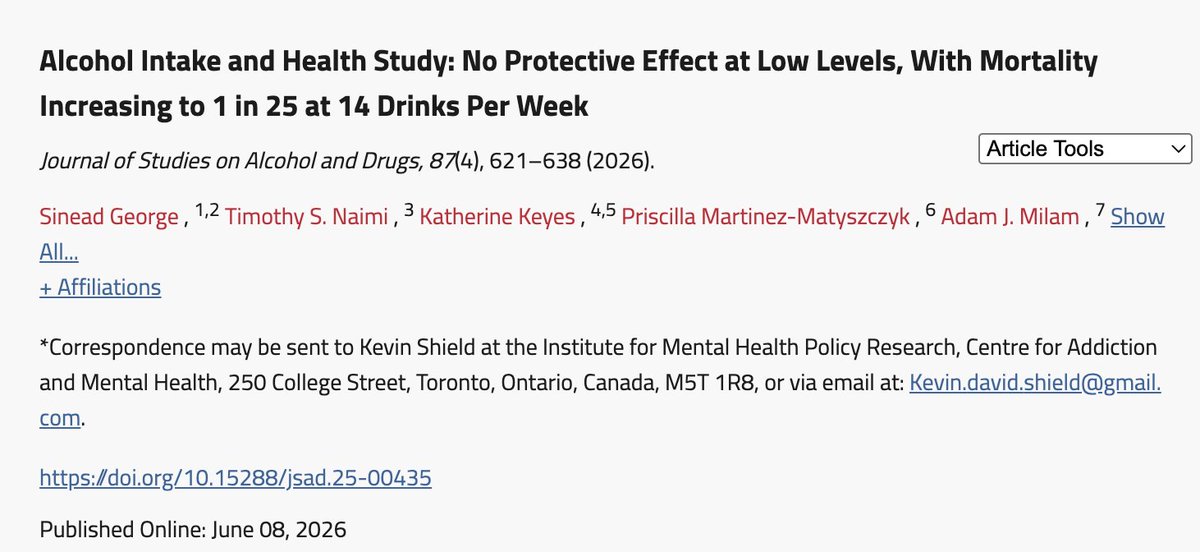
Nuova revisione basata su 843 studi: bere anche meno di un bicchiere di bevande alcoliche è associato a un rischio superiore di 10 tumori. Per quanto riguarda il cancro, le prove sono coerenti: il rischio aumenta con qualsiasi livello di assunzione di alcol. 1/3
Sembra superfluo ripeterlo ma non esiste assunzione di alcool esente da rischi. Non c'è alcun effetto protettivo o benefico.
Questi sono i fatti.
Poi c'è la vita reale dove se capita di bere un bicchiere sporadicamente non sarà quello ad ucciderci, l'importante è essere onesti
The blood–brain barrier can be damaged and leaky decades after an athlete retires from contact sport. This leakiness seems to trigger a lasting immune response that is closely tied to cognitive decline
https://t.co/laaLrUNUxY
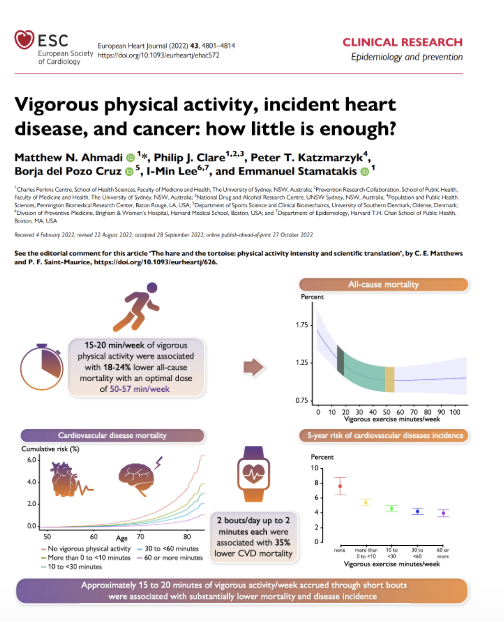
Just 15 to 20 minutes of intense exercise a week may lower your risk of early death
New research from the European Heart Journal suggests you do not need hours of hard training to see major health benefits.
1. Just 15 to 20 min/week of vigorous activity was linked to a 16% to 40% lower mortality risk
2. These benefits were seen even when the activity was done in short bouts of 2 minutes or less
3. The study followed 71,893 adults from the UK Biobank
4. Around 50 to 57 min/week was linked to the lowest risk overall
5. Even 10 to under 30 min/week was associated with much lower rates of:
- all-cause mortality
- cardiovascular disease
- cancer incidence
6. For cardiovascular mortality, the relationship was especially strong, and more vigorous activity was linked with progressively lower risk
The takeaway: small doses done consistently still matter
You do not need perfect. You need a few hard minutes, done regularly, to move the needle.
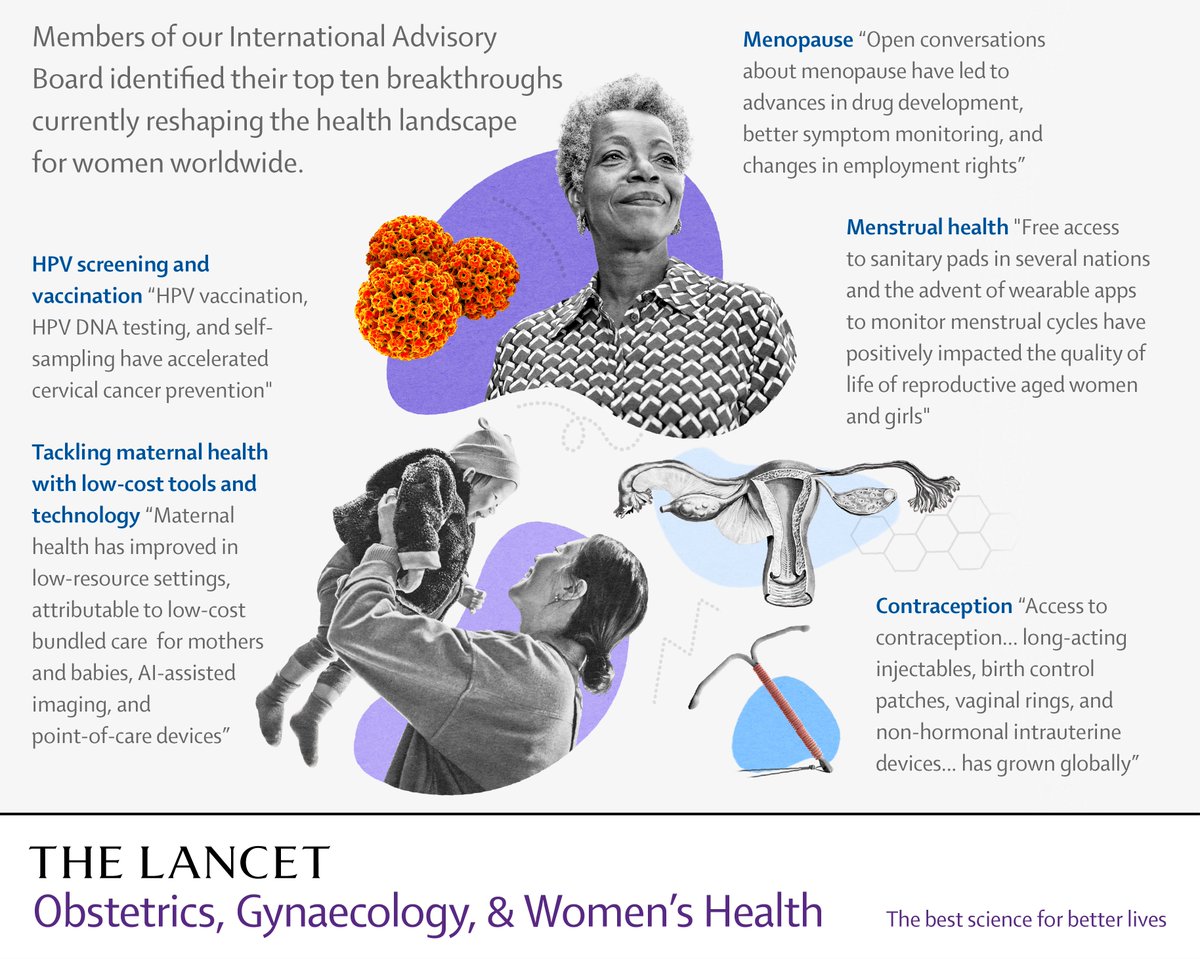
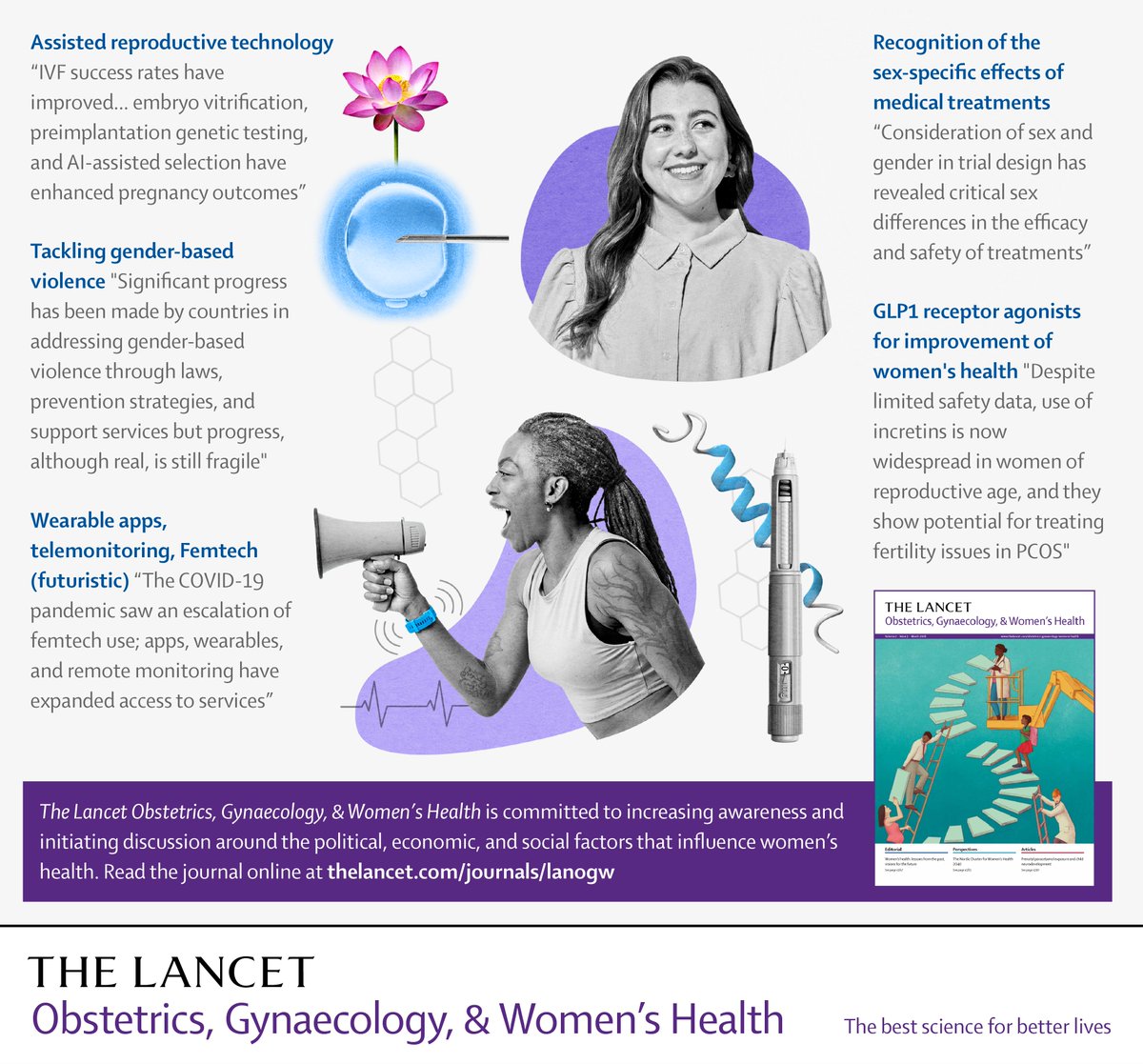
To mark #InternationalWomensDay, editors and board members from The Lancet Obstetrics, Gynaecology, & Women’s Health highlight 10 advances from the past 10 years that have transformed research and care.
Explore the milestones shaping women’s health today:
https://t.co/DIjqiawSNY
VEXAS syndrome is a newly discovered multisystemic disease affecting most organs.
A Review provides a comprehensive overview of VEXAS syndrome, including the disease's discovery, diagnosis, and treatment: https://t.co/2BPPLfwDD9
In the central nervous system, myelin is produced by oligodendrocytes and forms an insulating sheath around the axons of neurons.
In a new Science study, researchers report that damage to myelin initially causes swelling before leading to loss of myelin sheaths. They also demonstrate that swollen myelin can persist despite damage and can dynamically remodel to prevent sheath loss.
Learn more in a new #SciencePerspective: https://t.co/cCDTw0mRgr
Great visual how 🏃🏾♀️ physical activity and #exercise impact body organs and systems:
🫀heart
💪 muscle
🧠 central nervous system
🪢 peripheral nervous system
🆎 hematopoietic system
🦴 bone and cartilage
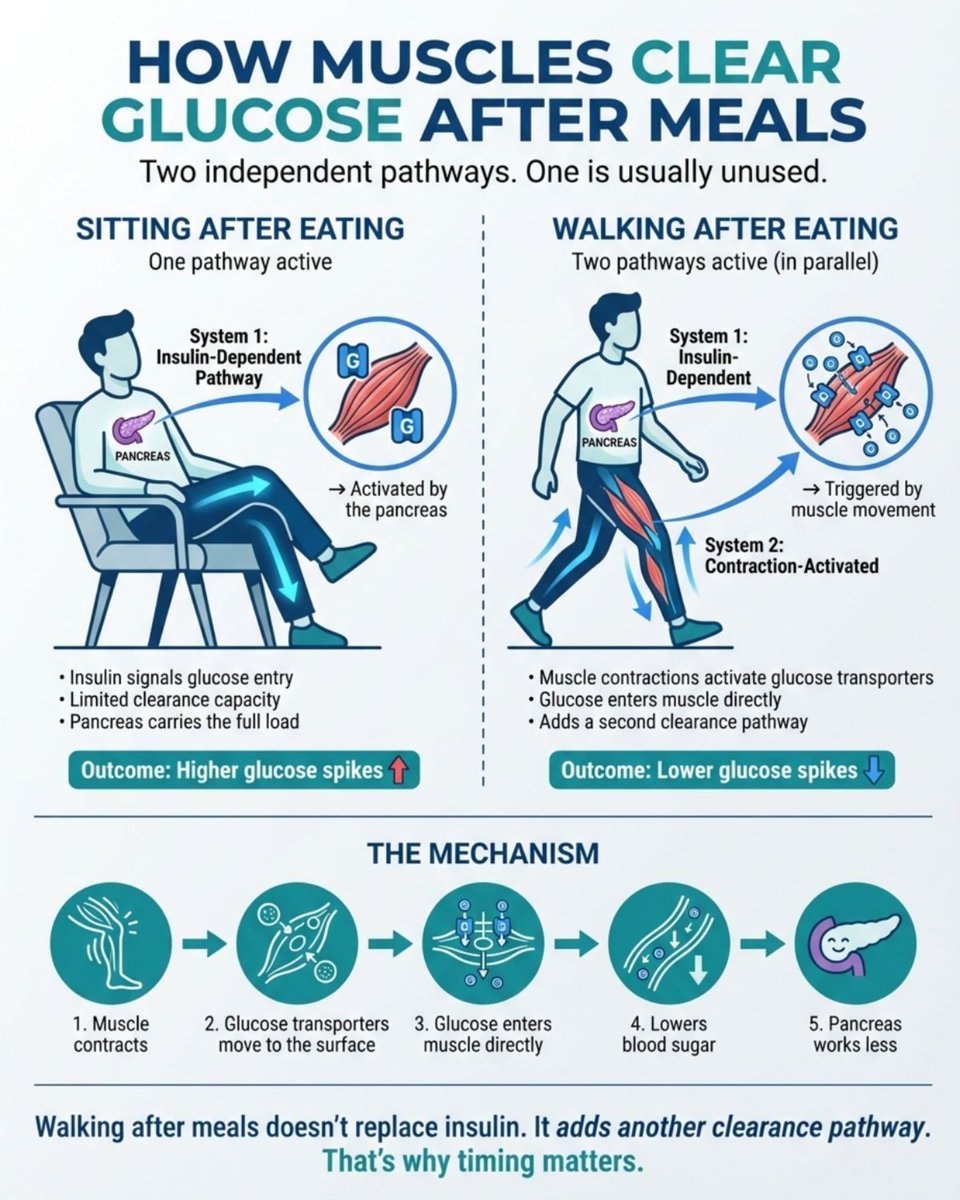
Your muscles clear glucose in two different ways after a meal.
Most people only use one.
When you sit after eating, glucose disposal depends almost entirely on insulin signaling from the pancreas. That pathway works, but it has limited capacity, which is why post-meal glucose spikes are higher and longer.
When you move after eating, even lightly, a second pathway turns on in parallel.
Muscle contraction independently activates glucose transporters (GLUT4), allowing glucose to enter muscle without waiting for insulin. The result is faster clearance, lower peaks, and less strain on the pancreas.
What’s happening under the hood:
• Muscle contraction triggers GLUT4 translocation
• Glucose enters muscle directly
• Blood glucose falls more quickly
• Insulin demand is reduced, not replaced
This isn’t about burning calories or “earning” food. It’s about using the physiology you already have. Walking after meals doesn’t override insulin. It adds another clearance pathway.
That’s why timing matters.
You never know what songs you might catch on this upcoming tour.
Here’s one of the tunes that started it all for @alterbridge
THE NEW RECORD - Alter Bridge - Out Now 🔥🔥
Get the album, tickets Tremonti Guitar Clinics and VIP Meet & Greets now at https://t.co/tHvg0J0Z6g
What Lies Within Euro Tour w/ @Daughtry_News and @Sevendust !
Jan 15 – HAMBURG, GERMANY
Jan 17 – OSLO, NORWAY
Jan 18 – OSLO, NORWAY
Jan 20 – STOCKHOLM, SWEDEN
Jan 22 – HELSINKI, FINLAND
Jan 24 – COPENHAGEN, DENMARK
Jan 25 – BERLIN, GERMANY
Jan 27 – GLIWICE, POLAND
Jan 28 – BUDAPEST, HUNGARY
Jan 30 – VIENNA, AUSTRIA
Jan 31 – ZAGREB, CROATIA
Feb 02 – ROME, ITALY
Feb 03 – BERGAMO, ITALY
Feb 05 – ZURICH, SWITZERLAND
Feb 06 – LYON, FRANCE
Feb 08 – BARCELONA, SPAIN
Feb 10 – LISBON, PORTUGAL
Feb 12 – MADRID, SPAIN
Feb 13 – BORDEAUX, FRANCE
Feb 15 – LUXEMBOURG, LUXEMBOURG
Feb 17 – OBERHAUSEN, GERMANY
Feb 18 – PARIS, FRANCE
Feb 20 – MUNICH, GERMANY
Feb 22 – AMSTERDAM, NETHERLANDS
Feb 23 – BRUSSELS, BELGIUM
Feb 25 – NEWCASTLE, UNITED KINGDOM
Feb 26 – MANCHESTER, UNITED KINGDOM
Feb 28 – DUBLIN, IRELAND
Mar 02 – GLASGOW, UNITED KINGDOM
Mar 04 – LONDON, UNITED KINGDOM
Mar 05 – NOTTINGHAM, UNITED KINGDOM
What Lies Within U.S. Tour w/ @filter Sevendust and @TimMontana
Apr 25 – Orlando, FL – House of Blues – TM
Apr 26 – Atlanta, GA – Coca-Cola Roxy – 7D/TM
Apr 28 – Houston, TX – Bayou Music Center – F/TM
Apr 29 – Dallas, TX – South Side Ballroom – F/TM
May 1 – Tulsa, OK – Skyline Event Center at Osage Casino Hotel – F/TM
May 2 – Omaha, NE – Steelhouse Omaha – F/TM
May 5 – Green Bay, WI – EPIC Event Center – F/TM
May 6 – Chicago, IL – The Salt Shed – F/TM
May 9 – Atlantic City, NJ – Event Center at Borgata Hotel Casino & Spa - F
May 10 – Boston, MA - Citizen House of Blues Boston – F/TM
May 12 – Huntington, NY – The Paramount – F/TM
May 13 – Montclair, NJ – The Wellmont Theater - F/TM
May 18 – Pittsburgh, PA – The Roxian Theatre – F/TM
May 19 – Detroit, MI – The Fillmore Detroit – F/TM
May 21 – Nashville, TN – The Pinnacle – 7D/TM
May 22 – Birmingham, AL – Avondale Brewing Company – F/TM
May 24 – Tampa, FL – Seminole Hard Rock Tampa Event Center – F/TM
#AlterBridge #MarkTremonti #MylesKennedy #BrianMarshall #ScottPhillips #Daughtry #Sevendust #Filter #TimMontana
@alterbridge You've topped yourselves once again. The new album is a masterpiece and I can't stop listening to it. Thank you for sharing your talent with us! 🤘#AlterBridge#NewAlbum
https://t.co/4nApddBhUF
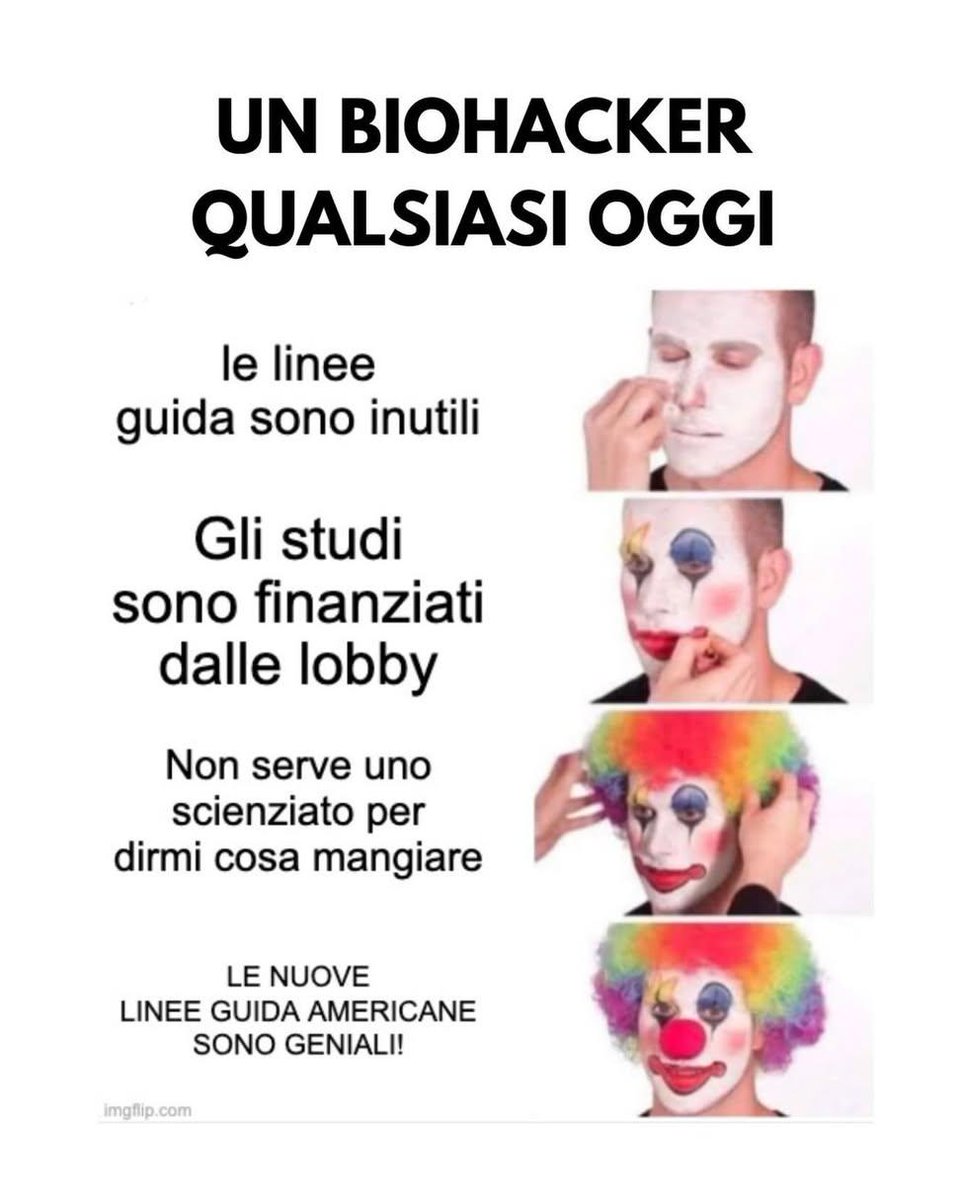
I cialtroni e i fuffa guru festeggiano, senza essere andati oltre alla figura della piramide alimentare e senza aver letto le nuove linee guida per intero.
Pagliacci.
La piramide che non è una piramide.
Ecco cosa dicono veramente le nuove linee guida dietetiche per il popolo americano:
https://t.co/dF6oLv3JjJ
Qui invece il PDF:
https://t.co/KxeQncEEoI
@alterbridge You've topped yourselves once again. The new album is a masterpiece and I can't stop listening to it. Thank you for sharing your talent with us! 🤘#AlterBridge#NewAlbum
https://t.co/4nApddBhUF
This graphic and description are not able to be close to exhaustive on the amount, depth, and nuance of information surrounding vitamin D.
Concerning vitamin D deficiency, clinical deficiency most prominently affects the neuromuscular and skeletal systems. The most visible impact of vitamin D deficiency is an increased risk of metabolic bone disease [e.g., rickets (type I) and osteoporosis].
It has been estimated that 40% of people in the United States are in a state of insufficiency (with some suggesting that number is higher). Reports in Canada are as high as 70-97% of people living in a state of insufficiency (PMID: 20413135). As noted in the graphic, people living in northern latitudes are more likely to experience vitamin D insufficiency/deficiency (important to remember that those states are different), as they likely spend less time outdoors and UVB radiation is not as strong as it is by the equator. It has been suggested that people living 40 degrees north (or south) of the equator get virtually no biogenic vitamin D activity in the winter months.
Concerning individuals with darker skin, it is important to know that the epidermal pigment melanin efficiently absorbs UVB from the sun. Thus, darker-skinned individuals can have lower circulating levels of pre-hormone vitamin D (calcidiol) and require greater UVB doses for comparable active vitamin D synthesis compared to lighter-skinned individuals. It has been suggested that compared to light-skinned individuals (skin type I - easily burned, never tans) dark-skinned individuals (type V or VI skin – seldom burn; always “tan”) require up to 5-10x more sun exposure to produce the same amount of active vitamin D. This difference has an evolutionary basis, with light skin being an adaptation of early humans living in higher latitudes, where the risk for suboptimal vitamin D in winter months was high (PMID: 30408154).
Of note, getting sunlight is great but unless you are outside between 10 am and 4 pm (UV index of 3 or above), you will not get much conversion of pre-vitamin D into active D3.
Our self-titled album is out now.
Thank you to everyone who supported us along the way. We’re incredibly proud of what we created together and hope you enjoy it as much as we do.
We’ll see you on the road.
🎧 Album: https://t.co/NsvvmCDHaC
🎟️ Tickets, VIP & guitar clinics: https://t.co/R7UcSlR83C













![WilliamWallace's tweet photo. This graphic and description are not able to be close to exhaustive on the amount, depth, and nuance of information surrounding vitamin D.
Concerning vitamin D deficiency, clinical deficiency most prominently affects the neuromuscular and skeletal systems. The most visible impact of vitamin D deficiency is an increased risk of metabolic bone disease [e.g., rickets (type I) and osteoporosis].
It has been estimated that 40% of people in the United States are in a state of insufficiency (with some suggesting that number is higher). Reports in Canada are as high as 70-97% of people living in a state of insufficiency (PMID: 20413135). As noted in the graphic, people living in northern latitudes are more likely to experience vitamin D insufficiency/deficiency (important to remember that those states are different), as they likely spend less time outdoors and UVB radiation is not as strong as it is by the equator. It has been suggested that people living 40 degrees north (or south) of the equator get virtually no biogenic vitamin D activity in the winter months.
Concerning individuals with darker skin, it is important to know that the epidermal pigment melanin efficiently absorbs UVB from the sun. Thus, darker-skinned individuals can have lower circulating levels of pre-hormone vitamin D (calcidiol) and require greater UVB doses for comparable active vitamin D synthesis compared to lighter-skinned individuals. It has been suggested that compared to light-skinned individuals (skin type I - easily burned, never tans) dark-skinned individuals (type V or VI skin – seldom burn; always “tan”) require up to 5-10x more sun exposure to produce the same amount of active vitamin D. This difference has an evolutionary basis, with light skin being an adaptation of early humans living in higher latitudes, where the risk for suboptimal vitamin D in winter months was high (PMID: 30408154).
Of note, getting sunlight is great but unless you are outside between 10 am and 4 pm (UV index of 3 or above), you will not get much conversion of pre-vitamin D into active D3.](https://pbs.twimg.com/media/G-PjeRWXgAAkVeD.jpg)


