I built .bdf to easily share html directly from my agents.
I use Claude a lot to create html slides and documents, but sharing plain html with others is annoying.
.bdf gives you a shareable link in a single prompt.
give it a try: https://t.co/bRkeBlXnId
Building apps has never been easier.
With Sites, Codex can turn your work, ideas, and plans into an interactive website or app your team can explore, use, and share with a URL.
Rolling out to Business and Enterprise plans, before expanding more broadly.
@sarahyang_00@zarazhangrui Nice! I‘m pulling that! I found HTML always a bit hard to edit and collaborate on. That’s why I built https://t.co/du8Op2weov, an easy way to collaborate and share slides and any kind of HTML.
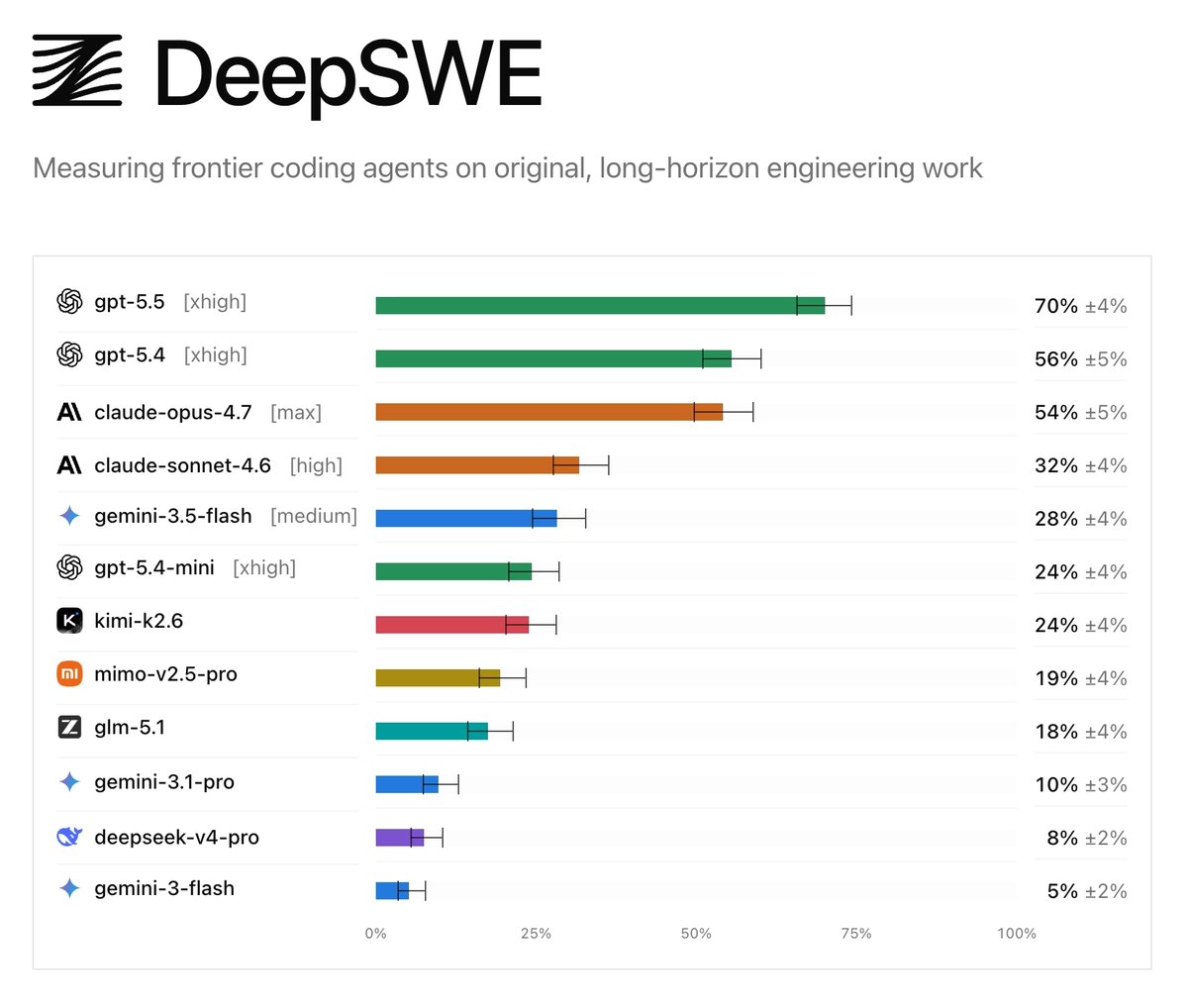
Today we’re releasing DeepSWE, a new standard for agentic coding benchmarks.
On public leaderboards, top models often look relatively close in capability. DeepSWE shows where they actually diverge, reflecting the realistic experience of developers in their day-to-day work.
I built .bdf to easily share html directly from my agents.
I use Claude a lot to create html slides and documents, but sharing plain html with others is annoying.
.bdf gives you a shareable link in a single prompt.
give it a try: https://t.co/du8Op2weov
This works really well btw, at the end of your query ask your LLM to "structure your response as HTML", then view the generated file in your browser. I've also had some success asking the LLM to present its output as slideshows, etc.
More generally, imo audio is the human-preferred input to AIs but vision (images/animations/video) is the preferred output from them. Around a ~third of our brains are a massively parallel processor dedicated to vision, it is the 10-lane superhighway of information into brain. As AI improves, I think we'll see a progression that takes advantage:
1) raw text (hard/effortful to read)
2) markdown (bold, italic, headings, tables, a bit easier on the eyes) <-- current default
3) HTML (still procedural with underlying code, but a lot more flexibility on the graphics, layout, even interactivity) <-- early but forming new good default
...4,5,6,...
n) interactive neural videos/simulations
Imo the extrapolation (though the technology doesn't exist just yet) ends in some kind of interactive videos generated directly by a diffusion neural net. Many open questions as to how exact/procedural "Software 1.0" artifacts (e.g. interactive simulations) may be woven together with neural artifacts (diffusion grids), but generally something in the direction of the recently viral https://t.co/z21CP5iQfu
There are also improvements necessary and pending at the input. Audio nor text nor video alone are not enough, e.g. I feel a need to point/gesture to things on the screen, similar to all the things you would do with a person physically next to you and your computer screen.
TLDR The input/output mind meld between humans and AIs is ongoing and there is a lot of work to do and significant progress to be made, way before jumping all the way into neuralink-esque BCIs and all that. For what's worth exploring at the current stage, hot tip try ask for HTML.
@karpathy finally we can replace pdfs. And its even more shareable: after you have a local html you can tell you agent to publish it via https://t.co/du8Op2weov, pretty nice!
@trq212 finally we can replace pdfs. And its even more shareable: after you have a local html you can tell you agent to publish it via https://t.co/bRkeBlXnId, pretty nice!
@steveruizok I converted PDFs to SVG before and pasted them into tldraw, so this working out of the box, would be great. But I found annotations hard to do, as there is no "text-marker". It would be great to have an opacity setting for pens and box backgrounds in general.
irgendwann hast du zum ersten Mal eine E-Mail empfangen und es hat seitdem nicht mehr aufgehört, es wird nie mehr aufhören, irgendwann hört dein Herz auf zu schlagen und die E-Mails werden weiterhin kommen