Good education has never been more important than it is now.
With AI, *what* you know matters less. Whether you can figure out and understand new stuff is totally essential.
Degrees like econ that teach you to think analytically about new problems are worth more than ever.
You know what other tools know better than most instructors? Coursera and YouTube courses from top faculty, *the internet*, books from the library. How many students used those tools instead of formal ed? Very very few. How many will use Claude independently to learn the material? Probably the same amount.
I know it doesn’t sound glamorous, but the primary role of faculty is to get students in the seats and create incentives to actually absorb the information. This is your job. AI can help as a tool, I’ve seen some great harnesses of AI for education, but it will not do this.
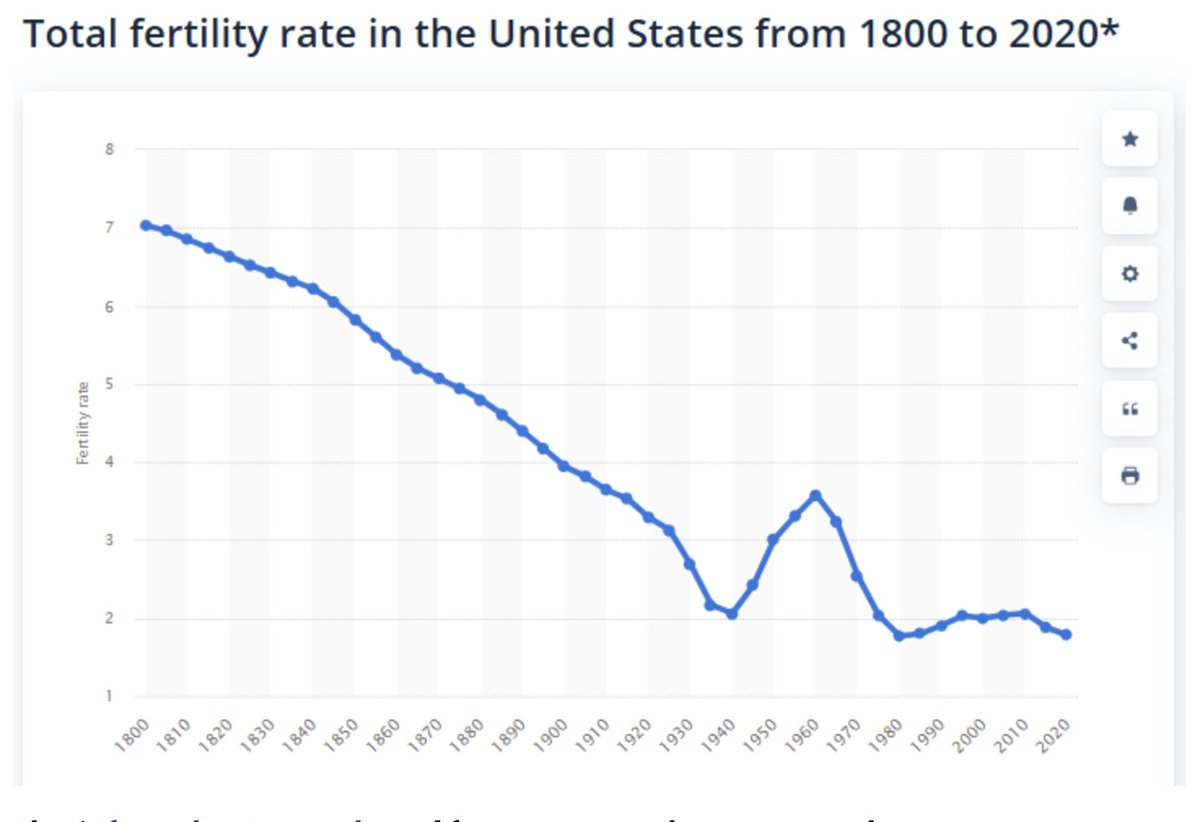
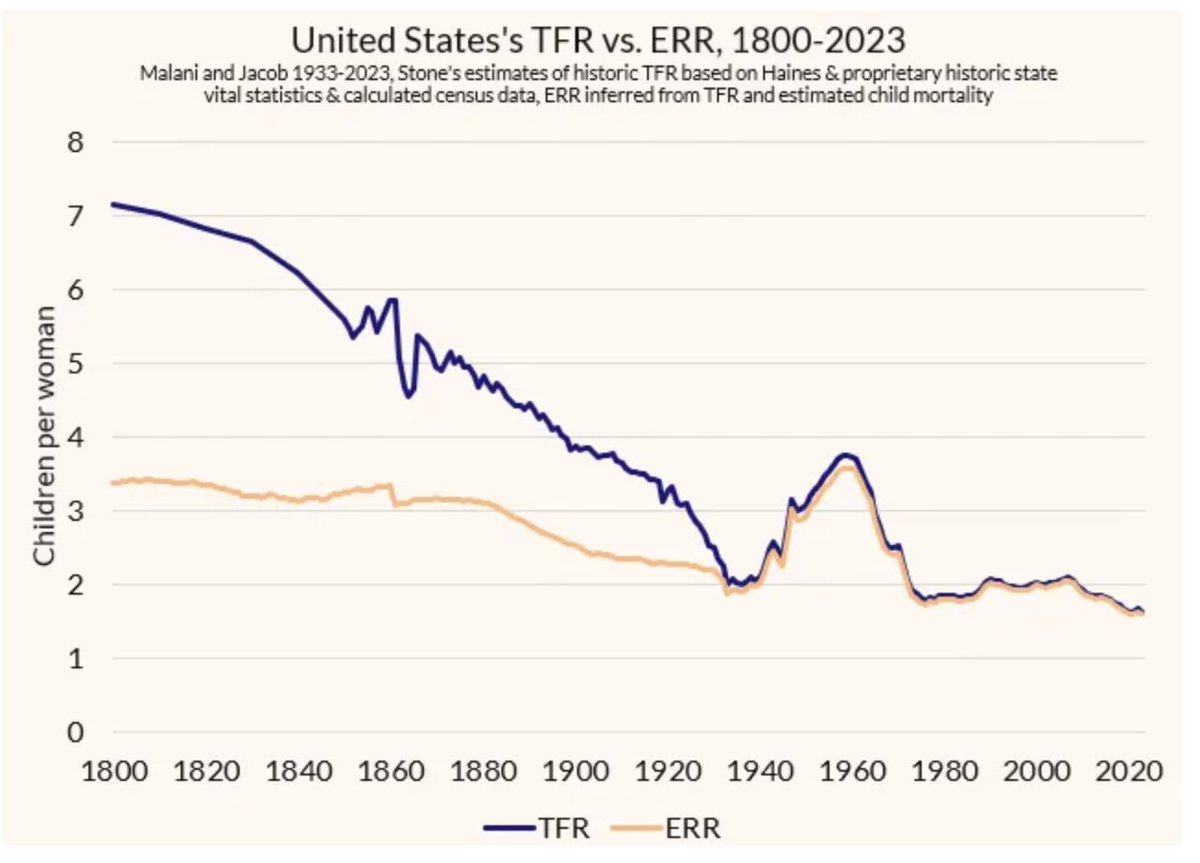
On the latest round of fertility discourse, friends don't let friends share chart 1 without the important context of chart 2, which is @lymanstoneky's child-survival adjustment:
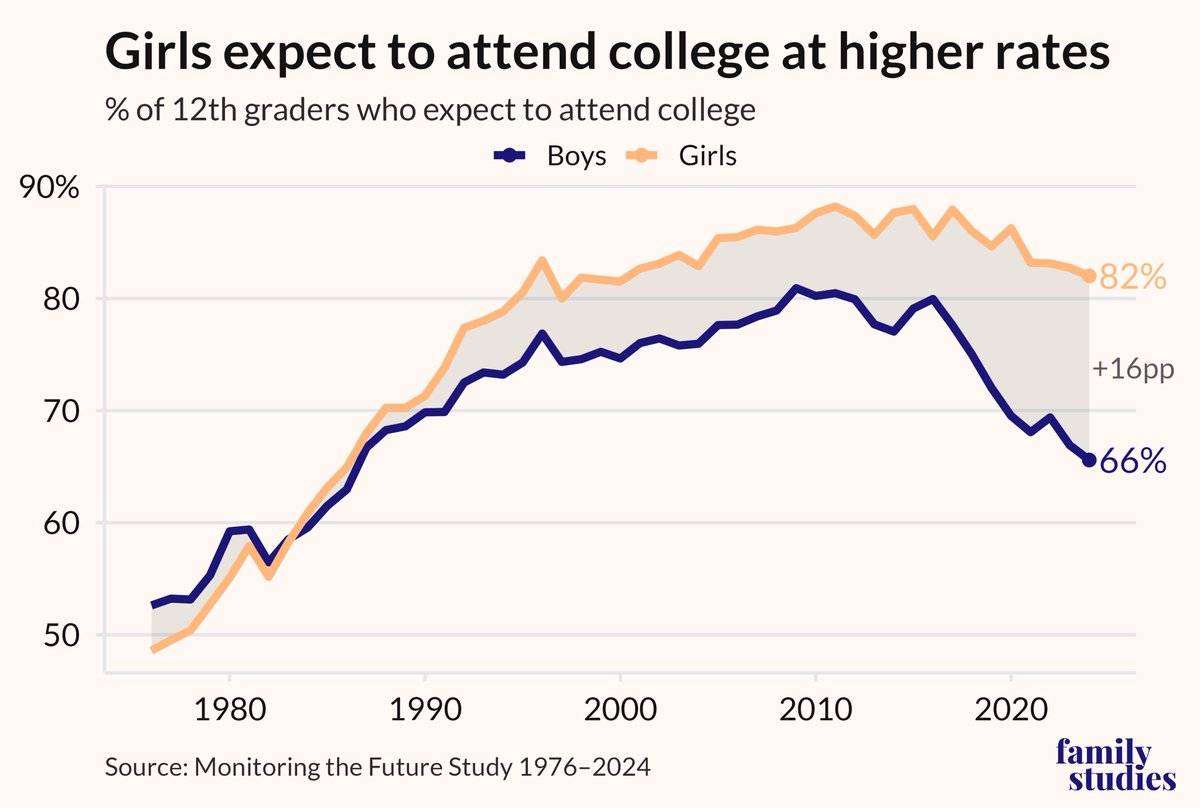
I know it’s unpopular but video/computer games / alt reality have to be playing a role. Especially since we know they’re differentially played by gender.
Hard to be inspired to invest in future if the right now is “pretty good” and entertaining at home.
People are acting like this is some kind of proof that cell phones cause no harm. But read to the end…long term mental health outcomes improve when phones are taken during the day. So the trade off is that students lose phone access during the day, and their standardized test scores don’t change; in exchange their mental health improves over time. Seems like a worthwhile trade.
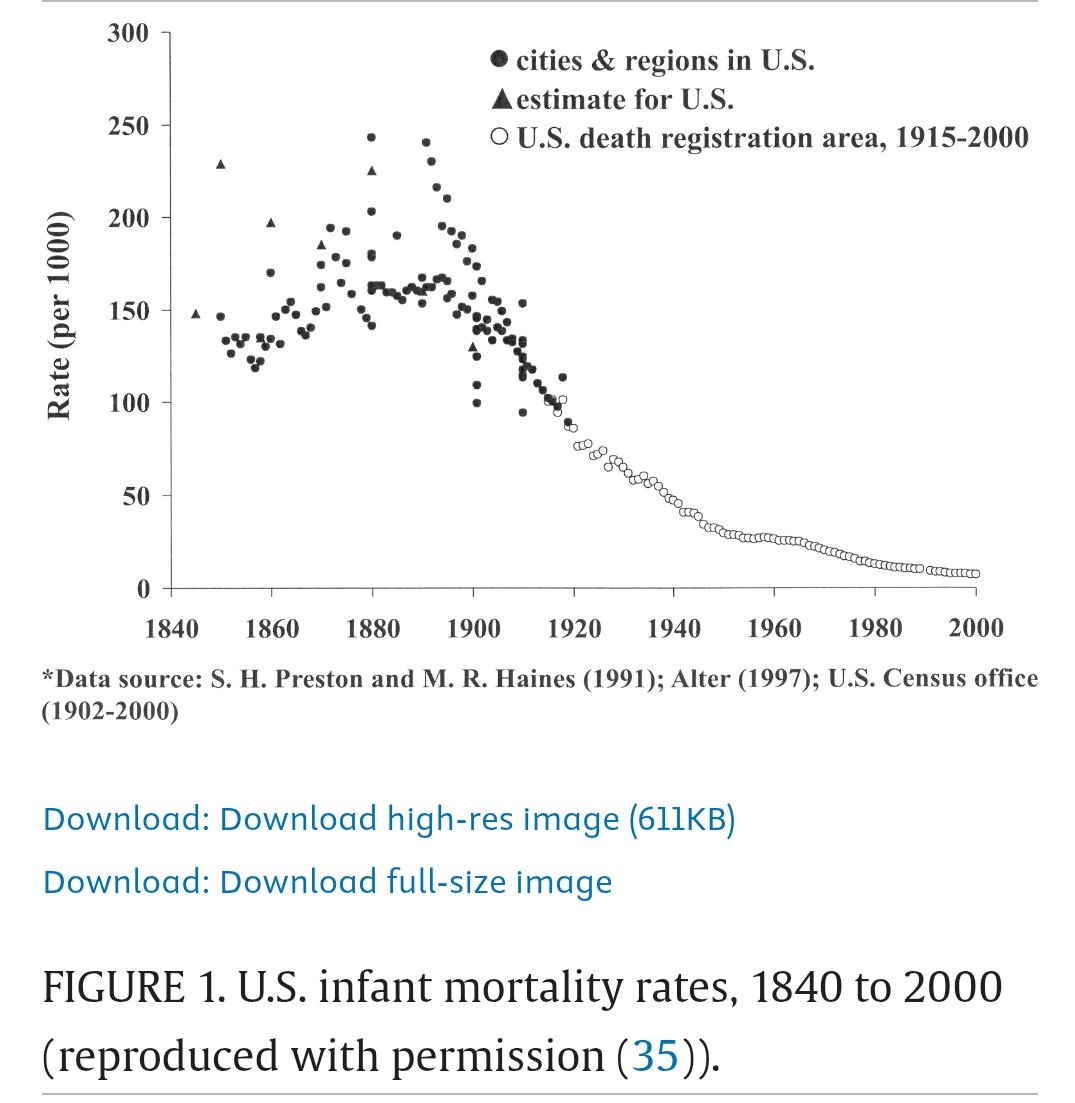
A large part of the decline in infant mortality is thanks to pasteurization of milk
Even today "consumption of unpasteurized dairy products was associated with 840 times more illnesses... and 45 times more hospitalizations... than was consumption of pasteurized dairy products"
Coaches fighting at a little league game. The way sports has become an idol in American society has gone unnoticed. Sports is a religion today for sure. Hence…👇🏾
@fosterdeariso My heart aches for the loss of the soul of kids sports.
But also my head aches when you ask “ok after that?” to those parents.
It feels like very bad, short-sighted, goal-setting… that is then lorded over everyone as “tHe ToUgH gEt GoInG” lore.
Bad news, dude:
If your kid doesn’t play travel/AAU they have no chance of playing varsity in high school.
Only exceptions would be small, rural schools without many players to choose from.
Any decent sized high school, every kid on varsity plays travel.
I’m begging parents to do the backward-induction on travel sports. (Former college football player here)
Looking for…
1️⃣ College scholarship? Invest in other things. Higher/more certain payoff.
2️⃣ Character building? Rec is the way.
3️⃣ Family time? Go fishing.
I’m curious about the general equilibrium case where colleges think they’re competitive firms (not monopolistic competition)
1. Drop sticker prices to bE mOrE cOmPeTiTiVe
2. Parents bail because they were using sticker price as a quality proxy
3. We get ourselves in a doom loop
I don’t think people have fully absorbed just how big the declines in student enrollment are going to be.
Eight states are projected to experience DOUBLE DIGIT declines by 2031.
@drantbradley Hubris / ignorance I would guess.
I have the other context of being the brother *drug around* to travel ball.
It was not “guaranteed” family time.
It was mad dash of getting left behind.
Bc even pre-cell phones, parents attention spans were finite.
This.
My 4th year on the TT I got what **I perceived** to be a career-defining opportunity. A reject-and-resubmit a top journal.
So I scrambled the jets. Put off other projects. Solicited feedback everywhere.
Only to get a 1/2 paragraph desk reject from the new editor.
The emergence of "reject and resubmit" as a decision option for editors has been harmful to Economics, in my opinion, in particular for junior scholars.
Why? The receipt of a "reject and resubmit" has, in my observation, all too frequently caused untenured faculty to spending enormous amounts of time and energy revising papers where eventual success was very unlikely. I am comfortable saying the creation of this option has not been research quality maximizing for individuals and by implication for the discipline. At best, these decisions reflect the intense pressure on junior scholars to publish in a "top 5" and so my claim is that this inefficiency is another indictment of the way top 5 publication affect Economics. Beyond this, I am unconvinced that the subjective expected value calculations of junior scholars have accurately reflected success likelihoods. (I certainly would have done poorly at them had I faced such choices before tenure.) Christopher Severan @ChrisSeveren raises an additional issue: by increasing the length of the revision process, changes in editor become more likely, a possibility whose probability is not known and I think not assessed in a decision to revise.
Further, I believe that the option created an "out" for editors to avoid rejecting papers. It is no pleasure to reject an article, especially junior scholars, and my observation is that the option has allowed editors to avoid having to be decisive after a first round of decisions.
As an editor, I tried to clearly distinguish between "warm" revise and resubmit decisions versus "tough minded" revise and resubmit decisions in order to make clear differences in likelihoods of success, but this was always predicated on a clearly feasible path to publication.
We were told that allowing them to merge with another airline had to be stopped for the good of the consumer. How is the consumer now? Is the consumer better off?
New newsletter: MODERN FATHERHOOD WOULD BE UNRECOGNIZABLE TO A 1950'S DAD
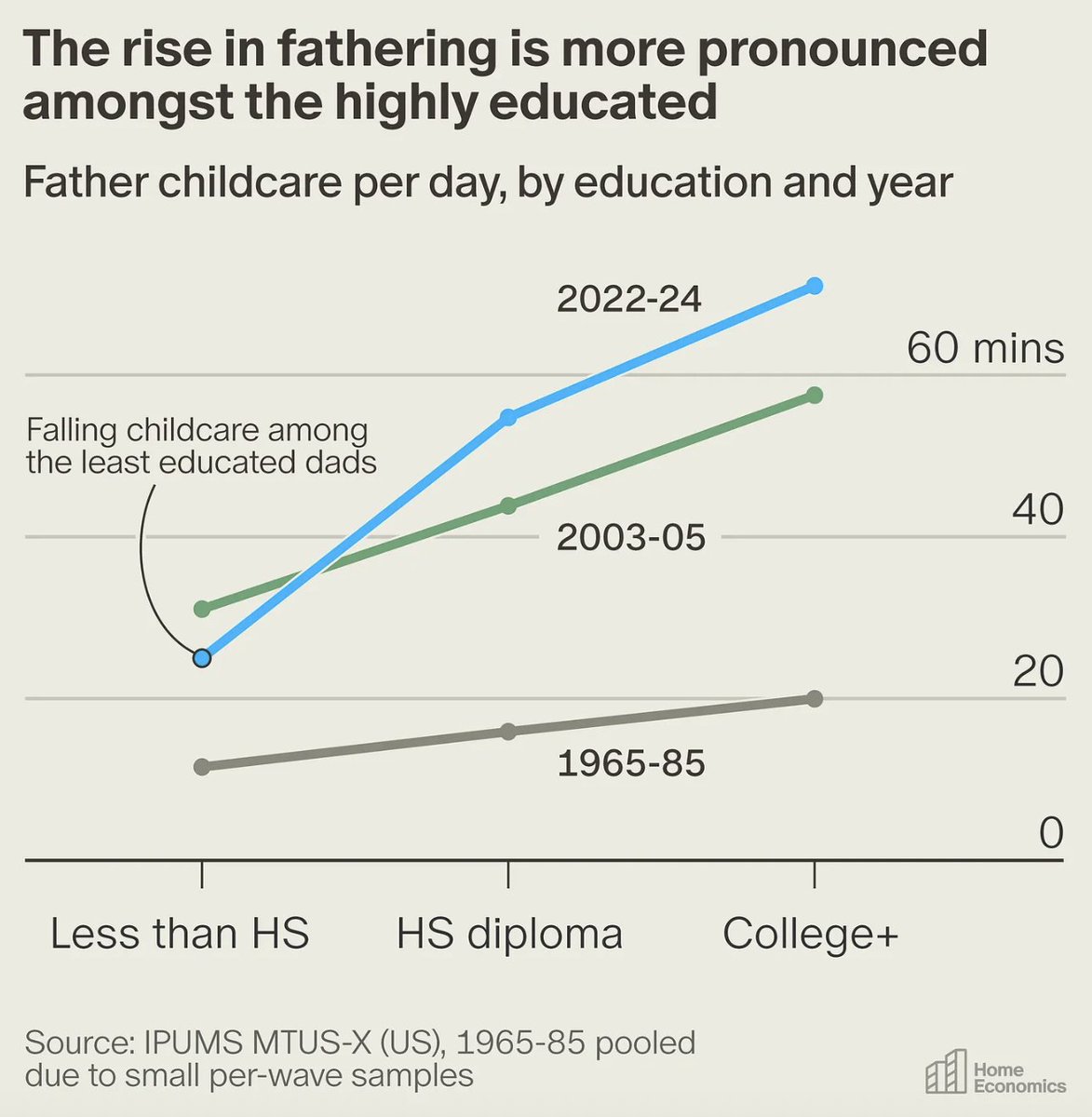
Compared to their Boomer parents, childcare time among Millennial dads has more than doubled.
Compared to their Silent Generation grandparents, it’s nearly quadrupled.
You will be hard-pressed to find any part of day-to-day modern life that has changed more in the last half-century than the way today’s parents—and fathers, in particular—spend their time.
The new American dad is more present and more exhausted—but also, more satisfied with life. What's behind this half-century transformation? Today's piece combines history, economic analysis, and gorgeous charts galore from @AzizSunderji
Dario is wrong.
He knows absolutely nothing about the effects of technological revolutions on the labor market.
Don't listen to him, Sam, Yoshua, Geoff, or me on this topic.
Listen to economists who have spent their career studying this, like @Ph_Aghion , @erikbryn , @DAcemogluMIT , @amcafee , @davidautor
The emerging American tax logic right now is something like:
- we can’t tax the poor because they’re poor
- we can’t tax the working class because they work
- we can’t tax tips bc that’s just unfair
- we can’t tax businesses because they create work
- we can’t tax property bc homeowners have it hard enough
- we can’t tax billionaires because their contributions are so precious and also they might move or get mad or give your primary opponent $10m
- and we can’t tax pensioners because they’ve “earned it.”
It’s like the accommodative parenting style of politics. Every group is so very special it needs a tax jubilee.
I guess that leaves … tariffs?