the concept of the gaijin perfectly explains this.
it is a japanese word that means "outsider" btw, it is not a slur. nope, it is a fact
in japan, no matter how long you live there, no matter how well you speak the language, no matter how much you love the culture, you will always be a gaijin.
to them you were not born japanese, you will never be japanese.
the same is true of european old money.
you can make a billion dollars, buy a château, send your children to the right schools but you will never be one of them cus you were not born into the tribe and your children will not be born into the tribe.
it takes generations to be accepted, if ever. and even then, you will be a curiosity.
a footnote.
a gaijin.
One thing adulthood has taught me is that I am not above anything. Homelessness, death, no job, literally anything can happen. Hence, I must never be too quick to speak over situations I’ve never found myself in. No one is above anything, not even your good actions can save you from your fair share of trials.
Life is crazy. Tables turn. Always stay humble & be grateful. ✌
Scientists put kids through 100 hours of reading, then scanned their brains. New wiring had physically grown inside the language regions. Communication between brain areas sped up by a factor of 10. Kids who didn't read showed zero change.
That was a 2009 Carnegie Mellon study. It gets wilder.
In 2013, Emory University scanned 19 students every morning for 19 straight days while they read one novel chapter each night. Mornings after reading, the brain areas responsible for understanding other people's emotions lit up with new connections. So did the region that processes physical sensation. Their brains were simulating what the characters felt, as if it were happening to them. Those changes stuck around for 5 days after they finished the book.
Now flip to scrolling. A massive review published in Psychological Bulletin last September pulled together 71 studies covering 98,299 people. Heavy short-form video use (TikTok, Reels, Shorts) showed a clear pattern: worse attention, weaker self-control, and more anxiety. Consistent across teenagers and adults, across every platform tested. Oxford didn't name "brain rot" its 2024 Word of the Year for nothing.
A 2024 brain wave study found that people hooked on short-form video had weaker activity in the front of the brain, the part that controls focus and impulse control. Separate brain scans showed the same thing: heavy scrollers had less activation in the exact regions that deep reading strengthens.
UCLA neuroscientist Maryanne Wolf has been studying this for decades. Humans were never born to read. There's no gene for it. Reading is something we invented, and it hijacked neurons that were originally meant for recognizing faces. Over time, it built entirely new brain circuits connecting language, vision, and emotion. But those circuits only survive if you use them. Stop reading, and they fade. Wolf's conclusion is simple: screens built for speed produce a speed-wired brain. Books built for depth produce a depth-wired brain.
One honest caveat: most of these studies are snapshots, not long-term tracking. People who already struggle to focus might just prefer short videos. But the same pattern showing up across nearly 100,000 people is hard to shrug off.
The tweet repeats the line seven times. The research backs it up with brain scans, EEG data, and white-matter imaging across tens of thousands of people.
fast food, fast fashion, songs being sped up, tv show seasons being only 8 episodes long, replacing youtube vlogs with fifteen second "day in the life" tiktoks, people in their 20s complaining about being too old...everything is so rushed, we have lost the art of lingering.
There is no Singapore Kenya is going to become.
And there is no Singapore we are headed to because, truthfully, Kenyans don’t want one.
Just like they didn’t want Canaan. Kenya is exactly where it is supposed to be.
The few intelligent people should stop day-dreaming. We have leaders who reflect our average, because that is who we are comfortable with.
When you see Oscar Sudi, understand this:
that’s how the majority of Kapseret voters think, speak, and relate. That’s why they want him.
Same story with Nairobi when they elected Mike Sonko.
Same story in Kiharu.
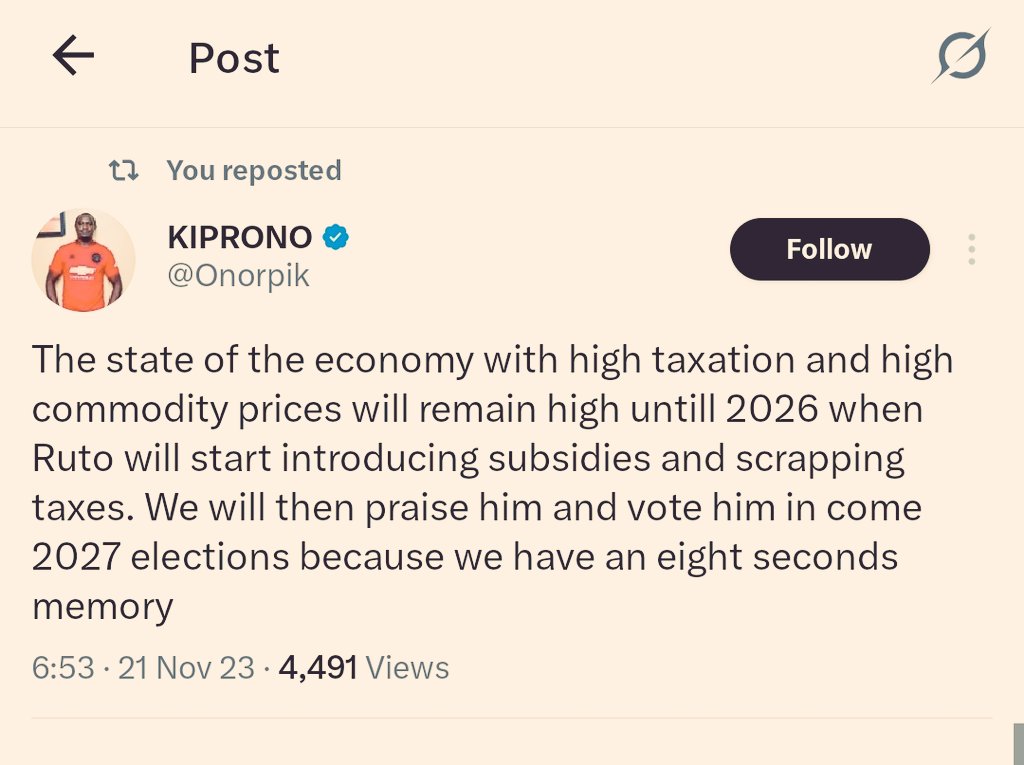
Same story nationally when we voted in William Ruto.
Leaders don’t fall from the sky. They rise from the people.
We are a nation of average highly emotional before elections, briefly “awake” during campaigns, then fully reset immediately after results are announced.
Kenya will only change at the pace of our minds.
About 1 cm per decade.
About half of all jobs in capitalist economies are considered pointless and unproductive, i.e., they are socially useless, according to the people who hold them.
David Graeber argues that this is by design. In his book, Bullshit Jobs: A Theory, Graeber posited that the ruling class believes that if ordinary people have both enough free time and material security, it would inevitably lead to a social revolution.
Graeber refers to the 1960s in the United States, when the abovementioned condition was met, albeit briefly. During these few years, housing, healthcare and higher education were affordable, workers’ unions were strong, and gains from production and technology actually translated to security for the majority.
As a result, people had time on their hands. They used this time to engage in something very dangerous: thinking.
According to Graeber, many young people were being relieved of the need to worry about survival, which allowed them to start asking questions and to organise to change the world. This was the ultimate nightmare of the ruling classes. So, they reacted by deliberately creating a world based on work discipline.
In 1930, John Maynard Keynes had predicted that by 2030, people would be working 15 hours a week. Graeber explains that the reason we didn’t get anywhere close to the 15-hour workweek predicted by Keynes is that the gains from productivity were diverted into creating administrative hierarchies.
Graeber wrote that “Rather than allowing a massive reduction of working hours to free the world’s population to pursue their own projects, pleasures, visions, and ideas, we have seen the ballooning not even so much of the ‘service’ sector as of the administrative sector…It’s as if someone were out there making up pointless jobs just for the sake of keeping us all working.”
Millions of people hold jobs in which they are being paid to do nothing, but for that very reason, they are kept under constant surveillance and control. This explains why people feel busy but feel it is unnecessary.
This is neoliberalism, which, to Graeber, was a project of political control, rather than an economic efficiency project, to keep people busy in a world that no longer needed their labour as much as it used to.
To Graeber, a population that depends on meaningless work for survival is easier to govern than one with time to reflect.
This is because surveillance-heavy, low-autonomy jobs are training grounds for obedience, where work becomes a moral credential without contributing meaningfully to anything.
This helps explain why unemployment is somehow stigmatised even when jobs are useless, overwork is celebrated even when it destroys health, and why automation is resisted even when it could reduce toil.
In summation, modern capitalism no longer needs most people’s labour, but it still needs their compliance, and that’s what work has become.
@Alfayaz11 Real change in Nairobi won't come from City Hall or State House. It will come from the people, organized, vocal and unwilling to accept dysfunction as normal. Because to be honest, Kenya doesn't suffer from leadership shortage but a shortage of pressure.
KES 300 billion cannot simply “go missing.” If the Auditor General cannot trace funds raised through government bonds, then we are staring at a full-blown crisis of accountability at the @KeTreasury and @CBKKenya
Public debt is borrowed on behalf of every Kenyan, present and future. Every shilling must be accounted for. Article 201 and 206 of the Constitution demand nothing less than full transparency in public finance.
Money does not vanish, it is made to vanish. Those responsible must be held personally liable.
We refuse to normalize theft. We refuse to accept impunity. We will pursue the truth, in Parliament, in court, and in the public domain until Kenyans know exactly what happened to their money.
Kenya is not a private enterprise. The Constitution must reign. We demand full accountability and radical transparency.
Once I get the bag my car better be ready to have the odometer fucked. Have you seen Kenya bro? This country is way more beautiful than what people give it credit for. Mtanipata Mugithi nights, Kamba festivals, Luo nights and all that. Might learn a couple languages too.