A lot of AI/tech execs have been vocal about the importance of competing with China recently.
Seeing who speaks out about this new green card policy will tell us a lot about who *actually* cares about US competitiveness, and who just uses China as a pretext to oppose regulation
"These party-state actors, especially MOFA and MSS, further extend their reach to university campuses by establishing research centers focused on American studies and foreign relations. China’s party-state power structure does not always align with global norms in conducting diplomacy, which has led the Chinese regime to establish these groups that present as academic and NGOs to facilitate international engagement, especially in people-to-people diplomacy, public diplomacy, and Track 2 and Track 1.5 dialogues , where think tanks play a critical role. These policy centers, located on university campuses, have become increasingly important for China’s America watch, as they offer many advantages: they are often viewed in the West as being more academic than other Chinese policy research institutions and are better able to develop connections, cooperation, and exchange with a wide range of U.S. counterparts. They are also perceived as lacking state affiliation, although this is in fact not the case."
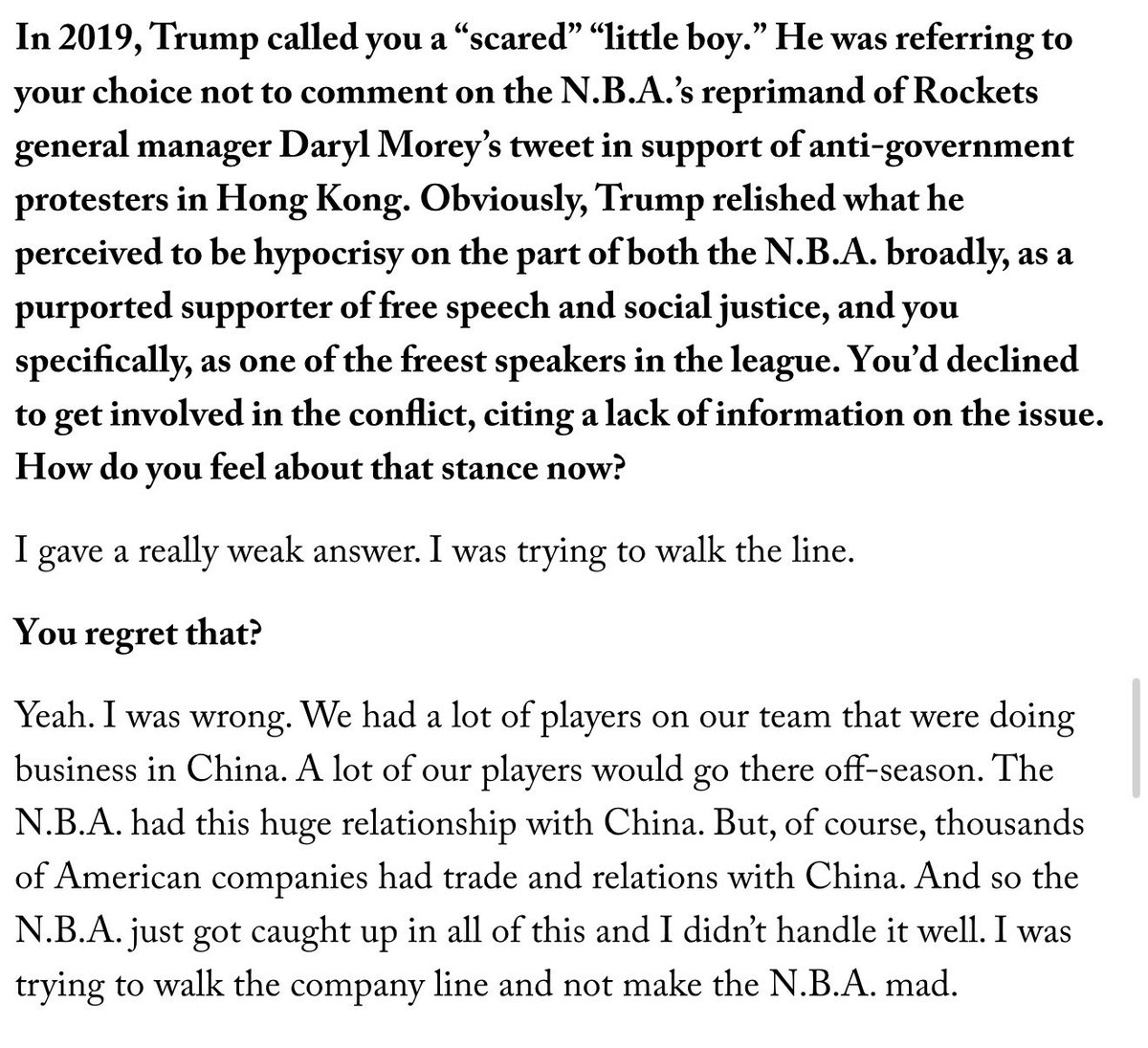
Kerr regrets his lack of comments during the NBA/China situation.
Says he walked the company line in order to not make the NBA mad
https://t.co/wDyxEE2978
No matter what happens from here, it was special to see the Warriors touch God one more time. Even if it was only for a few minutes at the end of a play-in game, that was very cool.
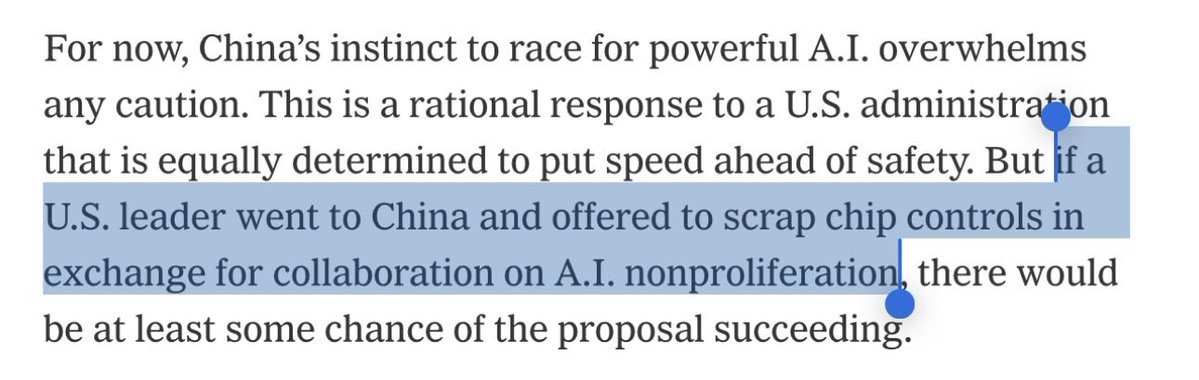
There are a few nuggets of truth in this @nytimes piece, but I’m afraid @scmallaby is 4 years late to the conversation—and he mostly seems to have swallowed the narrative fed to him by his interlocutors.
The main thesis of this op/ed is that we should abandon any effort to slow China’s progress in AI in the name of coordinating on safety. The idea is a noble one—I’ve been writing about it for six years, and lived it for three. In fact I penned a similar op/ed similar back in 2021 after writing more than 30 reports for @CSETGeorgetown on what China was actually doing to build its AI industry:
https://t.co/7LaEHK3Xt3
Unfortunately, what @scmallaby envisions is a fantasy that ignores years of history between the two countries and betrays a serious blindness to China’s national security decision making.
Before writing a New York Times op/ed on the subject, I beg you to ask anyone who worked on the 2024 U.S.-China Geneva AI Safety talks how the conversation went.
Not well.
To be sure, even after years of playing on Charlie Brown’s football team, I still think it’s worth coordinating with China to get aspects of our domestic AI policies right. This technology is too important to risk shoving pell-mell into the hands of would-be bioterorrists and cybercriminals.
But it would be a catastrophic mistake to willfully provide China the single resource it needs to make and serve even more powerful AI models—one that labs are *finally* and *dramatically* feeling the effects of in 2026—for the promise of “dialogue” with the Chinese government about AI safety, which we have already had.
And certainly not after last week—now that today’s frontier AI systems can verifiably hold nations’ critical infrastructure at risk.
I’ll have some writing coming soon on how the United States and China can better coordinate on AI safety where their interests genuinely align. But under NO circumstances should we allow China to condition such talks on relaxing our real, meaningful control over compute.
Strange @WSJ article about Jensen renting out the San Francisco opera house last year for a performance of “The Monkey King.” The article essentially frames it as a gilded age “champagne and opera” style event for “AI’s kingmaker.”
Makes for a good story, but the reality was quite different.
Mostly because the article leaves out an important detail; Jensen’s stated reason for hosting the event: helping to revitalize San Francisco’s downtown and the opera house. This was the actual focus of his speech, not the “champagne and opera” joke. And the event was full of Jensen’s good friends as well as various AI figures.
When I spoke with Jensen that night at the opera, the first thing he said to me was that it was really personally important to him to help downtown San Francisco get back to its glory days. It was essentially a fundraiser for the opera and San Francisco where no one was asked to contribute.
As someone who gets asked to contribute to a lot of charities and go to a lot of charitable events, I thought this was a generous and classy gesture on Jensen’s part and I’m sure many attendees took it upon themselves to donate. I certainly did!
Article would read differently with these facts, which kinda seem like the most important ones to me.
As far as the illustrious AI figures in attendance, important to note that the CEO of Jensen's largest accelerator competitor was actually at the opera at Jensen's invitation the night I was there; which again is quite at odds with what is described in the article. And please note that Nvidia’s largest competitor is not actually AMD.
One of the defining features of tech in the 90s was that the CEOs generally hated each other. I think it is good for the world and the AI industry for someone like Jensen to bring the industry together and I'm happy that he is doing this.
If anyone believes that any of the companies referenced would’ve struggled to raise money without Nvidia’s participation - they are simply wrong. I know because I was around many of these fundraises. And OpenAI’s embrace of AMD is object evidence that companies who have raised money from NVIDIA feel free to use competing products.
Finally, kinda sad that the net effect of this article might be to make other CEOs less likely to host comparably civic minded events.
I hope that I am wrong and that both Jensen - and other CEOs - are undeterred by this article. Nice for people to give back.
Balaji is wrong and Zeihan is wrong.
Systems are reflexive.
Balaji keenly observed the deterioration of America and formed a view that was correct in its cynicism at that point in time.
But that same observed rot is what galvanized someone like Bessent to step up and serve. It’s what convinces people like Thiel and Druck in the background to take their time to help construct a plan. It’s why people like Emil are in government right now.
I don’t disagree with Balajis framing and I appreciated Zeihan’s framing too before he went off the deep end with TDS.
Geopol is more complex than tech and crypto. For one thing the variables are not constant and for another finance, tech, psychology, game theory, industrial realities, domestic politics and military doctrine all interplay within the broader chess board.
But more important than anything else is understanding risk-tolerance and capabilities of the people with the levers of power. Balaji is starting from the assumption of status quo and WSJ framing and that is inherently flawed.
SF is so crazy because we have a figure skater who won two gold medals for the USA and a skiier who won two silvers for China…
and we choose the latter to lead our parade 🫠
🚨Must Watch @tiffanymeier_ on @EpochPremium
Alysa Liu's father tells the heroic story of Alysa overcoming CCP spying, threats & abuse to win Olympic Gold 🥇 for USA.
Be brave and heroic like Alysa Liu, not a cowardly genocide-denier like Eileen Gu.
How can you not?
She had everything in the world going for her in the richest & most free nation on the planet, and threw it all away to simp for a genocidal totalitarian dictatorship for some extra cash.
That's an utterly despicable lack of morality. Well worth despising.