Presenting this work tomorrow at AI4Research @ #ICML2026. Stop by if you’re around!
🗓️ July 10
Poster: 11:50 AM–1:00 PM / Hall A #2409
Oral: 1:50 PM–2:25 PM / Auditorium
Also happy to share that this work has been accepted to COLM! 🎉
LLMs should augment, rather than replace, human researchers. We wanted to see whether LLMs could actually provide constructive feedback on scientific papers using authors' responses as the signal.
Excited to share our new work, GoodPoint!💡
📄https://t.co/c82Wwzwk6r
LLMs should augment, rather than replace, human researchers. We wanted to see whether LLMs could actually provide constructive feedback on scientific papers using authors' responses as the signal.
Excited to share our new work, GoodPoint!💡
📄https://t.co/c82Wwzwk6r
Together, these results show that small models, trained on the right signal, can generate feedback that researchers actually act on. Author-centric signals are a key step toward that.
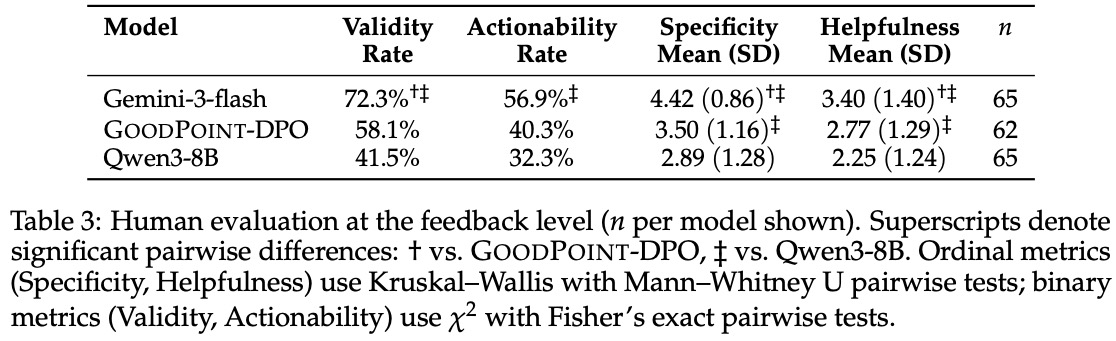
👩🔬 In a human evaluation with 13 authors, GoodPoint-DPO meaningfully closed the gap to Gemini-3-flash across validity, actionability, specificity & helpfulness.
On 1.2K held-out papers:
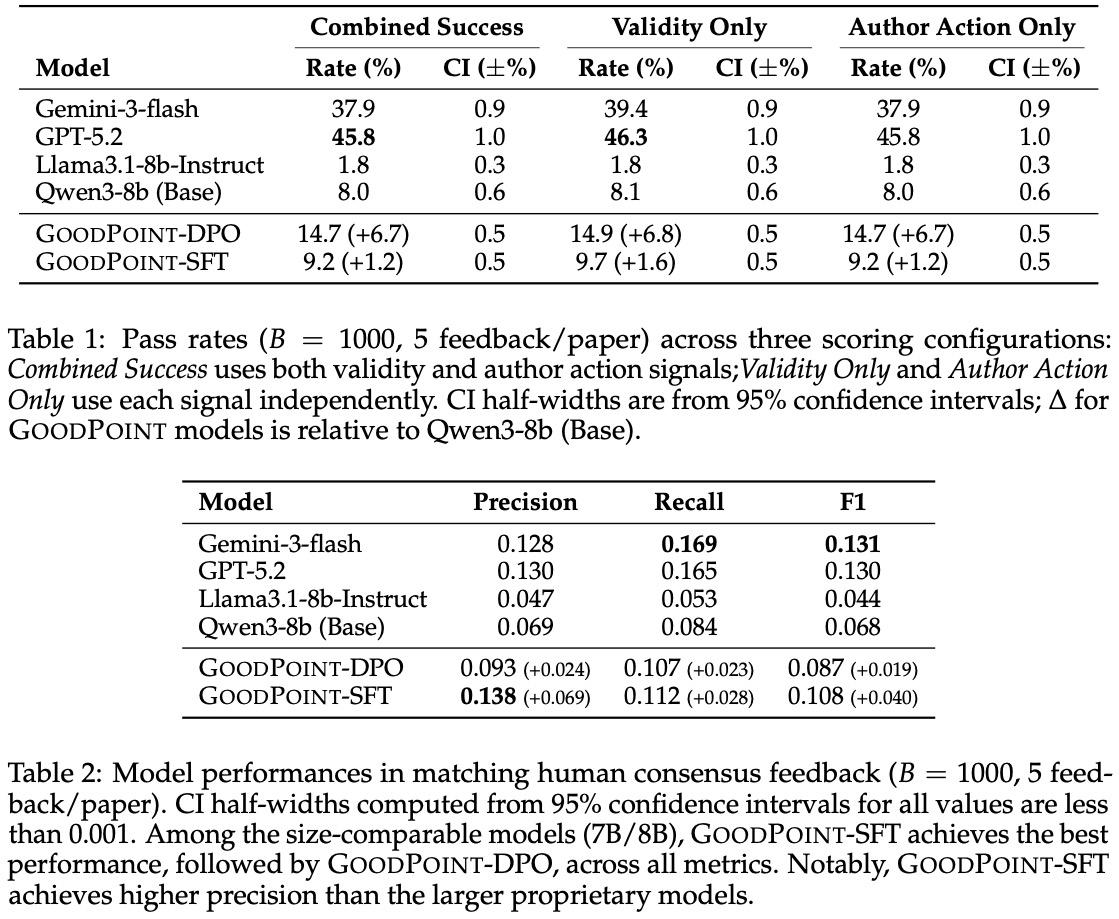
📈 +83.7% predicted feedback success rate over base Qwen3-8B
🎯 GoodPoint-SFT (8B) beats GPT-5.2 & Gemini-3-flash on precision matching human consensus feedback, despite being far smaller
We train Qwen3-8B in two stages:
1️⃣ SFT on successful (valid & actionable) human feedback
2️⃣ DPO on two types of preference pairs:
- successful vs. failed
- original vs. corrupted across 5 quality dimensions (specificity, clarity, accuracy, prioritization, constructive tone)
To study this at scale, we built GoodPoint-ICLR: a dataset of 19.5K ICLR papers (2020–2026) with full review-rebuttal threads, where each feedback item is labeled for validity & actionability.
Most LLM reviewers mimic reviewer style. We instead ask: what makes feedback genuinely useful to authors?
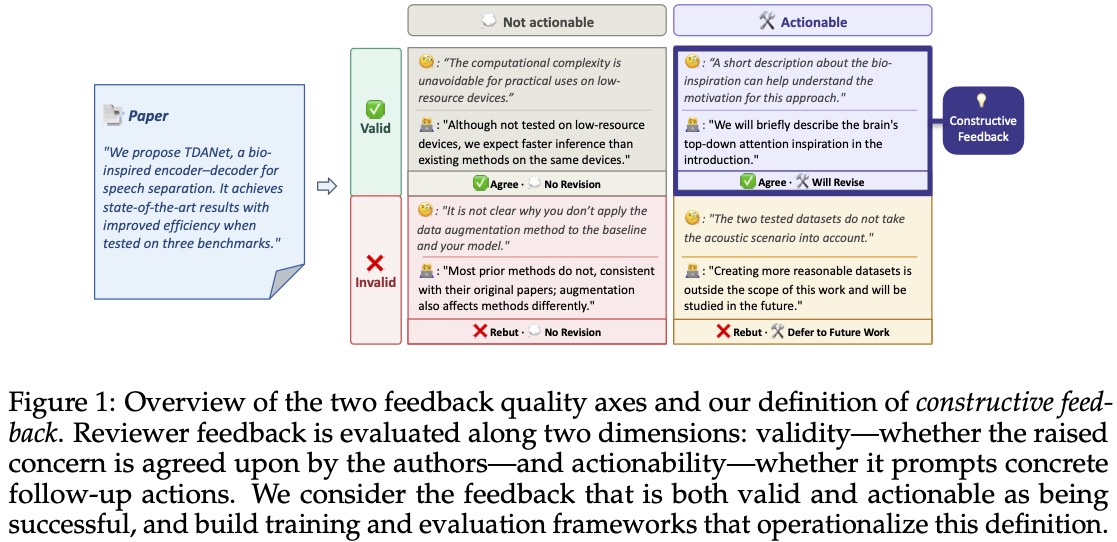
We define two axes from real author–reviewer discussions:
✅Validity — did the authors agree?
🔧Actionability — did they commit to revise?
💡"Successful" feedback = both
🔎 We compare human and LLM question-asking in real social contexts (Reddit) and uncover the gaps:
– LLMs overuse a narrow set of question types
– Prompting or post-training doesn’t reliably make them more human-like
LLMs are great at answering questions... but how do they ask them❓🤔
Come check out our paper “How Do LLMs Ask Questions?” at the #NeurIPS2025@CogInterp Workshop and ask your questions!
📅 Sun, Dec 7
⏰ 1:15–2:45 PM PST
📍 Upper Level Room 5AB
Join us for our poster presentation at #EMNLP2024 !
📆When: Thu 14 Nov 14:00-15:30
📍Where: Riverfront hall
📄Paper: https://t.co/NhS0EuqKk0
If you are interested in social reasoning and theory of mind of language models, please come by!
@emnlpmeeting
Will be at #EMNLP2024 to present our paper!
We explore precursory inferences of theory of mind in LLMs, providing deeper insights into their capabilities and ways to enhance them.
Surprisingly, providing perception info 👀 of others barely helps LLMs in inferring their beliefs💭!
Breaking down the Theory-of-Mind task into perception, perspective reasoning, and response generation. Then analyzing the performance of LLMs (pretty bad), led by @ChaniJung99, with @YejinChoinka and @hyunw_kim, co-authors @jiseon_kim1@_dongkwan_kim@jin__jiho@YeonSeonwoo Will be presented at #emnlp2024 main conference. See you in Miami 🏖️
https://t.co/eegKSIoN3M