I'm on the industry job market this year!
I'm a PhD student at CMU LTI. My work spans post-training, evals, alignment and multimodality!
Please reach out (DM) if you are hiring and think I'd be a good fit, I'd love to chat :)
Website: https://t.co/R3CjR0fln0
CV: https://t.co/sk96vg6rRp
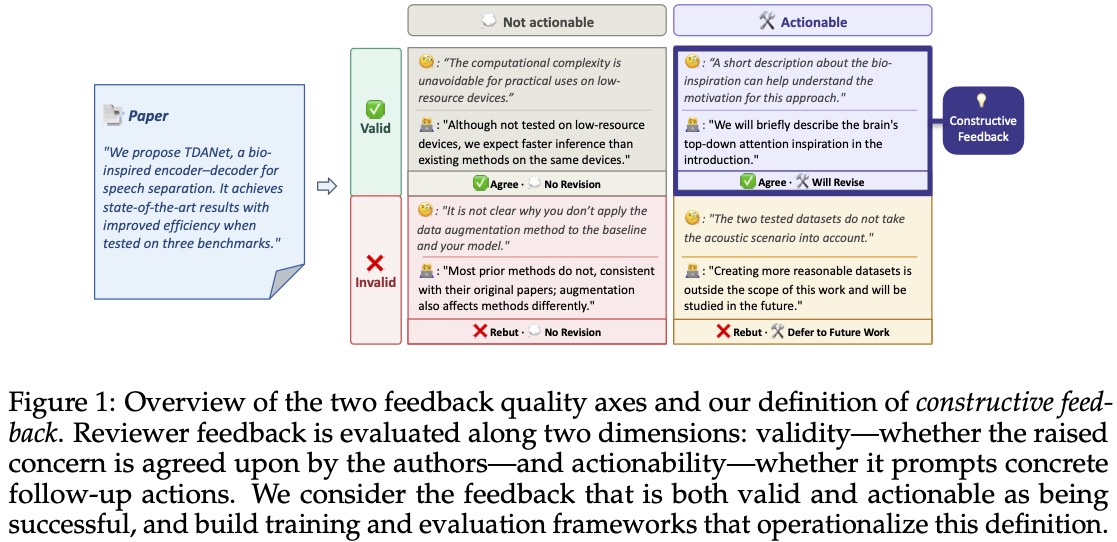
7/ GoodPoint: Learning Constructive Scientific Paper Feedback from Author Responses
Can models learn to give more constructive scientific paper feedback by looking at how authors respond to reviews?
Led and presented by Jimin Mun (@jiminmun_ )
📍 #57, Session 4
🕟 4:30 PM PDT
A lot of excitement in synthetic data for science is motivated by ambitious uses of LLMs (e.g., running a survey with GPT before real participants, forecasting promising experiments with LLMs). We ask, what beliefs should the experimenter have to make this a good idea? 🧵
I had an amazing time working with all the authors, especially @_chani_jung on GoodPoint (see details in Chani's thread). Now accepted at #COLM2026💫
Also, check out our work at ICML this Friday (7/10) at AI4Research!
LLMs should augment, rather than replace, human researchers. We wanted to see whether LLMs could actually provide constructive feedback on scientific papers using authors' responses as the signal.
Excited to share our new work, GoodPoint!💡
📄https://t.co/c82Wwzwk6r
LLMs should augment, rather than replace, human researchers. We wanted to see whether LLMs could actually provide constructive feedback on scientific papers using authors' responses as the signal.
Excited to share our new work, GoodPoint!💡
📄https://t.co/c82Wwzwk6r
How would you design a pretrained LLM that preserves output diversity AUTOMATICALLY after finetuning?
Our method: learn a diverse “annotation” distribution from the pretraining data that conditions the generations, and then **don’t touch it when fine-tuning**!
1/
We are holding the first workshop on Human-AI Co-Creativity @ ICML 2026, where 1 + 1 > 2!
We welcome all works around how 𝐡𝐮𝐦𝐚𝐧𝐬 (broadly defined, like lay people, writers, scientists, journalists, artists, ...) and 𝐀𝐈 (broadly defined, like LLMs, agents, VLM, embodied AI, ...) can come together to create more than themselves alone!
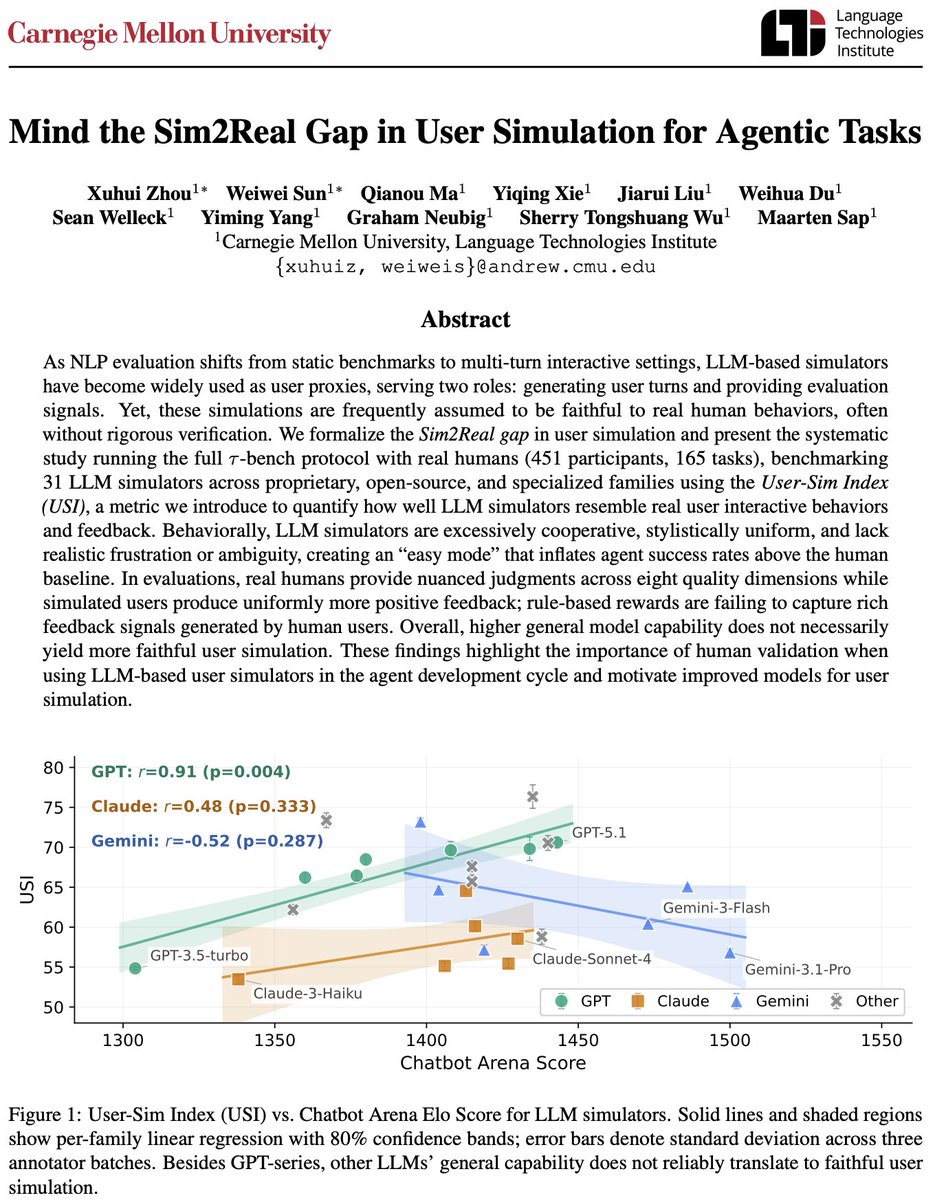
Creating user simulators is a key to evaluating and training models for user-facing agentic applications. But are stronger LLMs better user simulators?
TL;DR: not really.
We ran the largest sim2real study for AI agents to date: 31 LLM simulators vs. 451 real humans across 165 tasks.
Here's what we found (co-lead with @sunweiwei12).
🚀Apply to CMU LTI’s Summer 2026 “Language Technology for All” internship🎓Open to pre‑doctoral students new to language tech (non‑CS backgrounds welcome). 🔬12-14 weeks in‑person in Pittsburgh; travel + stipend paid.💸Deadline: Feb 20, 11:59pm ET. https://t.co/7SuItDHH98
LLM agent simulations for policy: A field full of potential and interesting questions. 🏛️🤖
We are excited to open this venue to facilitate open discussion on this important research direction!
LLMs are great at answering questions... but how do they ask them❓🤔
Come check out our paper “How Do LLMs Ask Questions?” at the #NeurIPS2025@CogInterp Workshop and ask your questions!
📅 Sun, Dec 7
⏰ 1:15–2:45 PM PST
📍 Upper Level Room 5AB
As of June 2025, 66% of Americans have never used ChatGPT.
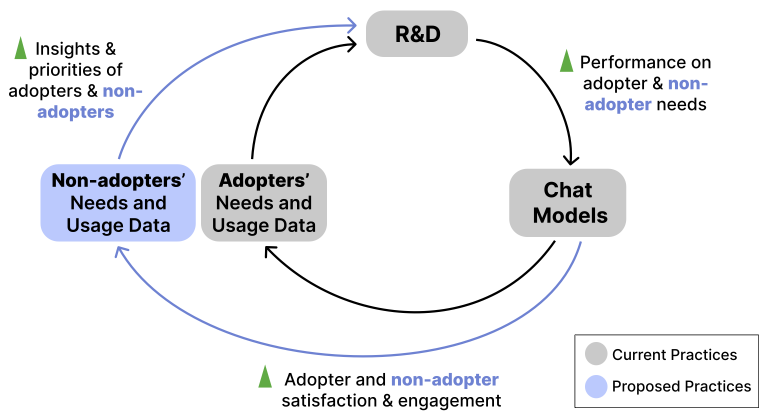
Our new position paper, Attention to Non-Adopters, explores why this matters: LLM research is being shaped around adopters, leaving non-adopters’ needs and key research opportunities behind.
https://t.co/YprwsthysY
📢 Announcing the First Workshop on Multilingual and Multicultural Evaluation (MME) — co-located with #EACL2026 🇲🇦
📅 Mar 24–29, 2026 | Rabat, Morocco
MME focuses on resources, metrics & methodologies for evaluating multilingual systems! https://t.co/wpYQcebro0
🗓️ Submit by Dec 19, 2025
We find that 1) acceptance of AI varies widely depending on use case context, 2) judgments differ between demographic groups, and 3) people use both cost-benefit AND rule-based reasoning to make their decisions where diverging strategies show higher disagreement.
Next stop for conference hopping: #AIES2025 in Madrid!
I'll be giving an oral presentation of our paper Why (Not) Use AI during paper session 1 tomorrow (10/20) at 11:45AM :)
See details in thread below 👇
https://t.co/p9ai1jZt01
To build consensus around AI use cases, it's imperative to understand how people, especially lay-users, reason about AI use cases. We asked 197 participants to make decisions on individual AI use cases and share their reasoning process.