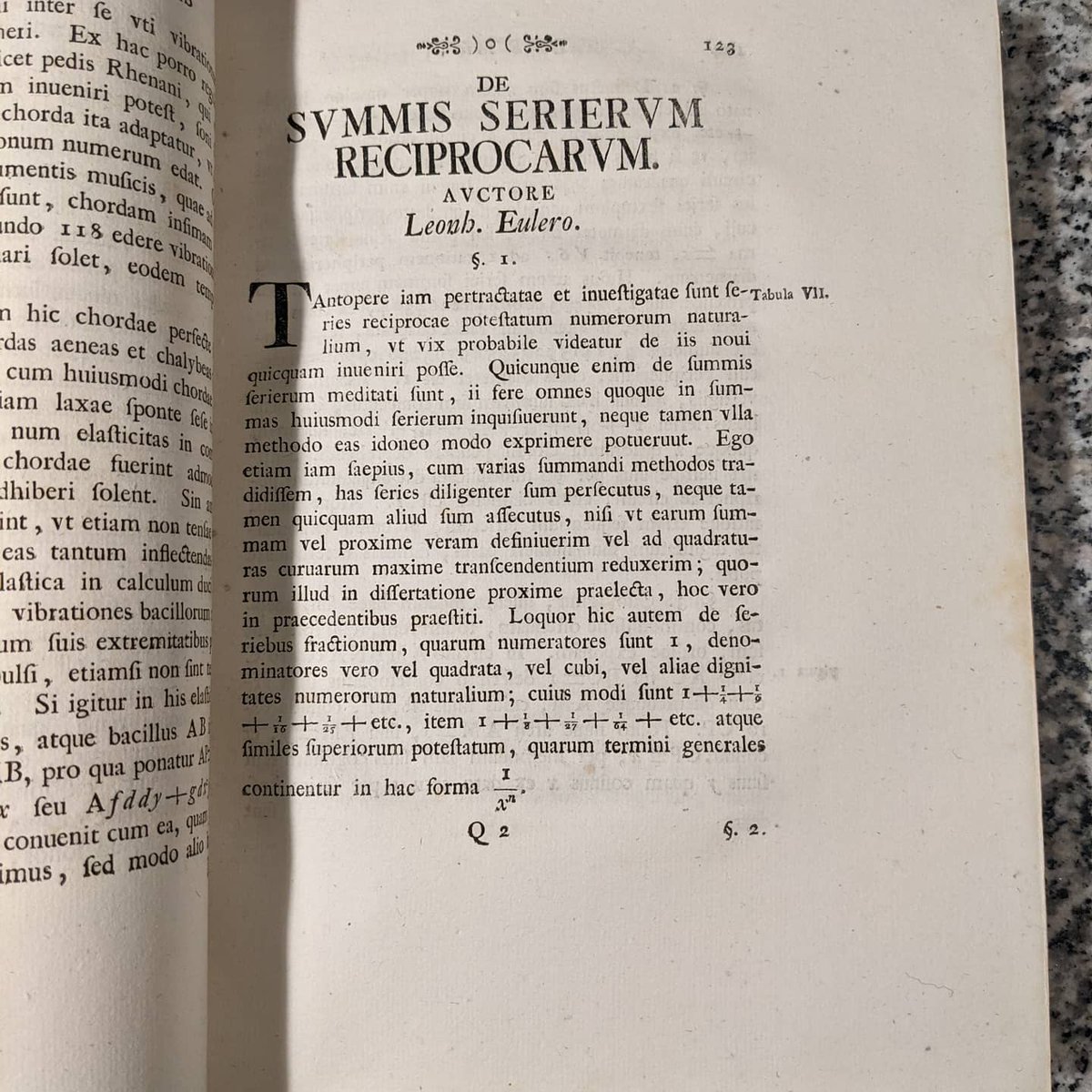
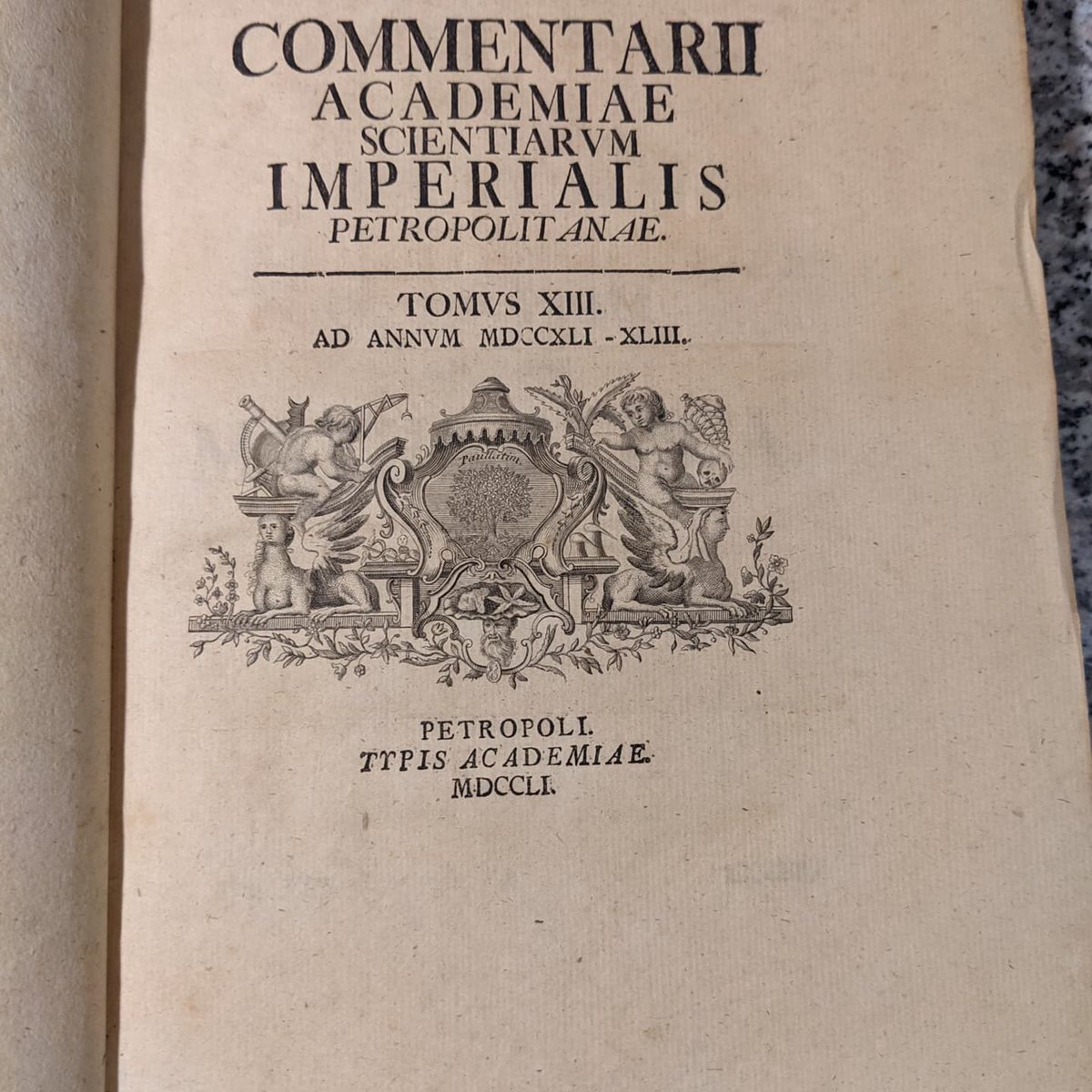
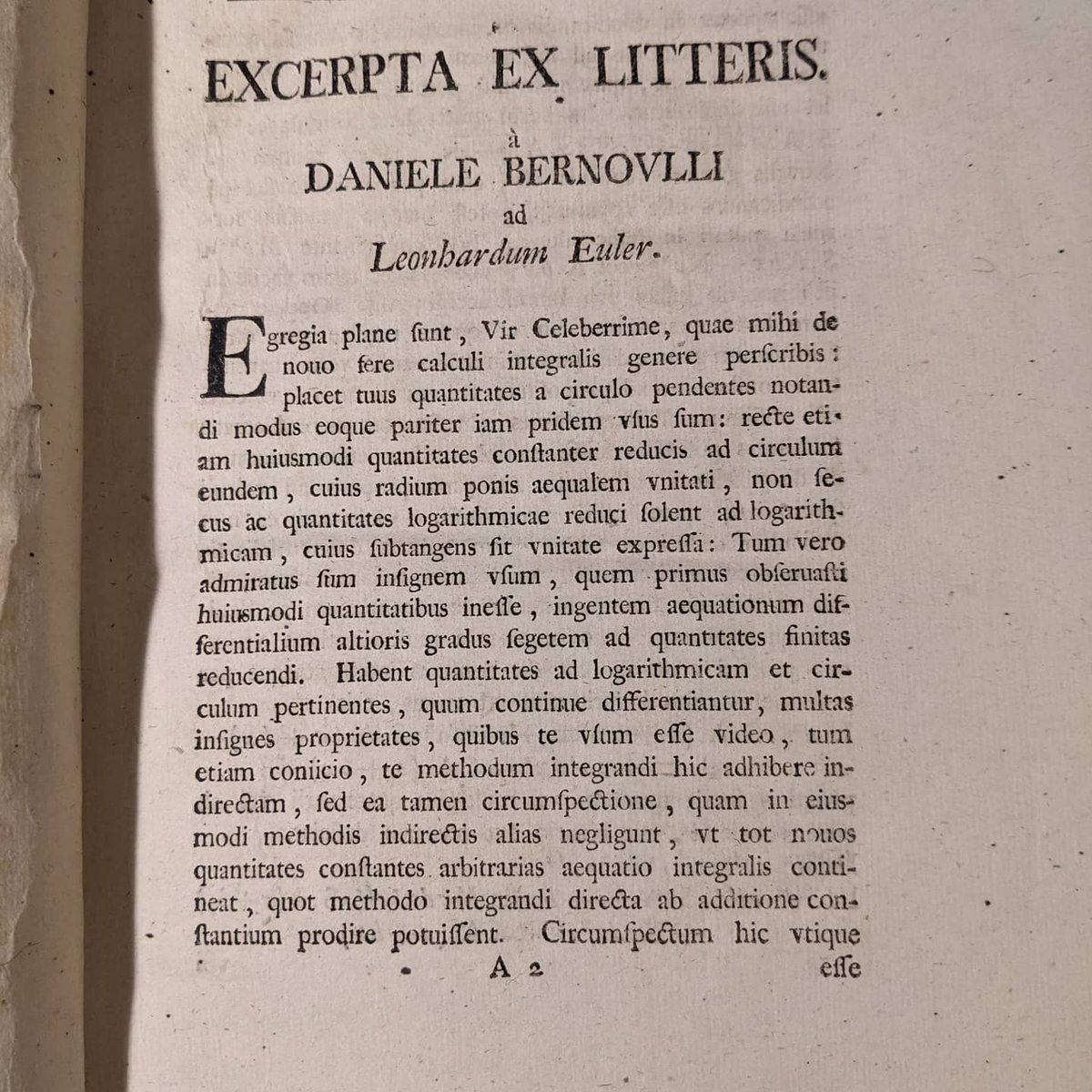
I figured my math followers would especially appreciate this! Just got these, they are originals from 1740 and 1751. Include the original publication of Euler's solution to the Basel problem, among other very cool things. So crazy to have these pieces of history on my bookshelf.
The other half missed in these conversations is that formalization is also a human endeavor! Probably the most important factor that has centered Lean for AI usage is the social convergence of a unified Mathlib, which is only possible with a huge amount of human interaction
Mathematics -is- a human endeavour.
There is something which maybe you're calling mathematics that has nothing to do with humans, some 'platonic otherworld' of abstract ideas. But what I call mathematics is the human attempt to explore and understand this world.
@KleeneAlgebra@roboguy20@aramh And not a coincidence that if you try to formalize categorical semantics in Lean/Rocq, you immediately fall into universe issues. It's natural in that setting for morphisms to be data but typing derivations to be propositions.
@statusfailed@krismicinski@aramh I wasn't thinking this direction at all. I meant that STLC, as usually presented with substitution, has less awkward categorical semantics with fibrations or multicategories. The intrinsic typing bit is specifically about formalization with impredicative Prop.
I have signed the Leiden declaration, and encourage everyone to read it and reflect.
Even if some of the points are impossible to achieve in reality, they are a good set of guidelines to try and do what is best for humanity.
https://t.co/xbJoxC6rJ3
@krismicinski@statusfailed@aramh Even for simple types the story is not straightforward. Fundamentally even the "CCCs are STLC" tagline most are familiar with is deeply unsatisfying formally, both from the perspective of how contexts/types interact and how difficult things are if you don't want intrinsic typing.
@KleeneAlgebra@roboguy20@aramh And not a coincidence that if you try to formalize categorical semantics in Lean/Rocq, you immediately fall into universe issues. It's natural in that setting for morphisms to be data but typing derivations to be propositions.
@joseph_h_garvin@davidbessis This is inherently an informal judgement based on examining the definitions and statements of theorems, and is the reason that work like this so dismally fails. They've carelessly inserted an LLM into this process at one of the most delicate places where trust affects correctness
@joseph_h_garvin@davidbessis The situation is the same, except it's divided into definitions and the proofs using them. It's why we don't typically add definitions in isolation, since each additional theorem gives more confidence we've faithfully represented the informal math...
You can read my thoughts and those of some others here. In particular I strongly recommend reading what Thomas Bloom and Melanie Matchett Wood have to say about it: https://t.co/ebObP4gD15
@littmath@antimath3 This framing of "human or AI" seems much too limited to me. It's not the tools I object to, it's the accompanying irresponsible *human behavior* to use AI in a way that proliferates proofs that are incorrect or so large/poorly structured as to be inscrutable, even when formalized
People who are sharing their take about reliability at GH:
- The COO (owning operations)
- The CTO (engineering)
- The CPO (product)
They are all peers to one another, and a subset of GH staff reports to them.
You know who we don't hear from? The CEO. Because there is none.
Just to clarify, this is very much WIP documentation about Lean's newest proof automation. I am not a developer for core Lean. I put it somewhere public to encourage discussion on Zulip; these are not "official" docs yet. (But I think it's pretty uncontroversial advice!)
@Robertljg In Lean you can arbitrarily extend how syntax is interpreted. This offers great flexibility and is more accessible in Lean by happening within the language itself, but introduces subtle classes of bugs that can happen within the elaborator.
It's great to promote a variety of proof assistants and compare technical differences. Given the title though, it's essential to discuss controversial trade-offs in Lean like definitional proof irrelevance and liberal elaboration. Without this thorough comparison seems difficult.
@krismicinski Similarly, I started using proof assistants so now I can feel equally insecure about the labels "mathematician" and "computer scientist"!
@AcerFur@littmath My view is that, especially because you're involved in formalization, that there's enough change already for the door between industry and academia to remain somewhat open, but it will be much easier for those who understand your position to help you through it with the degree.
@JustDeezGuy@eatonphil For inputting Unicode, I use Lean's neovim plugin that adds replacements that I find a bit easier to remember, e.g. \alpha gets replaced with α as you type. I've also been trying out ghostty for my terminal, but I'm not particularly attached to it.