I've lived in Nepal during a few months, a stunning country that's really dear to my heart.
I was notably there during the 2015 earthquake, a time when one of the main leaders of the current "Gen Z" protests (Sudan Gurung, who founded Hami Nepal) lost a child, which was the trigger for his activism.
I've seen the corruption. In fact the truth is that formal government structures barely function in much of Nepal - outside major cities, the state is more theoretical than real. It was crystal clear during the earthquake, but also at other times. For instance I've seen, with my own eyes, that when a petty crime occurs, people don't call the police but resort to mob justice by default (and it's not pretty). The people are left to care for themselves almost entirely on their own.
Additionally, Nepal has the single most challenging geography in the world which, despite everything you hear about countries having agency, shapes virtually every aspect of national development. Nepal has:
1) the world's most difficult terrain,
2) the world's strongest storms (because all the clouds from the Indian subcontinent come crashing into the Himalayan wall). I've experienced dozens and, believe me, it's scary: village streets are transformed in torrential rivers in a matter of minutes.
3) regular earthquakes (how do you think the Himalayas got created?),
4) is landlocked,
5) is a buffer state between 2 great powers
6) is at India's mercy for virtually all imports and exports (due to the Himalayan barrier with China); which I witnessed firsthand when India brutally decided to impose a blockade after the 2015 earthquake (to express disagreement with a constitutional amendment), making a horrible humanitarian disaster even far worse
Good luck with all that... To say that steering such a country towards prosperity would take extraordinary statesmanship is the understatement of the century.
I see many people reflexively saying that the current protest movement is a US-backed color revolution (with, having briefly looked into it, no convincing proof that I could identify). I'm not so sure, given the country's crushing constraints. What would even be the point of orchestrating a color revolution in a place with such geography?
Protesters' apparent enthusiasm for Balendra Shah (https://t.co/4CbBBwMi90), Kathmandu's mayor, further undermines the color revolution theory. He's a Nepali anti-India patriot with zero background related to the West, who won the mayor race as an independent in 2022 on a platform of fixing drains and fighting corruption. He's not promising to realign Nepal with the West; he's promising functioning traffic lights and demolishing illegal buildings - and he won't even lead the protests, claiming he's beyond the Gen Z age bracket. A color revolution with a chosen leader who doesn't want to lead, and whose "patriotic" views are inconvenient to US foreign policy? Hard to believe.
But for the sake of argument, let's say it's true: what would the US gain? Even at the height of colonial land-grabbing, after having won the Anglo-Nepalese War (1814-16), the British - which colonized rocks in the Atlantic just to have them - took a hard pass on colonizing Nepal. Though they were impressed by the Gurkha fighters who, to this day, form regiments in the British Army (which incidentally adds yet another handicap: Nepal's finest fighters are contractually obligated to other nations).
Occam's razor means that the more likely truth is that Nepal's dysfunction doesn't require foreign orchestration - its circumstances guarantee it for free.
And in any case, the point is largely moot because even a successful color revolution would be a Pyrrhic victory for everyone involved.
The US would gain influence over a government that can't govern, in a country in which you can't base meaningful assets, and from which you couldn't project power over China anyhow (there are 8km high mountains in between...).
India wouldn't care - they've already proven they can economically strangle any Nepali government that displeases them.
China would shrug behind its Himalayan wall.
And the Nepali people would wake up the next morning with the same impossible geography, the same dependence on India, the same unforgiving terrain.
I don't want to end this post on such a deterministic note, and make it sound like Nepal is condemned to a fate of perpetual misery.
The Nepali people I met were among the most resilient, ingenious, and warm-hearted I've encountered anywhere. They've survived everything geography throws at them with remarkable grace. If any population could eventually find a way to make the impossible merely difficult, it would be them.
The protests, whatever their origin, show this: that despite the odds, the young generation still believes in a better future for their country. That, in and of itself, is the most important fact about these protests - more important than who organized them or what foreign powers think. And that spirit, if channeled properly, is perhaps the most important asset Nepal has that doesn't depend on geography or geopolitics.
Last word: please go visit Nepal. Visit Everest base camp. Visit the birthplace of Buddha. Take a trek in the blooming Rhododendron forests of the Annapurna. Go watch some of the last wild rhinoceros of Asia. Eat some of those delicious momos.
Your tourist dollars won't solve Nepal's structural issues, but they'll meaningfully help real people living real lives, and you'll have the trip of a lifetime in the process. Geography might have dealt Nepal a difficult hand for development, but it also created one of the world's most extraordinary places and people.
Indian News channels are claiming that the protest by GenZ in Nepal was for social media ban. This is not true, It’s actually against the long standing corruption, Tyranny, oppression and autocratic leadership. Social Media ban was just one of the many stimulus.
Thousands of Gen Z protesters gathered in Maitighar to protest against corruption and the government’s decision to silence free speech by banning social media apps.
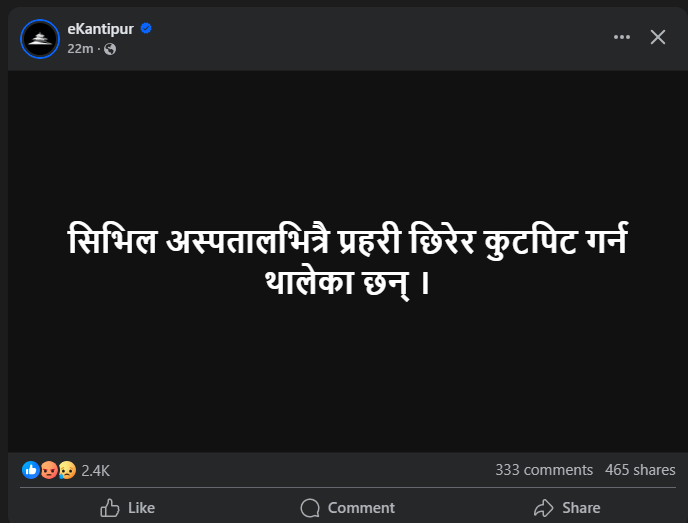
People in Nepal, including children, have been killed by police and security forces in Gen Z-led protests against government corruption.
Despite the purpose of the demonstrations, international media headlines have reduced them to merely protests over the country’s ongoing social media ban.
Media need to represent this protest accurately and not reduce it to a ‘social media ban protest.’ This is a broader anti-corruption movement led by students, and it deserves to be reported as such.
#GenZprotestNepal
Youngsters in Nepal were making a lot of videos about politicians and their children and the luxurious life they live. People were getting tired of the corruption in Nepal and the anger was only growing.
KP Oli led Nepal Govt banned social media sensing trouble.
And now the youngsters are out on streets challenging the Govt.
We sincerely request to impose visa bans to all the ministers of the current cabinet, including KP Sharma Oli, Ramesh Lekhak, his parter Sher Bahadur Deuba, the Chief of Nepal Police and the Chief District Officer of Kathmandu, on those who shot 14 young men aged 20-25, including a 12-year-old child, in the chest and head.
@UN@GOVUK@USAGov@potus@EUCouncil
saying it’s a “gen-z protest” or “social media ban protest” minimizes the gravity of what’s happening in nepal and the pent up anger of the people. it’s our responsibility now to call out any media house incorrectly portraying it as such!
While the children of corrupt politicians enjoy glorious days in France its the average college student who takes the bullet just because they raised voices against the very corruption their politician parents fuel