i think we finally have enough clues to reverse-engineer ilya sutskever’s secret SSI research.
my highest-probability guess: SSI has found a brain-inspired way to make an AI continually learn.
today’s frontier models learn mostly during training. afterward, their core knowledge is largely frozen. they consume enormous datasets and still fail strangely when a problem falls outside their training.
SSI may have an early system that can:
• learn a new skill from very few experiences
• recognize when an approach is failing before reaching the final answer
• update itself without erasing old skills
• transfer one lesson into completely different problems
• keep learning after deployment
think of it like a gifted teenager instead of a finished encyclopedia. it may not begin knowing every profession, but it could rapidly learn any profession.
the evidence lines up almost too cleanly:
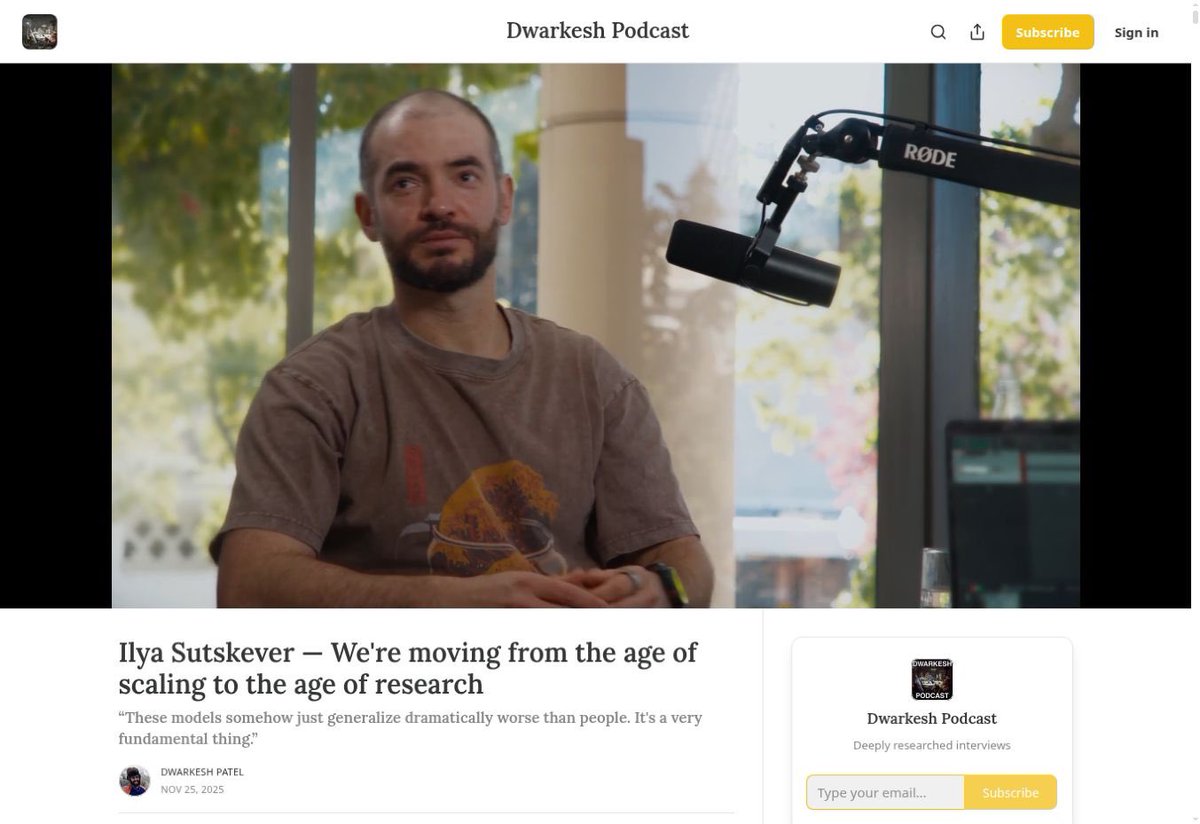
ilya called poor generalization the fundamental limitation of current AI. models “generalize dramatically worse than people.”
he described SSI’s target as a “superintelligent 15-year-old” capable of learning any job.
when asked how to create human-like learning, he said there is a machine-learning principle he has opinions about but cannot discuss publicly.
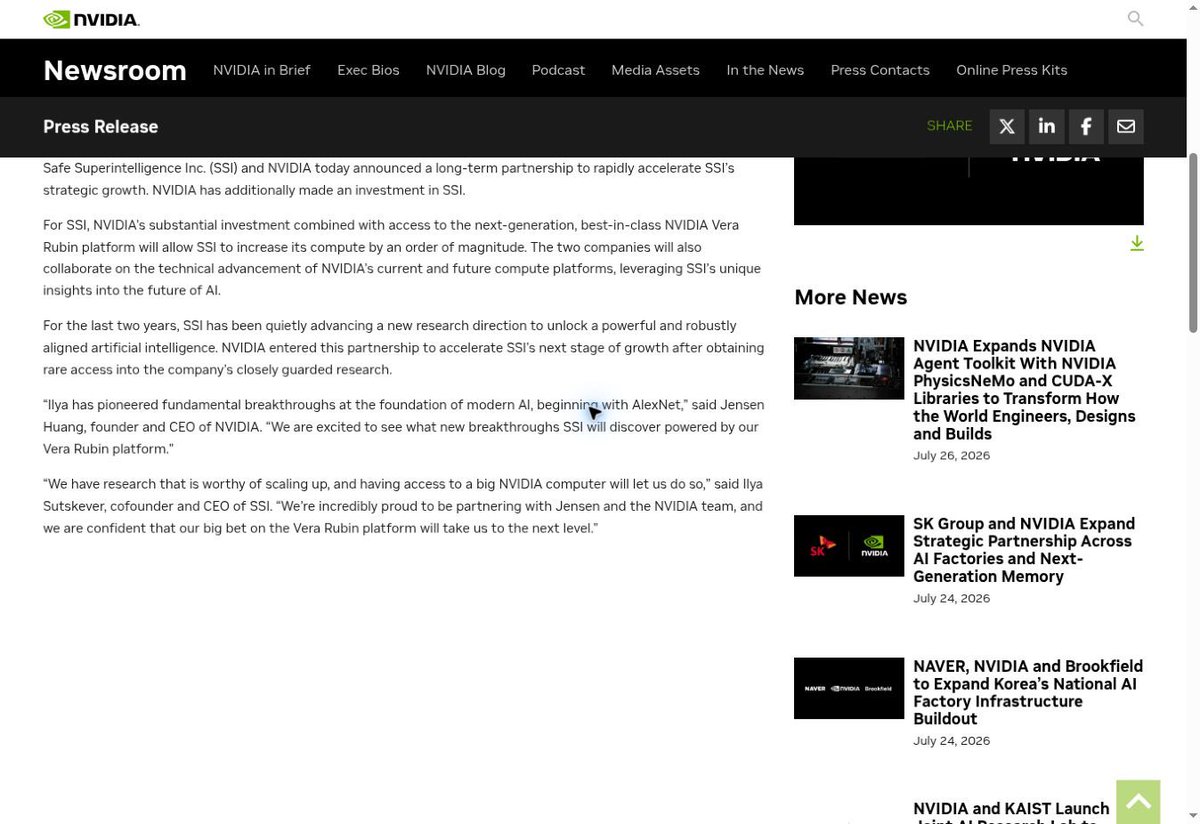
WSJ now reports that SSI’s secret research focuses on “overlooked aspects of how the human brain functions.”
Nvidia received rare access to the research, made a substantial investment, gave SSI 10x more compute, and agreed to let SSI help shape future computing platforms.
my technical guess:
experience → internal judgment → self-correction → durable learning → transfer → repeat
the internal judgment may be the brain-inspired component.
humans do not wait until the end of a 10,000-step task to know they are failing. emotions, intuition and judgment provide constant feedback. ilya has argued that AI needs an equivalent internal “value function.”
this could also explain SSI’s central promise: capability and safety trained together.
the same mechanism that teaches the AI what works may also teach it what it should care about.
my confidence is roughly 70% on human-like generalization plus continual learning, and 40% that an internal value system is the central mechanism.
the simplest description:
an AI whose intelligence compounds from experience, with its values learning inside the same loop.
BREAKING: Nvidia is in talks with OpenAI to guarantee $250 billion in financing for a data center in Ohio.
Details include:
1. The guarantees from Nvidia would help OpenAI lease a 10GW project that SoftBank is developing in Ohio
2. In total, the project could cost more than $500 billion, the largest data center project ever announced
3. The power for the project is controlled by the US government and funded separately by Japan under a recent trade deal
4. Commerce Secretary Lutnick is reportedly involved in deciding who will get the power
The data center buildout just hit a whole new level.
The possibility of rapid and discontinuous change in the digital world arising from something like this is underrated. It may well happen, be ~irreversible, and transform the dynamics of the internet.
There’s something major happening with @OpenAI & @AnthropicAI’s businesses that has huge implications for the compute and memory complex
>Both Anthropic and OpenAI have had explosive revenue growth this year, while at the same time, seeing significant gross margin expansion (see chart)- close to unheard of for companies to see sequential margin expansion while they’re scaling this aggressively
At least so far, it looks like each jump in capability has been worth more to customers than the cost of delivering it. And that gap is getting wider, not narrower… 1/5 🧵
Everyone is worrying about what happens if AI capex stalls or turns out to be over-invested, but I'm at least as worried about what happens if the AI labs just decide to stop selling tokens in a year or two in favor of moving up the value ladder.
That kind of centralization would do enormous damage to American capital markets and social cohesion. 100T over 2,500+ companies or 20T in ~3 companies? Which do we want?
Delaying and crippling American AI models no longer makes sense from a cyber or bio security perspective (if it ever did).
Malicious actors now have access to frontier capabilities. Complete jailbreaks of Kimi 3 will be available shortly.
The only sensible approach is to use the tools at our disposal - including the very best AI models - to secure the ecosystem.
1. Move more aggressively in programs that help defenders and code maintainers find and fix bugs in their own code.
2. Move at all on pandemic preparedness, including pathogen surveillance, pre-emptive vaccine development for every major virus family, stockpiling PPE, and standing up production facilities for future vaccines.
We're already moving on the cyber front, but can and should go faster. On the bio front, while there are some efforts, we're woefully behind. In both these categories, efforts would reduce global risk to threats from multiple origins, not just those involving AI.
The AI genies are out of the bottle. Everyone who wants it will shortly have access to frontier AI. Real AI security means securing the ecosystem, not securing individual models. We need to shift from securing AI models to using AI models to secure the world.
The only thing that stops a bad guy with AI is giving good guys equally powerful AI.
Big news: Kimi-K3 by @Kimi_Moonshot is now #1 in the Frontend Code Arena with 1679 pts, surpassing Claude Fable 5.
This is a 17-place jump from Kimi-k2.6 (#18 -> #1).
In Frontend, Kimi-K3 ranked #1 in 6 of 7 domains: Brand & Marketing, Reference-Based Design, Data & Analytics, Consumer Product, Simulations, and Content Creation Tools, landing #2 only in Gaming behind Fable 5.
The full model weights will be released by July 27.
Congrats to the @Kimi_Moonshot team on this major milestone!
"An estimated $156 billion of data center projects were cancelled or delayed in 2025, and $130 billion in 1Q26. Community pushback against data center construction has accelerated in 2026 as new moratoriums have been introduced, with the majority of the change happening at the local level. This puts pressure on costs and timelines and could alter the geographic distribution of data centers. Sustained data center pushback could ultimately extend the cycle and reduce future supply by lowering capex and financing needs" - Morgan Stanley
IMO there seems to be a coordinated effort by many bright tech leaders to downplay AI's effects on jobs with explanations that are so far beneath them that it's getting difficult to watch. You don't become as successful as they are with the critical thinking they're articulating right now and I'm certain it's intentional.
I get it. They're in a comms repair mode after the labs butchered AI's PR. But man is it intellectually dishonest to say "the data shows,” like the last two years of GPT 4 are supposed to be linearly extrapolated forward. I think they're doing the public a massive disservice. In fact, it just increases asymmetric downside risk with every second candid discussions are delayed.
Just because there is downside risk and highlighting where that is so people can properly prepare and adjust now does not make anyone a doomer.
every data center story says it uses "as much power as 100,000 homes" like that's a scandal. an aluminum smelter pulls five times that and it's why airplanes are cheap. measuring industry in homes is how you train a country to believe building things is a crime