Round 3 of the BNB Chain Permanent Liquidity Program starts right now with $100M in rewards!
It’s bigger, broader & designed to reward BNB Chain-native tokens that hit key milestones.
Follow these steps to win a split of $1k in $BNB!
🔸 Follow @BNBChain
🔸 Reshare this post
Here’s what’s coming 🧵👇
@michaelhirsch@0xFacet If so, the amount allocated to presale will determine the token price at lp launch. For example, with 25% to presale and 75% to lp, the token price at presale will be 3 times the price at launch. Thus no one will participate in the presale.
You can’t make this up: Etherscan finds Ethscriptions “counter-intuitive” because we rely on indexers.
I’m curious to hear Etherscan’s analysis of their own product! It’s an indexer everyone in Ethereum relies on. Is this counter-intuitive?
You can’t make this up: Etherscan finds Ethscriptions “counter-intuitive” because we rely on indexers.
I’m curious to hear Etherscan’s analysis of their own product! It’s an indexer everyone in Ethereum relies on. Is this counter-intuitive?
Ethscriptions are a step backwards? Compared to what? To centralized L2 sequencers that can be turned off at any time?
To fairly judge Ethscriptions we must compare it to its competitors (L2s), not focus on its downsides in the abstract.
@0xCygaar says reliance on indexers is Ethscriptions’ big drawback. Fair enough! But L2s also have a big downside: reliance on centralized sequencers.
The real question is this: is reliance on indexers worse than reliance on centralized sequencers?
Well, just days ago the premiere L2 had a major outage. Ethscriptions has never had an outage. In fact it cannot ever have an outage or be censored or turned off by anyone!
If you can’t afford L1 smart contracts and freedom from censorship is a "must have," then Ethscriptions, far from being a step backward, is your only option!
To address the indexer issue. First: what is an indexer? An indexer is a piece of software that enables you to get information that Ethereum nodes have but do not make readily available.
For instance, while nodes can quickly identify the owner of an NFT, they struggle with aggregating a user's entire NFT portfolio. We use indexers to overcome this limitation.
If you have ever relied on platforms like OpenSea or Uniswap for asset information, you have benefited from indexers. Rejecting indexers means disengaging from a significant portion of the Ethereum ecosystem.
But isn’t it more convenient to retrieve data directly from nodes in O(1)? It is! But how does this data get into L2 smart contracts in the first place? Only because the centralized sequencer permits it.
With Ethscriptions, writing data cannot be censored and the state of the protocol can be verified by anyone. As critics correctly point out, this comes with a downside: if you want to verify protocol state without relying on any external service you need to run your own indexer.
Ultimately, in the "happy path" indexers and centralized sequencers are similar. L2s typically don’t censor transactions and Ethscriptions indexers are typically available and have correct information.
The differences come in the "unhappy path" in which Ethscriptions indexers and L2s both shut off. In this situation your maximum exposure on the Ethscriptions side is running your own indexer.
But when an L2 shuts down you lose everything you’ve built there and there is nothing you can do about it no matter how much you’re willing to pay.
Even the largest Ethscriptions critics should agree with this statement: Ethscriptions’ reliance on indexers poses less downside risk than reliance on centralized sequencers.
In summary, while Ethscriptions and L2 solutions each have their trade-offs, Ethscriptions offer a distinct advantage in terms of resilience and censorship resistance, making it a valuable option in the broader Ethereum ecosystem, and not a step backwards.
Ethscriptions are a step backwards? Compared to what? To centralized L2 sequencers that can be turned off at any time?
To fairly judge Ethscriptions we must compare it to its competitors (L2s), not focus on its downsides in the abstract.
@0xCygaar says reliance on indexers is Ethscriptions’ big drawback. Fair enough! But L2s also have a big downside: reliance on centralized sequencers.
The real question is this: is reliance on indexers worse than reliance on centralized sequencers?
Well, just days ago the premiere L2 had a major outage. Ethscriptions has never had an outage. In fact it cannot ever have an outage or be censored or turned off by anyone!
If you can’t afford L1 smart contracts and freedom from censorship is a "must have," then Ethscriptions, far from being a step backward, is your only option!
To address the indexer issue. First: what is an indexer? An indexer is a piece of software that enables you to get information that Ethereum nodes have but do not make readily available.
For instance, while nodes can quickly identify the owner of an NFT, they struggle with aggregating a user's entire NFT portfolio. We use indexers to overcome this limitation.
If you have ever relied on platforms like OpenSea or Uniswap for asset information, you have benefited from indexers. Rejecting indexers means disengaging from a significant portion of the Ethereum ecosystem.
But isn’t it more convenient to retrieve data directly from nodes in O(1)? It is! But how does this data get into L2 smart contracts in the first place? Only because the centralized sequencer permits it.
With Ethscriptions, writing data cannot be censored and the state of the protocol can be verified by anyone. As critics correctly point out, this comes with a downside: if you want to verify protocol state without relying on any external service you need to run your own indexer.
Ultimately, in the "happy path" indexers and centralized sequencers are similar. L2s typically don’t censor transactions and Ethscriptions indexers are typically available and have correct information.
The differences come in the "unhappy path" in which Ethscriptions indexers and L2s both shut off. In this situation your maximum exposure on the Ethscriptions side is running your own indexer.
But when an L2 shuts down you lose everything you’ve built there and there is nothing you can do about it no matter how much you’re willing to pay.
Even the largest Ethscriptions critics should agree with this statement: Ethscriptions’ reliance on indexers poses less downside risk than reliance on centralized sequencers.
In summary, while Ethscriptions and L2 solutions each have their trade-offs, Ethscriptions offer a distinct advantage in terms of resilience and censorship resistance, making it a valuable option in the broader Ethereum ecosystem, and not a step backwards.
@okxweb3 Jingle bells, $ETHS swells, on a blockchain ride! Hop onto the Facet-VM sleigh today! 🛷 Never too late to join the ETHS community and enjoy the journey~~ #Ethscriptions#eths
Yesterday's major Arbitrum outage highlights the risk inherent in centralized sequencers. Such sequencers are dangerous when L2 operators strive to keep them on, and even more dangerous when they engage in active censorship.
The L2 ecosystem treats censorship resistance as a "nice to have." First amass billions in TVL, then figure out the censorship issue.
But censorship resistance is a core feature of Ethereum, not an "add-on." It should be the cornerstone of any scaling solution, not an afterthought.
This is why we built @0xFacet, a scaling solution that cannot be censored or shut off by anyone ever. At first glance, Facet's approach might seem counter-intuitive, but it gets the big picture right. By prioritizing anti-censorship from the outset, we lay a foundation on which other features can be built.
Does forced inclusion solve the L2 censorship issue?
Forced inclusion allows users to circumvent the sequencer and directly submit transactions. However, there are drawbacks: these transactions are subject to a one-day delay and incur higher costs compared to regular L2 transactions. Its effectiveness in real-world scenarios remains untested and uncertain.
We view this as insufficient. On Facet, all transactions are "force included" at the same low cost.
Can't the Facet Indexer go down?
The Facet VM can indeed go down. But this doesn't mean the Facet Protocol is down.
It simply means a temporary reduction in the protocol's state visibility, akin to the inconvenience users face when Etherscan goes offline. Just as Ethereum remains operational without Etherscan, so does the Facet Protocol when the VM goes down. If Etherscan or any other indexer is down often, competitors will emerge to fill the gap.
Isn't it ironic that inscriptions caused the Arbitrum outage and yet you're proposing an inscriptions-based solution to scalability? If we just got rid of inscriptions entirely we would be fine!
Inscriptions have the potential to revolutionize how we use blockchains. It should not be surprising that such technology has many applications and high usage!
Is there a Medium article about Facet?
Why yes!
https://t.co/txLzz11B37
Introducing Facet: the affordable decentralized computation protocol.
Facet isn't a blockchain. It's a new way of looking at blockchains
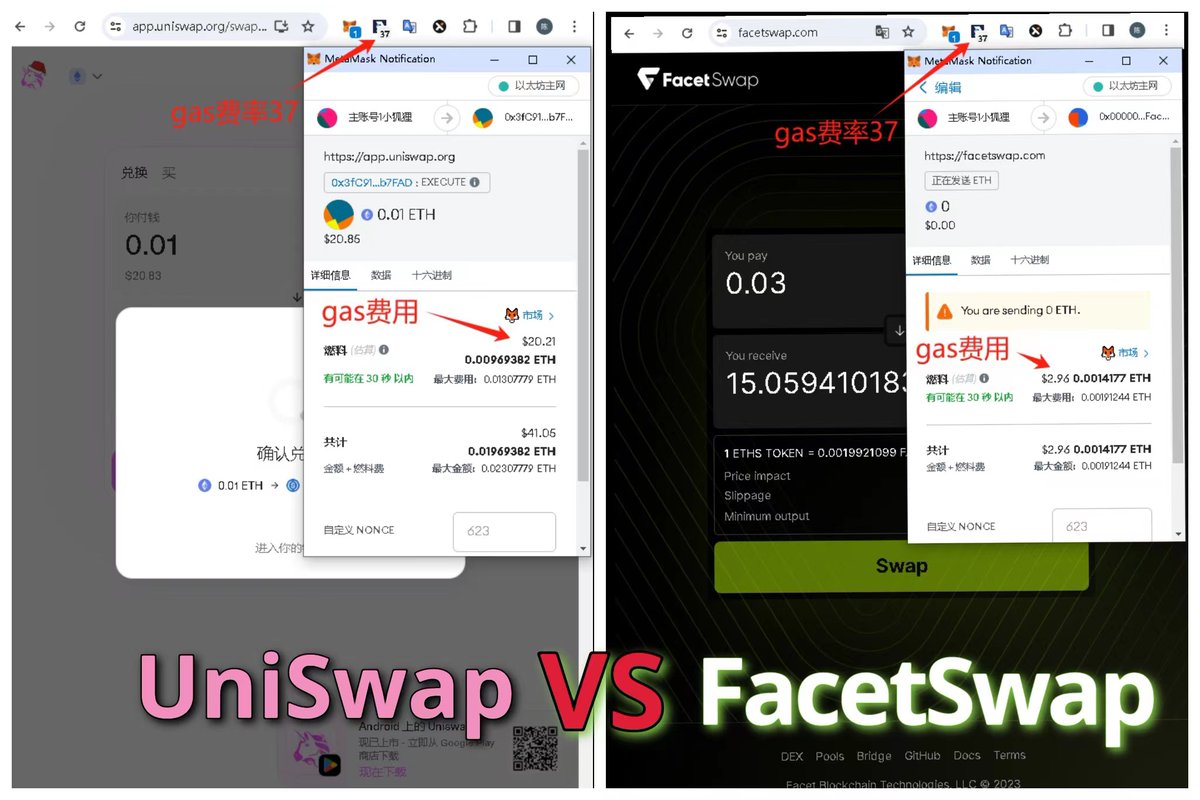
And just by changing our perspective, it turns out that we can reduce Ethereum transaction costs by up to 99%
🧵
https://t.co/CHGeBkjyVG
It's time to BLAST OFF. I just received 18000 $BLUR from @BLUR_io's Season 2 drop. Season 3 starts NOW and is powered by @BLAST_L2, the only L2 with native yield backed by Paradigm and Standard Crypto.