@JTMDigital@nullpackets@AncientMedicin3 infrastructure is messy but the play is clear. chainlink sits between every chain that matters for institutional settlement
I dont know if its more sad or more funny that everyone from eth to xlm is still running the "whole world will run on my chain" narrative in 2026 - while institutions are proving that thesis invalid daily with Kinexys moving $16T in a day - DTCC's Besu based AppChain going live in a month with Canton Network and Stellar approved to host assets - Swift deploying their own Besu chain going live Q4 - Broadridge processing $280B RWA's per day.....
the math's dont math
$LINK everything
defi insurance protocols now pricing layerzero bridge coverage at 3-5x chainlink CCIP rates. that's not a suggestion to migrate, it's a mandate. remaining holdouts face a simple equation: pay 3-5x premiums or switch to CCIP. LINK sits under $10b market cap securing $62b+ in value. every quarter this insurance gap persists, another wave of forced migrations hits. the $4b that moved in 20 days was voluntary. the next $4b will be involuntary, driven by insurance providers and institutional compliance teams who won't underwrite layerzero exposure at any price.
Let's call a spade a spade. There's nothing of intellectual substance or technological acclaim happening here.
What *is* actually happening in the Ethereum ecosystem? You're jizzing your pants solely because ETH is being burnt. Why is it being burnt? Because pepe traders are gambling on a shitcoin & MEV sandwich bots are stealing money from people & congesting the network. There's nothing to be proud about. It's a digitized version of a claw grabber arcade machine fleecing people left and right.
Imagine thinking that a legitimate web3 usecase would deploy into this archiecture, where their overhead cost spikes by 10X because they're competing for blockspace with frothing Pepe coin degenerates.
The DTCC is among *THE* most important financial market infrastructures in the world.
This is a production integration.
This is easily the largest and most high-profile adoption of a crypto protocol by an institution in crypto's history and it's not close.
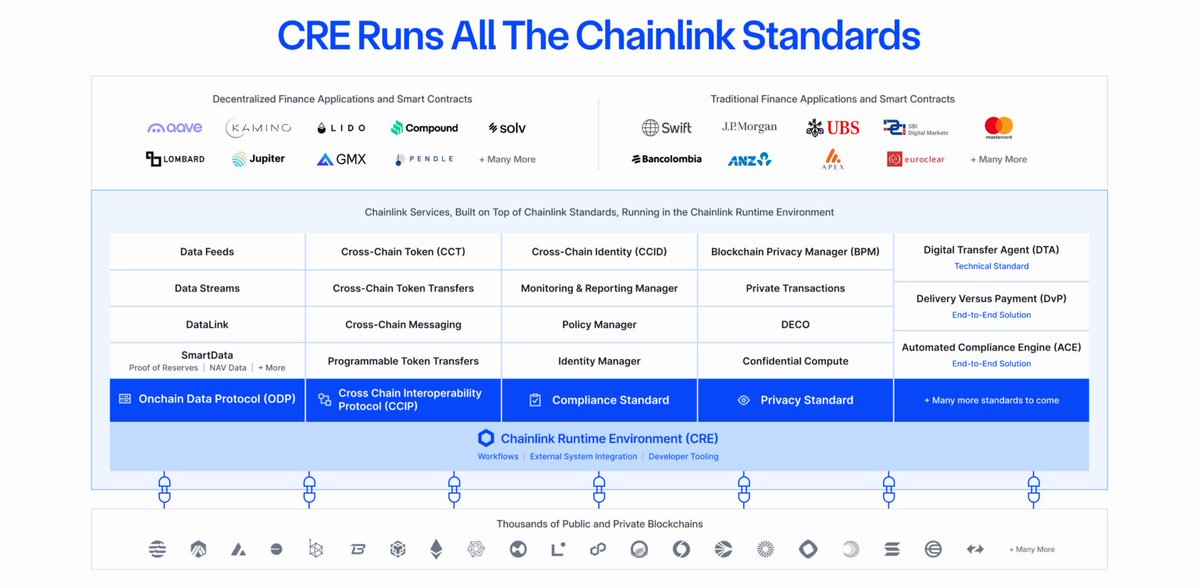
Today we announced progress toward our goal of advancing 24/7 collateral mobility. DTCC’s Collateral AppChain, a shared infrastructure platform for collateral, will leverage the Chainlink Runtime Environment (CRE) and @chainlink data standard to enable near real-time collateral management across financial markets and blockchains.
The integration will enable the seamless pairing of asset prices, valuations, and movement, with the aim of overhauling how market risk is managed globally and unlock greater capital efficiency.
This milestone reflects our broader vision to enable 24/7, near real-time collateral management across the global financial system.
Read the full announcement: https://t.co/ELVio44scA
NEW: @The_DTCC is integrating Chainlink data and orchestration standards into the DTCC’s Collateral AppChain.
DTCC and Chainlink are advancing 24/7, near-real-time collateral workflows across global markets and blockchains.
Glad to see all the hard work that Chainlink has put into generating real security is being recognized as valuable by more and more teams in our industry. It seems that focusing on making the secure and reliable solution is what wins in an industry where securing value is a key feature of everyone's product.
We have seen the trend of low quality data oracles with poor security being switched out for Chainlink for many years now, with that trend continuing on a regular basis; https://t.co/LOcbYNfqnz
We are also now seeing the same dynamic in cross-chain connectivity/bridging, where providing security with actual decentralization, actual monitoring and actual private key security is increasingly valuable to both protocol teams and the users of their products.
It is much easier and often faster to cut corners and run a single node and call it a decentralized bridge, have no monitoring on those bridges and keep the extra profits from cutting these key security and reliability features, but that comes at the expense of your users systems going down e.g. due to one AWS zone outage, or your bridges getting hacked with one set of admin keys.
Chainlink's thesis as a technology, standard and community is to not cut these corners, but do what we can to raise the standards of our industry and provide reliable on-chain data, reliable cross-chain interoperability and now reliable off-chain to on-chain orchestration across all smart contracts on all chains.
chainlink CCIP moved $18b+ in cross-chain value last quarter. $6m/month in oracle fees. zero exploits across 80+ chains. now JPMorgan kinexys, ondo, and DTCC are using it as settlement infrastructure for a tokenized securities pilot going live october 2026 with 50+ firms including blackrock and goldman. DTCC settles 98% of US securities. LINK market cap is $7.28b. the protocol routing settlement for firms holding $87 trillion in assets trades below uniswap. that's either the mispricing of the cycle or the market correctly pricing token value accrual risk. i know which side i'm on.
DTCC tokenized securities go live for partial trading july 2026 with full production october. USDC is the settlement currency. if 1% of daily US equity volume routes through tokenized rails that's $29B daily in USDC settlement demand. current USDC transfer volume across all use cases is ~$280B monthly. one use case would 3x total USDC velocity. circle, chainlink, securitize, backpack all confirmed in the working group alongside blackrock, JPM, goldman, citadel. securitize got FINRA approval for atomic settlement may 4. chainlink provides proof of reserve and data feeds across the entire asset lifecycle. the value accrues to the settlement layer and oracle layer, not to platform tokens with no fee capture. already posted about ondo's 108x P/S disconnect. apply that lens to every RWA token. the chokepoints are USDC and LINK. every tokenized equity trade must settle in one and price through the other.